

A.I. and the toy business
How will growth of A.I. Impact the toy industry?
By Steve Reece
Artificial Intelligence, normally known as A.I. is a massive topic currently and has been for the last 5 years. The prospect of A.I. systems becoming more intelligent, more capable and more impactful than human beings is of obvious concern to everyone. Furthermore, the abilities of these systems have advanced so much further than where they were in the space of just a few short years that we have to consider just how powerful these computerised agents of change can become eventually.
Specifically, from the perspective of the Toy business, there are two main areas in which we can consider the impact of artificial intelligence:
1) Non-product specific usage
2) A.I. integrated with Toys to create more compelling products
Artificial Intelligence: Changing The way we live and work
There are so many ways that this tech is changing our working lives, it would not be possible to list them all here. But we can run through a few of the most impactful…
Precision trend spotting and forecasting
In the Toy business we are ultra focused on spotting trends we can exploit for cool new products. With some help and direction from humans, A.I. will get better and better at analysing social chatter, retail data, and cultural signals to predict themes, aesthetics, and mechanics that have the potential to lead to breakout hit Toys. Whereas today the trend spotting process is ad hoc and often more creatively than quantitatively lead, A.I systems can help us measure, analyse and quantify where the opportunities might be.
Copy, branding & packaging
A.I. can already create strong copy and good graphic design. This capability will only get better, and so it’s quite likely that the graphic designers of today will become the graphic A.I. operators of tomorrow.
Sales Forecasting
The hardest thing in the Toy business to get right is sales forecasting. In fact, forecasts are nearly always wrong, the only question is will they be under or overestimates of demand – both of which brings a different inventory problem. As AI advances it will use deep analysis to help make forecasts more accurate, although they will never be perfect because human purchase decisions are often not rational and predictable. But those areas which can be analysed and predicted will get better. AI will allow us to streamline logistics by predicting demand spikes, optimizing inventory, and flagging bottlenecks.
Administrative Tasks
This has been written about so extensively elsewhere that we hardly need to go into it, but clearly the ability of AI to crunch data and to perform basic and even complex administrative tasks is going to save a lot of time and money for Toy companies, albeit with some inevitable job losses sadly.
Aiding concept creation
Already Toy designers can feed in their ideas and prompts to AI and those systems can generate mood boards, character sketches, and packaging mock-ups. This is going to both accelerate the process as well as give creatives a lot more power to be creative in conjunction with these powerful tools.
A.I. in toys
This is where things start to get very exciting. For a long time, Toy companies have talked about bringing Toys to life, and for so long we did that in a very limited way. Some small movement, sounds and mannerisms gave the impression of lifelike Toys. But up until the current A.I. revolution, we could not make Toys that were truly capable of having a two-way conversation with children. Today the technology is there. Children have always spoken to their Toys as they played with them imaginatively. It’s one of the cutest things to behold – children talking imaginative nonsense to an inanimate object. Now though we really are at the point where the Toys can start to talk back to the child via genuine two-way communication.
A new era of toy interaction is upon us
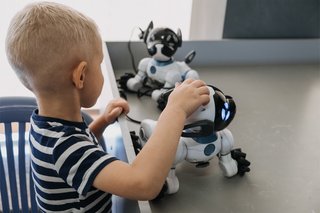
Just think about that for a moment – think about a cute and cuddly Plush Toy that can tell a child a bedtime story as they hug it. If children love a cute but inanimate Toy, imagine how much they are going to love a Toy that talks to them on their level and can react spontaneously.
Think about learning Toys which work at the pace of the child’s learning and adapt to the child’s style of learning. School class sizes vary from country to country, but 20 to 30 children per class is the average. Which means that the teacher is delivering educational content and knowledge at an average rate of learning. They can’t normally take that much time to adapt the class for the lowest and highest performing children in the class which means that by default most Kids are getting a very imperfect, inefficient and frustrating learning journey in school. Whereas A.I. on the other hand can adapt to the child and even tailor the topics to what the child finds most engaging leading to accelerated learning outcomes. And then imagine packaging that up into a fun Toy product. Whereas parents often don’t want to buy the latest hot licensed Toy, what parent will not want a Toy that accelerates their child’s development – potentially dramatically in some circumstances?
Concerns and barriers for A.I. toys
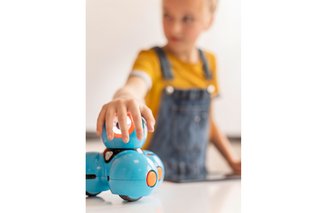
There are some clear and obvious concerns and barriers to overcome in this space. Clearly the products have to be well executed and functional i.e. the voice recognition needs to work, and the responses need to be in line with what both Kids and parents want. Moreover, it is obvious that a Toy which has such an ability to be loved by a Child could potentially be used in a nefarious or harmful way or hacked in some way and so child safety and parental control are utterly critical. Finally, there is the cost. To incorporate real working A.I. in Toys will lead to price points higher than the average lights and sounds Toy. Price point barriers are going to be tested by these Toys, and some price point ceilings are going to be shattered. But before we get lost in the usual retailers don’t like high price points debate, let’s just remember that these Toys can deliver an experience we have never given Kids and their parents before, and maybe this will prove to be worth paying for from a consumer perspective.
What will drive the toy industry in the coming year? Discover the Toy Trends of the upcoming Toy Fair now.
You can find the right products from January 27-31, 2026, at the entrance to the middle of the exhibition center in Nuremberg.
About the author
Steve Reece has been in the toy industry for 25 years. He started out at Hasbro where he was responsible for the brand management of key brands such as Monopoly, Play-Doh and Trivial Pursuit. He now runs a consultancy called Kids Brand Insight, which helps toy suppliers to build robust and diversified supply chains and find the right staff.