

Ten billion global figures in 50 years
From bricks to bestsellers: 50 years of Lego minifigures
Pirates, wizards, space combatants, racing drivers, fire fighters and chocolate makers: these are just some of the imaginative minifigures often featured in new sets revealed by Lego at the Spielwarenmesse. The company has now produced far more such figures than there are people in the world. The success story began 50 years ago: the first minifigures were launched in 1975, precursors to the modern models released since 1978.

Looking at the originals from today’s perspective, Jens Nygaard Knudsen’s breakthrough miniature figures seem a little static: first sold in toy stores as part of Lego sets half a century ago, they had no facial expressions or moveable arms and legs. But they were still clearly recognisable as people – from firefighters and police to doctors and various trades. Their size made them ideal for role plays with Lego vehicles and houses – many of the sets were also designed by Jens Nygaard Knudsen, who was born in 1942 and would go on to become chief designer at Lego.
The proportions and the modular concept were the most important factors in the subsequent evolution of the minifigs: legs and torsos, round yellow heads and a selection of hairstyles and headgear could be combined in new ways again and again. Nothing has changed in this respect since the final minifigure design was debuted in 1978. These miniatures have gone on to enjoy many successes – starting with a spaceship featuring the first Lego spacemen minifigures being crowned European Toy of the Year at the Spielwarenmesse in 1979.
Brilliantly simple – simply brilliant
The 1975 minifigures weren’t the first people in the Lego offering. In 1974, the Danish toymaker showcased a selection of large figures with expressive facial features and intricately constructed arms. These miniatures were excellent for role playing in spaces with the right equipment or large vehicles, but less so in static dioramas with newer and newer vehicles and buildings. The current four-brick tall, highly stylised minifigures were far more suitable in the latter context: with their brilliantly simple design, they proved simply brilliant. And they established the scale of roughly 1:43 still used for many Lego play scenarios today.
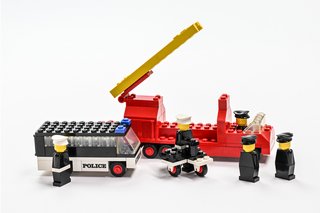
The first generation of minifigures was debuted in small sets such as #659 Police Patrol, with a van, motorbike and two police officers, and #693 Fire Engine, with a turnable ladder, trailer and three figures, but also in large sets such as #363 Hospital, which featured a first-aid station, ambulance and seven figures. Other busy mini-folk released in that first year included construction and railway workers, warehouse staff and millers.
More evolution than revolution
Looking at Lego’s models at that time, the introduction of the 38.4-millimetre-tall figures (standing 40.1 millimetres with the head stud) was clearly more of an evolution than a revolution: the iconic #367 Moon Landing set with three spacemen to the scale of the larger figures, for example, was also released in 1975. Lego didn’t immediately convert every figure populating its play world, and the first generation of miniatures remained part of its offering for a few years more.
Meanwhile, Jens Nygaard Knudsen and his team were working tirelessly to further perfect the little Lego heroes. Nevin Martell, for example, provides some insights in his Lego minifigure biography. The figures underwent plenty of tweaking and refining, including trials of heads with moulded faces and the production of prototypes with column-like legs and others with round feet. Important steps in the development process were captured in metal castings. Two picture tableaux (Red Woman and Blue Man) in Martell’s 2009 book trace this evolution in detail.
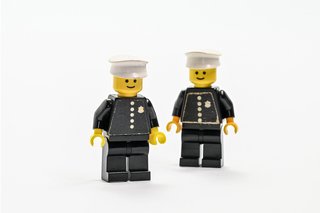
Then in 1978, the final result was produced: the minifigures as we know them today were patented, with joints at the hip to allow individual movement of the legs, angled arms, swive wrists and simple gripping hands – as well as a friendly smile on their face. The first figure produced after all this development work was again an amiable helper: the police officer in the #600 Police Patrol and #621 Police Car sets. At the time, his torso featured a sticker with silver buttons and a police badge. Likewise, the fire chief in set #602 wore gold-coloured buttons on the jacket of his uniform and a new helmet with neck protector. Later, printed details became standard – paving the way for ever more designs and themes.
Traditional play worlds and successful licences
Still in 1978, Lego established two new and very successful play worlds in which the minifigures assumed a key role. The first was the interstellar adventures with its spacemen, initially dressed in white or red, in the theme now known as Classic Space, with its grey, blue and yellow vehicles and structures. In 2022, the Danish company paid tribute to this important part of its history with special model #10497 Galaxy Explorer. The second was the medieval knights play world, with the first sets for this also appearing in 1978.
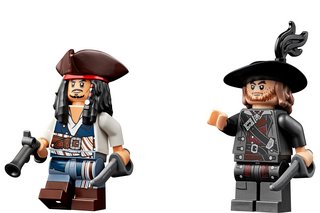
Since then, these global figures in brick form standing almost four centimetres high and made from a robust plastic (acrylonitrile butadiene styrene or ABS) have had an unprecedented success story. They’ve been helped in this by the many licensing rights acquired by the world’s largest toy company over the years, chief amongst these being the ever-popular Star Wars and this year’s Formula 1. But fans of Harry Potter, Pirates of the Caribbean and other popular media franchises have also been well catered for. With the matching printed faces and ever greater selection of accessories, the relevant characters can be brought to life – some even with shorter legs since 2002.
The minifigures have also long since become a collector’s item in their own right, with great interest in particular among Lego kidults, or “Adult Fans of Lego” as they call themselves. And there are plenty of little characters for fans and collectors to get their hands on: since their launch 50 years ago, more than 10 billion of these global figures have been produced. Lego has been bringing out its own collectible editions since 2010.
About the author Peter Thomas
Telling stories about technology and people: This has fascinated the journalist, author, cultural scientist and lecturer for more than 30 years. Technical toys are always in focus, from construction kits to interactive digital educational toys. After studying and working as a research assistant at university, Peter Thomas writes for daily newspapers, magazines and corporate publications in German and English-speaking countries. In addition to the world of games, his focus is on mobility, security, energy and medical technology.
The latest minifigure collections and lots of other new releases will be showcased to trade visitors at the Spielwarenmesse in Nuremberg from 27 to 31 January 2026:
LEGO Group, Hall 12.2, Stand P-01.
TIP: Set up a meeting.