

75th anniversary: Nuremberg as seen by Reiner Knizia
Interview with the game designer
By Peter Neugebauer
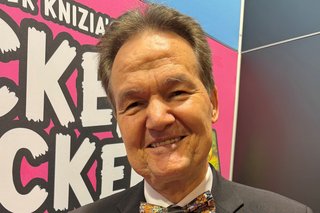
When I arranged a Zoom interview with game designer Dr. Reiner Knizia, he appeared on screen bang on time. He seemed content, signalling openness and curiosity. This positive first impression was quickly confirmed during our conversation when he mentioned that he had just signed a contract with a publisher of games in Southeast Asia. At this point, he turned his camera towards the wall and showed me a world map marked with over 40 countries in which his games had been published. The Philippines will soon be added to this list. So, how did Reiner Knizia become such a significant figure in the gaming scene? He is one of the most significant designers of analogue games worldwide, if not the most significant.
You have worked as a board and card game designer for 40 years. How did it all begin?
Reiner Knizia: It started at a hairdresser's in Illertissen, my hometown. When I was a child, I could buy games there because there was no toy shop. It was during those haircuts that I became interested in games, and even then I felt the urge to change the ones I played. My first publications appeared in the spielboxtrade magazine from 1985 onwards. Over several issues, I contributed a 'game to remove and play'.
Even in those early years, I attended the Spielwarenmesse in Nuremberg. There I met Bernd Brunnhofer, who was the publisher of Hans im Glück at the time — a small start-up. We discussed ideas at the fair, and with Brunnhofer I was able to arrange the publication of my first game concept. The card game Goldrausch was released in 1990.
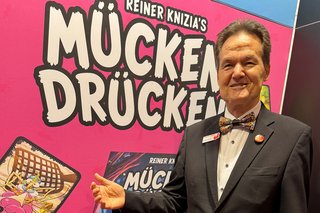
Today, meetings at the fair are different. For several years, you have had your own counter in Nuremberg.
Reiner Knizia: This is an important step towards greater professionalism. I am grateful to the trade fair management for allocating me one of these highly sought-after stands, and I will certainly continue to rent it in future. Having my own stand at the trade fair allows me to hold discussions with partners. Most importantly, I can showcase exclusive prototypes and present them to publishers in a private, familiar setting.
But you don’t just sit in your booth and wait for customers during the fair, do you?
Reiner Knizia: No, of course not. Appointments are scheduled. Editors from Germany and abroad who don’t have their own stand also come to see me. I also attend appointments at the stands of important publishing partners. There, I present new games to editorial teams.
Is the fair important to you for any other reason?
Reiner Knizia: Absolutely! Nuremberg is the best place for networking — believe me, I've attended many fairs around the world. None of them can compare to the Spielwarenmesse.
As a designer, there are three aspects that are especially important to me:
1.Firstly, there’s the opportunity to speak directly with the decision-makers and managing directors of game publishers. This enables me to gain a better understanding of their philosophy and learn how individual publishers wish to develop their programmes. As a designer, I can then respond by offering targeted new game developments.
2.Secondly, the range of information available is unparalleled. Only here in Nuremberg can I find out which games publishers are releasing, what's popular, and where new trends are emerging. This also helps with further game development.
3.Thirdly, as it is a trade fair, it is fairly quiet and there are no crowds, unlike at the consumer fair SPIEL in Essen, which serves a different purpose.
Born: 1957
Residence: München
Background: PhD in Mathematics
Game designer: Since 1985
Games published worldwide: Over 800
To the website: www.knizia.de
Can you give an example of the concrete impact networking can have?
Reiner Knizia: My experience of the Chinese market: It may seem obvious, but sometimes you need to be reminded. China had a one-child policy for many years. This has consequences for family structures. Families with only one son or daughter require different types of gaming products, particularly since both parents usually work and the child spends a lot of time with their grandparents, including playing.
For example, consider the current situation in the German market. Exchanging ideas with decision-makers enables larger projects to be discussed and agreed upon. Shortly after the pandemic, I presented my idea for the For One series to Axel Kaldenhoven, the managing director of Schmidt Spiele. We quickly reached an agreement, enabling me to develop this new, innovative game series. The publisher's classics Kniffel and Mensch ärgere dich nicht remain key titles. I have now had five titles published in this series.
- Award-winning Knizia Games
- 1 x Spiel des Jahres: Keltis/Kosmos
- 1 x Kinderspiel des Jahres: Wer war’s/Ravensburger
- 4 x Deutscher Spielepreis: Modern Art (Hans im Glück), Euphrat & Tigris (Hans im Glück), Tadsch Mahal (Alea), Amun Re (Hans im Glück)
- 1 x Deutscher Kinderspiel Preis: Wer war’s (Ravensburger)
- Numerous international awards
Let’s look at other publishers.
Reiner Knizia: I don’t want to rank or highlight any manufacturers. However, there is one exception. I have published over 100 games with Ravensburger. The manufacturer with the blue triangle is my most important partner. Meeting the publisher in Nuremberg is essential.
You must have visited other international fairs like Gen Con in Indianapolis or Games Expo in Birmingham.
Reiner Knizia: Gen Con is the most important fair in the USA, even more so than the New York Toy Fair. Many publishers attend. I attend every year or so to maintain and establish contacts. The Games Expo in Birmingham doesn’t have the exact same significance for me, although I was very pleased that there is a Knizia Avenue there to guide visitors.
Finally, may I ask you to look into the crystal ball. Where do you see the Nuremberg fair and yourself in ten years’ time?
Reiner Knizia: The Nuremberg Fair will not undergo radical changes. It will remain the leading trade fair for publishers, buyers and designers. Naturally, there will be structural changes. However, Nuremberg has always succeeded in developing further in the past. Adapting to modern times is necessary, and the organisers have always recognised the need for careful progress.
As a game designer, I don't expect much to change for me. Things will stay as they are today. The challenge is to stay relevant. Attending the International Spielwarenmesse in Nuremberg every year helps with this.
Thank you for your time and for the conversation. We wish you continued success.
The International Game Inventors’ Convention is an exclusive event held during the Spielwarenmesse that brings together ambitious game designers and experienced publishing teams.
Friday of Spielwarenmesse: 30 Jan. 2026
Venue: Nuremberg Exhibition Center, NCC Mitte, Level 1
Registration deadline for game designer: 7 Dez. 2025 at Game Inventors‘ Convention
About the author
Peter Neugebauer is still a “big kid” through and through. In early childhood, his parents introduced him to board games. And games were obligatory and always welcome as presents for Christmas and on his birthday. He didn’t stop playing, not even during his years of study or working life. Early on, he reviewed new products, initially in trade journals, then also in daily newspapers and, for almost 40 years, in industry magazines. He can’t live without playing.