

How AI, China and the creator culture are revolutionising the retail trade
By Theresa Schleicher
Retail is facing a turning point: if it grinds to a halt, it’ll shrink – unless it radically rethinks its approach. That’s what the latest Future:Guide Retail (in German) from The Future:Project and Theresa Schleicher, Germany’s leading retail industry expert and futurologist, reveals. “If a quarter of Germans want to economise more, retailers will have only two options: stand still and shrink – or rethink their approach,” is how Schleicher sums up the urgency of the situation.
Children remain a priority: spending on the next generation is immune to austerity measures
The good news is that research has highlighted that spending on children, in particular, is not among the most significant areas affected by cutbacks compared to other sectors. Nevertheless, the toy industry must also adapt to increasing price pressure from competitors as well as new demands from young consumers and families in the future if it is to remain competitive.
Five trends that are shaping the future of retail
1. Chinese power
In Europe, brands such as Temu and Shein are evolving into everyday ecosystems. Their product ranges, fast delivery, gamified loyalty and C2M data integration are linking consumers, producers and services to create a new retail logic that goes beyond mere pricing strategies. As Schleicher stresses, “The Chinaisation of European trade is not a thing of the future; it’s something that’s already happening today.” This will become a key issue, particularly in the family segment – ranging from toys to children's clothing – and among younger customers in the fashion sector; the toy industry will have to adapt accordingly, not least by adopting sound pricing strategies, but also by communicating effectively.
2. Retail agents
Artificial intelligence (AI) is now responsible for handling product ranges, pricing and customer communication. According to research and advisory firm Gartner, by 2040, 70% of all consumers will be using personal AI agents on a daily basis. Retail agents understand customers, make decisions and dynamically design product ranges, prices and services – from virtual nutrition coaches to empathetic store assistants. These developments are more than just technological; they actually help small and medium-sized retail companies and industry in particular to produce more efficiently, to design products in line with new trends in the toy sector, and to sell them economically and fairly across a myriad of different channels.
3. Inspirational intelligence
From discounts to surprises, 53% of people would like retailers to offer more inspiration and surprises. Some of them are new product testing platforms that showcase new products. Another area is the daring redesign of inner city spaces: even for smaller retailers pop-up experiences in the city may be relevant. Influencers are also reshaping the shopping experience, with almost 70 million people in Germany already following influencers.
4. Functional market
As future generations design their own products rather than purchasing standardised items, a new market is now emerging. It begins with the enhancement of health products, such as food and smart home devices, which promote mental and physical wellbeing. It then extends to textiles, toys, and interior design, which incorporate physical and psychological enhancements. Health is becoming more sensual, emotional, and curatable.
5. Sustainable mainstream
Used, recycled and high-quality materials are creating consumer experiences that are not only sustainable, but also affordable and emotionally charged. Luxury, quality and environmental awareness are merging to form new products and business models. Simple, sustainable solutions are becoming particularly significant for future generations – which is why the market in this area is very large, especially for families.
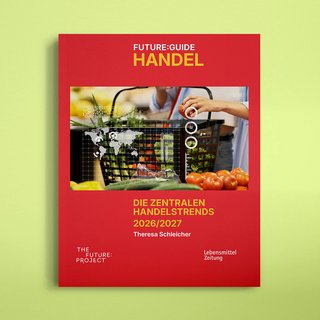
More trends can be found in the Future:Guide Retail. The guide is aimed at decision-makers, retail companies and anyone who would like to understand how new trends and global dynamics are shaping the retail sector. The study (in German) is now available in the online shop of publisher Deutscher Fachverlag GmbH and at thefutureproject.de.
Growth in 2030: What are the upcoming development and trends in the toy industry?
Theresa Schleicher, Retail Industry Expert & Futurologist, Berlin
When considering the future of toys, we need a certain degree of paradoxical competence when the desire for quality runs up against cheap offers, when inflation confronts the new hedonism, and when super-convenience and AI stand alongside the longing for local intelligence and inspiration. What happens when everything strives in one direction and at the same time pulls in the opposite one?
About the author:
Theresa Schleicher is regarded as Germany’s leading retail industry expert and futurologist. She acts as a sparring partner for retail companies, the Future Institute and the Federal Ministry for Economic Affairs and Energy. The author of a number of well-known trend studies in the retail sector previously served as managing director of one of the largest consulting and creative companies in the German-speaking world.