

bio!TOY 2025: Driving forward the sustainability of toys
Insights into the use of bio-based and recycled materials
By Daniele Caroli
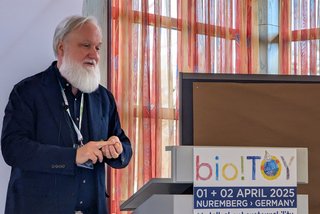
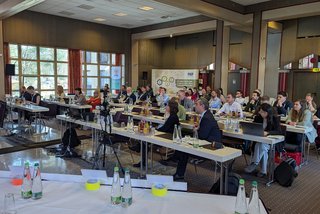
The 4th bio!TOY conference took place on April 1st and 2nd, 2025 in Nuremberg, proving itself an impressive trove of information about the multifaceted aspects of sustainability in toys, especially as regards the replacement of fossil-based plastics with bio-based and recycled materials. The event, that enjoyed great success among the live and online participants, was organized by the Renewable Carbon Plastics trade publication. It was supported by several bodies, including Spielwarenmesse eG, and actually it started up with Sharon Keilthy of STAC (Sustainable Toys Action Consulting) talking about the Toys Go Green area at the 2025 Spielwarenmesse. She explained that out of 107 applications 84 were accepted and that among bioplastics, bio-PE resulted the dominant material, with bio-PP emerging. Of the 84 selected toys, 25 were made of recycled plastics, 22 of wood, 20 of cardboard/paper, 8 of bioplastic, 8 of recycled wood, 6 of organic cotton and 2 of cork.
Complexity and limits of sustainability
Following an introduction by Sonia Sánchez, STAC’s co-founder, who emphasised the complexity of the concept of sustainability, Søren Kristiansen, Senior Director of LEGO’s Technology Materials Department, reported on the company’s search for sustainable materials for production. This search had to take into account features such as playability, safety, perceived quality by consumers, durability, and the ability to be reused or recycled, as well as the supply chain. By 2024, 33% of LEGO products could be made from renewable sources. Research is ongoing, but since the availability of biomass and recycled plastics is limited, additional carbon sources will be required. In his speech, Brendan Hill (Sustainable Market Development and Sales EMEA at Braskem) presented Europe’s ambitious Plastics Industry Roadmap. The roadmap estimates that, by 2050, 65% of plastics will be circular, mainly through mechanical and chemical recycling and the use of biomass, while the remaining 35% will still be fossil-based. On the second day, Alexander Kronimus of the Plastics Europe Deutschland association also remarked that global plastic use will increase two to threefold by 2060 due to economic and population growth. This will lead to an increased risk of plastic leakage and accumulated plastic stocks, so a circular economy is absolutely necessary.
The issue of cost

The conference addressed one of the key issues relating to sustainable materials: cost. Niklas Voss, Associate Director at FKuR Kunststoff, admitted that 'costs are definitely higher, although it depends on the application'. This was confirmed by Magdalena Stebetak of Gowi, who revealed that the 200-year-old Austrian toy company has recently launched three product lines: one made from sugarcane-based polyethylene, one made from 95% PCR recycled materials and one made from 100% recycled soothers for sand moulds. As a result, the material costs for baby bottles and cups are becoming too high. 'Moreover, large quantities must be purchased and paid for in advance; our bio toys are too expensive for the market. Consumers choose virgin plastic products because they are cheaper and demand from end consumers is not as high as we think'. However, Stanislaw Hafka of Kaneka, which produces the bio-based, biodegradable polymer Green Planet, said that while their material’s price is double that of virgin plastic, the cost of waste treatment should be considered, since regulations will soon be introduced. Not to mention the increased concern among consumers and stakeholders regarding persistent microplastics. During the final Q&A session of the conference, Dennis Gies of Toynamics Europe offered an alternative perspective. He stated that “cost cannot be a topic of purchase as opposed to sustainability, since materials cost is one part of the process, worth less than a third of the total product cost”. Stefano Gandolfi, owner of Italtrike, endorsed this view, providing an example: "We changed the production of the wheels because we adopted a new, more expensive [and sustainable] material, but we saved on the production process thanks to the new equipment".
Production of bio-based polymers increases
When it comes to materials, the responsibility lies with the chemistry industry to provide the toy industry with the right solutions. After showing several toys made of bio-based polymers and biocomposites, Michael Carus, founder and CEO of the Nova-Institute consultancy, said that in 2023, the production of fossil-based plastics worldwide reached 394 million tonnes, compared to just 4 million tonnes of bio-based plastics. Interestingly, in the same year, only 0.023% of the total global biomass demand (13.6 billion tonnes) was used to produce bio-based polymers, equating to an area share of just 0.013%. However, production capacities for a large number of bio-based polymers are increasing rapidly worldwide, with Asia leading the way (59%), followed by North America (16%), Europe (13%, set to grow) and South America (11%).
A unified certification is still missing
Sharon Keilthy later agreed with Magdalena Stebetak that "only a small percentage of the population is actually looking for green products". There was general consensus that consumers could be better educated and informed if there were a unified certification for sustainable products. The Ethical Supply Chain Programme (ESCP) is developing the Recycled Materials Chemical Safety Assessment, as toy companies want a standardised process, according to Carmel Giblin, the ESCP’s President and CEO. This is due to the fact that using recycled materials produces more variables, and existing chemical management systems are not suitable. This activity is leading to the creation of a regulatory database providing access to information on recycled materials and their availability. This service is intended for the industry, but it could also help to build trust with consumers. In the European Union, the Digital Product Passport, which is expected to include key product features such as the carbon and environmental footprint, might be a welcome solution.
Design’s contribution
Luisa Torres of Feber and Stefano Gandolfi of Italtrike, pointed out that materials are only one aspect of sustainability in toys, as there are many other factors to consider. Meanwhile, Fabio Guaricci, founder and creative director of TOY Design Studio, stressed that design can greatly impact the sustainability of toys. He illustrated the principles of Design for Disassembly, an approach to product design that emphasises making products easier to take apart at the end of their life cycle for easier recycling, reuse or refurbishment. This approach must include features such as modularity and standardised connectors, as well as clear labelling that indicates how to disassemble the product and identifies the materials used. Of course, each principle requires cooperation between the designer and the brand.
Michael Thielen of Renewable Carbon Plastics (previously Bioplastics Magazine) thanked all participants and announced that the next bio!TOY conference will take place in 2027.
Focus on Sustainability
With the special "Toys go Green" in Hall 3C, the Spielwarenmesse is strengthening the industry’s awareness of sustainability. A visit to Spielwarenmesse Digital showcases innovative and environmentally friendly toys that make an important contribution to a better future.
About the author
Italian journalist Daniele Caroli has been editor-in-chief and contributor to international trade magazines in the nursery products and toy businesses since 1994. He was President of BCMI (Baby Care Magazines International) and of ITMA (International Toy Magazines Association). Previously, he had worked as a journalist in music and consumer electronics periodicals.