

Electronic toys: more sophisticated than ever
Advanced integrated electronics and AI are enhancing the toy selection
By Peter Pernsteiner
Computers and memory chips have been a common feature in many toys for years. Almost all model railways are now digitally controlled, and digital technology is also a must in radio-controlled cars and other vehicles. Both segments have already been spotlighted in separate Spielwarenmesse reviews. This time, the focus is on the many other electronic playthings designed for the enjoyment of children and grown-ups.
Think fast!

Starting in the preschool segment, the robust LumiTap reactive game board from GimmiSys helps little ones burn off energy. With a play surface measuring 75 x 75 cm, it features 81 large touch-sensitive buttons (in a 9 x 9 layout) with computer-controlled RGB LED backlighting. Enclosed in a sturdy outer frame, the board has a control panel on one side for selecting from (currently) twelve games for one to eight people. In ColorTap, up to eight children or grown-ups gather around the board and have to hit the touch-sensitive buttons with their hand or fist as quickly as possible as soon as their assigned colour lights up. Combination skills are needed for ColorConnect, with players having to link up areas with matching colours. There are also classic games on offer, such as TicTacToe and Snake (which keeps getting longer and faster). In preschools, LumiTap can be used directly on the floor or placed on a table. It can also be supplied with screw-on feet. In addition to the preschool segment, GimmiSys is also aiming its board at indoor play centres, event locations and hotels with play corners.

Cooper from Learning Resources, a moving robot standing 10 cm or so high, helps children aged five and older to code sequences and interactions. It has a sensor that allows it to recognise coloured cards with commands. These are first laid on the table to plan out a sequence that is subsequently programmed into Cooper. In addition, the robot has a black line sensor at its base for automatic path tracking, a light sensor on the top and an infrared sensor at the front for detecting obstacles. It is also able to communicate with other Cooper robots in multiplayer mode. Sequences of up to 100 commands can be stored. The spherical robot moves about on large motorised rubber wheels. The built-in battery pack can be charged via a USB-C port and should deliver about an hour of play. The robot can be purchased as a solo unit or as a school set with four Cooper robots and teaching resources for 20 lessons.
The fun of creative construction

Carl the colourful coding chameleon is a robot construction kit with 133 pieces from Kosmos. It is designed to teach children aged ten and older the basics of automation. Once built, Carl measures between 27 and 40 cm in length (thanks to his adjustable tail). He moves with a motor and rolls his eyes. Underneath, there is a photo sensor for analysing the colour of the floor. Depending on the operating mode, he can change the colour of his stomach to match the surface below with the help of an RGB LED or execute an automation command based on the included coloured cards. These cause Carl to move forwards or backwards, for instance. He also has an infrared sensor on his head to measure the distance to an obstacle or potentially a prey object. If the distance is right, he then opens his mouth and a small arrow attached to a line shoots out, just like a chameleon’s tongue. Then the line and arrow are retracted. In addition to meeting the coding chameleon, this writer also captured further new insights in a video interview during a visit to the Kosmos stand: to the video

With CodingCube, Freakware is catering to building block enthusiasts with their own ideas. The programmable mobile mini-computer can be used to automate builds engineered using blocks of many manufacturers. Measuring just 56 x 56 x 32 mm, the computer can be built using standardised building block pins and features a wide range of connectors. For example, four motor blocks and four standard model servos can be directly connected. Nine sockets serve as digital interfaces for external sensors. Another two sockets are intended to function as digital outputs or analogue inputs. CodingCube also features a light sensor and an integrated six-axis gyroscope for position detection. There is a 35 x 28 mm colour display for the interface and four buttons underneath for interactive user navigation. In addition to its built-in memory, CodingCube has a slot for an easily replaceable MicroSD memory card. The USB-C port is used to charge the integrated battery pack and to code the device via PC. Finally, Wi-Fi and Bluetooth are included as wireless communication interfaces. The starter set comes with various elements, such as two 64 mm-long motor blocks with 44 mm rubber wheels and a trackball as a support for initial vehicle experiments.
Artificial intelligence as a useful aid

With the aid of artificial intelligence, two little robots from Miko want to help children to learn through play and have fun. Even the smaller Miko Mini, standing around 17 cm tall, has a colour display measuring 5 cm diagonally and can flexibly move around and dance thanks to its motorised front wheels and its track roller. A small camera helps it to detect obstacles and more. The companion Miko app includes a number of features, such as an AI-powered Story Maker that produces personalised storybooks based on what children share about their day. For this, the Miko robot asks a few simple questions via its speaker and quickly processes the answers received via its microphone to render a beautifully illustrated story – perhaps about an elephant that moves very carefully around the bedroom so as not to break Peter’s model railway (see also the lead image for this piece). Miko Mini’s big brother is Miko 3, measuring 22 cm in height. It has a landscape-oriented touchscreen (12 cm diagonal) and is even more manoeuvrable. Parents can also connect to it from anywhere to video chat with their children.
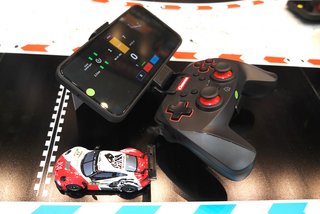
The Carrera Hybrid concept essentially resembles a blend of racing track and radio-controlled cars. However, there are no slots for guiding the vehicles, and the racing cars are controlled using a smartphone with the aid of AI software. For this, the 1:50 scale cars have a photo sensor on the bottom to detect an optical pattern on the flat track elements. Thanks to the AI, and depending on the skill of the drivers, the cars can be driven with setups ranging from semi-autonomous to fully manual. Tyre performance is also electronically adapted to the driving time and speed, simulating real wear. The company Sturmkind, developer of the system for Carrera Toys, showcased a new game console controller from Snakebyte with a smartphone holder for intuitive car steering. A Ferrari 296 GT3 and a Ford Mustang GT3 in multiple versions will also be released as new racing cars during the year. Three new track elements add to the fun: in addition to smooth bends for high-speed driving, there are also 180-degree hairpin bends and a constricting chicane. This writer got the latest Carrera Hybrid news in an interview at the Spielwarenmesse: to the video
Self-driving cars in city traffic

Many grown-ups have autonomous Car System Digital models in 1:87 scale from Faller integrated into their miniature cities. Ultrasonic locators mounted above the setup track the vehicle positions, so that the traffic flow can then be adjusted via computer, for instance. The integrated electronics needed for this plus the ultrasonic capsule for the vehicle roof had previously been so large that only model trucks were big enough. Faller has now developed new electronics with a much smaller ultrasonic transmitter that can fit in a model Mercedes Sprinter ambulance, for example. Another new feature showcased at the Spielwarenmesse was a tablet app for convenient remote operation of the Car System Digital software. This will be released for Android tablets and iPads later this year. With just a tap of a finger, users will then be able to, for example, easily manage road junctions, operate traffic lights, schedule driving breaks and individually control vehicles on the visualised street map. Faller also presented and explained both of these innovations to this writer in a video interview at their stand, which can be viewed here: to the video
About the author
Peter Pernsteiner discovered his love of technology journalism while studying electrical engineering and soon after joined the editorial team of a major ICT trade magazine. Since 1994, he has been writing as a freelance journalist, particularly on technology topics – including for model railway magazines. In 2016, he also launched a YouTube channel for tech reports, which has since attracted a global audience.