

75th Anniversary – Part 2: Founding Exhibitors
Our gratitude goes out to Ravensburger, Märklin and Haba
By Sibylle Dorndorf
Brands give products a special meaning and make promises to buyers. When these promises are kept and emotional connections are forged through stories that touch us, brands become lifelong companions and ultimately legends. People are drawn to these brands because they are associated with cherished memories. Memories of childhood.
What fascinates us about major brands is the pioneering spirit of their founders...
Our second journey back in time to the early days of Spielwarenmesse begins with one of Germany's most iconic trademarks: the Ravensburger blue triangle. Over the years, it has become a seal of quality and playfulness. This takes us to Märklin, the market leader in model railways, who presented their first clockwork railway with a track system at the Leipzig Spring Fair in 1891. The story concludes Eugen Habermaass, who founded today's Habermaass Firmenfamilie company in 1938 after becoming fascinated by wood.
Ravensburger AG
Joy, Education, Togetherness
Where we come from
When bookseller Otto Maier founded his publishing house in Ravensburg in 1883, he initially produced template folders for crafts and architecture. However, the first game was not long in coming. Inspired by the works of Jules Verne, who was a bestselling author at the time, Maier lovingly handcrafted 'Around the World' – thus laying the foundation for an exemplary success story. Ravensburger games, such as the classic memory, became consumer favorites. Just like the children’s and young adult books from the publishing house, they bear the blue triangle as a promise of values. The decision for this trademark, which celebrated its 50th anniversary in 2024, was a milestone: it brought consistency and recognition to the publisher’s appearance.
Who we are

Today, the Ravensburger brand is better known internationally than the city of the same name. Although the company is headquartered in this city, the brand with the blue triangle is firmly established in consumers’ minds worldwide. The group has expanded its portfolio into other segments through acquisitions. Today, three global brands — Ravensburger, Brio and ThinkFun — as well as several national brands, contribute to growth and diversity. Otto Julius Maier, the creator of the blue triangle, led Ravensburger to international success. In 2017, his son, the great-grandson of the company’s founder, took over leadership of the business. Clemens Maier is Chairman of the Board of Ravensburger AG and is open to new ideas. As Head of Innovation Management, he introduced the groundbreaking electronic toy pen Tiptoi. His credo is: “We must be present in both the tactile and digital worlds.”
Clemens Maier ... personally
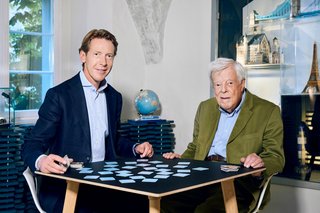
Clemens Maier, was ist über den ersten Messeauftritt von Ravensburger bekannt?
My father, Otto Julius Maier, attended the very first Spielwarenmesse in 1950, when he was just 20 years old. Just two years later, he took over the family business, which he led for four decades. He recently celebrated his 95th birthday. He recalls in the book The Grandson, or Mister Ravensburger Catches the Hat that it was exciting to suddenly meet all the other toy manufacturers and customers he hadn’t known before. The first stand was small, at around 15 square metres. Today, our stand measures almost 1,200 square metres. He also remembers that it took until 1958 for foreign manufacturers to be 'let in' and for Spielwarenmesse to become international.
The toy industry is a big family. And Spielwarenmesse is like a family reunion. What do you look forward to every year?
For me, the fair is a highlight every year. It’s not just a platform for new products, but a place where the entire industry comes together. I especially look forward to direct exchanges with our customers – both national and international – and to experiencing the excitement for our new products live. A fixed ritual is our stand party on Thursday evening. A real get-together with employees, customers and partners. Every year, the atmosphere is marked by a spirit of optimism, exchange and genuine connection. It’s a moment that shows how much passion there is in our industry.

Is there any product that Ravensburger presented at the very first edition of Spielwarenmesse that is still available today?
Products from exactly 75 years ago are no longer in our range; they are stored as treasures in our company archive. In 1959, we presented a matching card game at the fair, which is known worldwide as memory.
What are your wishes for Ravensburger and Spielwarenmesse?
75th Anniversary of the fair – that’s not only an impressive number, but also a reflection of the development of our industry. For Ravensburger, it’s an honor to have been there from the very beginning. We wish the fair to remain a place where innovation, exchange and enthusiasm for toys come together.
As an exhibitor, I wish for Ravensburger to continue being part of this special platform with curiosity, creativity and a strong team spirit. For us, the fair is not only tradition, but also inspiration.
In 1959, Ravensburger presented the game memory at Spielwarenmesse. “What matters is how well we manage to inspire the sales staff in toy retail – so that they pass on their enthusiasm to the customers,” says then Head of Games Programming Erwin Glonnegger. Over 80 million memory games have been sold worldwide to date – it seems we have succeeded.
Clemens Maier, Ravensburger Gruppe
Gebr. Märklin & Cie. GmbH
Always Full Steam Ahead
Where we come from
In 1859, Theodor Friedrich Wilhelm Märklin, a coppersmith, founded a tinworks business, initially producing gutters and stovepipes. Later, Märklin added products for children to its portfolio, including doll kitchen accessories, miniature carriages, and toy baby carriages.
If Märklin had remained with this product portfolio, the toy industry would have missed out on a fascinating brand. However, a tragic accident set the company on a different path: the founder fell down the stairs and died shortly afterwards. The company's future was at risk. The young widow, Caroline Märklin, took charge and continued the business. Even before her husband’s death, she had been responsible for sales. She successfully expanded the company before handing it over to two of her sons. It was these two who ventured into the field that would make Märklin world-famous. At the Leipzig Spring Fair in 1891, they presented the first Märklin model railway.
Who we are

Over the years, Märklin has become synonymous with model railways. However, the company has also experienced its fair share of highs and lows throughout its eventful history. At the beginning of the 2000s, the entire model railway industry was struggling in a declining market.
In 2006, the 22 family shareholders sold Märklin to the British financial group Kingsbridge Capital. However, due to significant legacy issues, the investor could not prevent insolvency in 2009. Thanks to the insolvency administrator's strategic skills, the future of this illustrious brand is secure: in March 2013, Michael Sieber, the CEO of the Simba Dickie Group, and his son Florian acquired the company via the newly founded Sieber & Sohn GmbH & Co. KG. Florian Sieber became Managing Partner. He has succeeded in rejuvenating the brand and bringing it back into children’s rooms. Sales figures rose. The legend lives on, and the brand's radiance remains undiminished.
Florian Sieber … personally

Florian Sieber, what do we know about Märklin’s first appearance at the fair?
When Ludwig Erhard, the Federal Minister of Economics and a native of Fürth, opened the first German Toy Fair in Nuremberg on 12 March 1950, Märklin was not only one of the first exhibitors, but also one of the founding members, represented by Carl Ehmann. As Märklin’s Paris branch manager, Ehmann was certainly one of the driving forces behind the fair's internationalisation. At the first Spielwarenmesse, Märklin mainly presented model railways in H0 gauge (scale 1:87), which was previously known as ‘00’ and referred to as ‘half zero’ from 1950 onwards.
The toy industry is a big family. And Spielwarenmesse resembles a family reunion. What do you look forward to every year?
Spielwarenmesse is one of our highlights. After all the intense preparations and development of new ideas, it’s a special feeling every year when we stand together with the team at our stand. All the hard work we have put in over such a long time becomes tangible – the concepts, the innovations and our new models. At that moment, we feel a sense of pride and joy, as well as curiosity about how visitors will react to the results.

Is there any product that Märklin presented at the very first edition of Spielwarenmesse that is still available today?
Our legendary 'Crocodile' locomotive was first introduced 75 years ago as the CCS 800 model in H0 scale. It remains one of Märklin’s best-known and most popular models to this day. Designed as a replica of the famous Swiss Ce 6/8 locomotive, we have reissued and developed the model repeatedly over the decades. Despite all these technical innovations, the Crocodile's distinctive charm has remained intact. It has become a timeless classic and the emblem of Märklin.
What are your wishes for Märklin and Spielwarenmesse?
Of course, we always wish for special highlights, like the Millennium Locomotive or the Emma engine from Jim Button, which we were able to present perfectly in cooperation with Spielwarenmesse in Nuremberg to delight our visitors.
Märklin inspires collectors and enthusiasts
The H0 scale Millennium Locomotive was the most expensive series model that Märklin has ever built. Released to mark the turn of the millennium, this legendary Swiss Crocodile locomotive was crafted from solid platinum. Its special feature was that the shunting lights were real cut rubies. It cost about 63,000 Deutsche Marks. At the time, bodyguards guarded the display case, creating a museum-like atmosphere.
Märklin fascinates kids and kidults
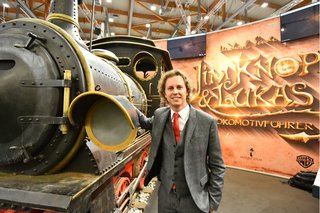
To coincide with the film Jim Button and the Wild 13, starring Henning Baum, Uwe Ochsenknecht and Annette Frier, Märklin released several starter sets in 2018. Thanks to light and sound effects as well as digital control, the sets offered high play value for children and nostalgia for adults, causing sales figures to soar. The iconic centrepiece: Emma, the charming locomotive. She travelled from the Babelsberg film studios to Nuremberg, where she became one of the most photographed attractions at the fair.
Habermaass Firmenfamilie
Play Works Wonders
Where we come from
Haba's history is shaped by a pioneering spirit and a commitment to sustainability. In 1938, Eugen Habermaass founded two companies with two partners. When his partners left in 1940, he had to run both businesses alone. He achieved this with the energetic support of his wife, Luise. In 1950, Haba presented itself at Spielwarenmesse, and the abbreviation became the brand name. Following Eugen Habermaass's unexpected death, Luise Habermaass continued running the company. In 1961, her son, Klaus Habermaass, joined the company. Gradually taking over the areas of technology, finance and development, he ultimately took over the management at the age of 24. Like his father, Klaus Habermaass focused on creating high-quality wooden toys. Haba became renowned for its classic building blocks, which remain a core part of its product range to this day. Klaus Habermaass paved the way for the future of the Habermaass Firmenfamilie with his keen sense of market and product development, his determination and his commitment to social responsibility.
Who we are

For almost 90 years, Haba has been synonymous with the highest quality, in terms of both materials and the games and toys themselves. Over time, the product range has expanded to include cloth dolls and board games. In particular, the board games segment has been successfully developed in recent decades. At Haba, vibrant creativity is combined with the considered strength of a family business now in its third generation. Sabine, Heike and Volker Habermaass remain true to the founders’ core values: a love of natural materials and craftsmanship are just as important to them as they were to their predecessors. They are steering the company, which is now active globally, in a contemporary direction. Today, the Habermaass Firmenfamilie is one of the most successful family businesses in Germany.
Gabriel Stahl, long-time Haba employee … personally

Haba has been an exhibitor from the very beginning. What does the company know about Haba’s first appearance at the fair?
Unfortunately, we don’t have any concrete details. We also don’t know if there are any surviving eyewitnesses. However, we searched the archives and found many photos and documents of early fair appearances. These include trade fair images from 1952, Luise Habermaass at the stand in 1958 and pictures of Ludwig Erhard visiting our stand in the same year.

Is there any product that Haba presented at the very first edition of Spielwarenmesse that is still available today?
exhibiting wooden toys, including wooden vehicles, trains, jewellery and weaving frames, as well as the popular wooden building blocks which continue to evolve and remain part of the Haba range to this day. In 1954, the Haba wooden duck was introduced, celebrating its 70th birthday in 2024.
The toy industry is a big family. And Spielwarenmesse resembles a family reunion. Gabriel Stahl, what do you look forward to every year?
As a sales representative for Haba, I have come to know many colleagues over the past 23 years, and I look forward to meeting them in person at the fair – something that is difficult to do in everyday life. But above all, I am looking forward to the atmosphere at the fair. Even when I was a buyer 36 years ago, I was captivated by it, and it still inspires me every time.
What are your wishes for Haba and Spielwarenmesse?
The 75th Spielwarenmesse is a very special event for us. Not only does it mark the impressive history of this leading international fair, it also celebrates our long-standing partnership as an exhibitor. We wish for continued inspiring encounters, strong impulses for innovation and sustainable business relationships at Haba. We hope that Spielwarenmesse will continue to be a vibrant meeting place for the industry, uniquely combining tradition and progress.

Team Haba
One of Haba's most unforgettable Spielwarenmesse moments was undoubtedly the launch of the hit trade fair game Trüffel Schnüffel in 2006. This story is retold time and time again, and fortunately, a photographer was present to capture all the 'sniffing noses' in a picture, so this event lives on within the company.
Celebrate the big anniversary of the Spielwarenmesse with the global toy industry and all exhibitors in Nuremberg from January 27 to 31, 2026!
Meet further founding exhibitors
75th Anniversary – Part 1: Founding Exhibitors
Our gratitude goes out to Heless, Glocken-Huck and Loquai Holzkunst.
75th Anniversary – Part 3: Founding Exhibitors
Our gratitude goes out to Tipp-Kick, Teddy-Hermann and rolly toys
75th Anniversary - Part 4: Founding Exhibitors
Our gratitude goes out to Emwe Rathgeber GmbH and Peter Bausch GmbH & Co. KG
About the Author
Sibylle Dorndorf has been writing about the toy industry for almost 30 years, most recently as editor-in-chief of the TOYS magazine family at Göller Verlag, Baden-Baden. Her passion: companies that reinvent themselves, brands that position themselves credibly, people who have something to say and products with a future.