

Paper lover Erwin Hapke: A cosmos of paper
Paper art exhibition in the Kunsthalle art centre in Nuremberg
From Peter Budig
Paper art is attractive – and all the animated discussion about it is drawing people in their droves to the Nuremberg Kunsthalle even on a hot summer Saturday afternoon to talk about a very special exhibition. Dr Matthias Burchardt from Cologne ardently presented the work of his late uncle Erwin Hapke at the end of June 2022. It was an origami-like monument to the possibilities afforded by paper, the dependability of order, and the limits of the individual. Harriet Zilch has curated the exhibition Orderly conditions (4 June to 28 August 2022), which consists of four rooms with four artists.
Hapke’s art: the soul of paper in the great breath of time
“Weißes Papier” (“White Paper”) is the name of an early album (1993) by German cult band Element of Crime. “Ich werd’ nie mehr so rein und so dumm sein, wie weißes Papier” (“I’ll never be as pure and as ignorant as white paper”) is the refrain of the song in question. It’s a song of misfortune about an abandoned man, and if you ever seek comfort in the melancholic, then the album and the song are up your street. And the song is perfect – its entire mood, and the feeling of being lost in this eerie world that is always disposed towards injustice and that supposedly defies any reasonable order. And it fits in with the story of Erwin Hapke, who died in 2016.
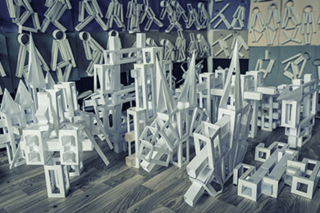
The doctor of biology countered the chaos of the world with the orderly cosmos of his folding art: Erwin Hapke’s world was created in over three decades and completely took over all the available space in his house. From pure, innocent paper that he bought or received as a gift, “The lonesome folder” (as the WDR radio podcast described him) folded tens of thousands of figures, each one unique: insects, cattle, elephants, other mammals, athletes, buildings, witches... They populated his entire home, a huge three-storey former school building in the district of Unna. Every wall, every staircase, all the tables, the windowsills, other storage spaces were ultimately populated by his figures – whole herds of innocent paper. Not just arbitrarily pasted, put together, laid out, but ordered, according to carefully reflected philosophical or scientific laws of the world. A magnificent opus – and a nightmare of a legacy.
Of course, it’s origami – and it also breaks all the rules of this art
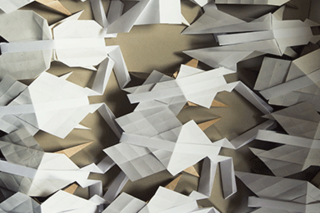
The figures – as already said, tens of thousands in total – are reminiscent of the well-known art of origami. Artful folding was already practised in Japan before the invention of paper (around 100 BC, probably in China). It was not until around 600 AD that the art of folding simple and complex figures from expensive paper developed. The classical rules are simple and irrefutable: a model is folded from a square piece of paper – with no use of scissors or glue at all. “My uncle broke all these rules,” says expert Matthias Burchardt with a smile. In addition, origami works in line with a plan and honours the principles of reproducibility and repeatability. Erwin Hapke, however, has created thousands of complex unique pieces. Nevertheless, the word origami comes from the Japanese “oru” for “to fold” and “kami” for “paper”.
Hapke created a brand new world of his own after his old one had come apart at the seams
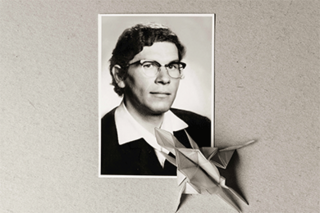
Born in 1937, as a young adult, Erwin Hapke lived with his sister Erna in the house near Unna; their father, a carpenter, had fled with the family from East Prussia. Hapke, a highly gifted but unsociable boy, completed an apprenticeship as a locksmith before taking his A-levels, studying and gaining a doctorate in biology. There is only fragmentary information about the years that followed. When he lost his position as a marine biologist at the Max Planck Institute in Wilhelmshaven, he returned, broke, to his parents’ house after a short odyssey through Germany in the early 1980s; his parents welcomed him with open arms. From then on, he lived in complete seclusion. After his parents died, his sister, who lived nearby, took care of him. He almost never left the house and kept to a strict daily routine, creating his collection, which he already addressed, in all its details, to a non-existent audience. A scientific work of art for himself, a monument to his beloved parents, and a thoughtful work for the public – this was how he saw the rooms of his house, all organised and annotated with philosophical and literary comments.
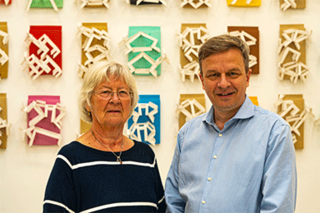
It was only on the day of the funeral that his nephew, the philosopher and educator Dr Matthias Burchardt, discovered the extent of this “museum”. “Including a visitor toilet, wayfinding system, folding instructions – and pre-folded paper. So that the imaginary audience that Hapke expected after his death could practise,” said Burchardt during his talk. It is only thanks to the nephew’s instinct that the monumental artistic opus did not immediately land in the waste paper collection. The inheritance his mother Erna received, the huge house in need of renovation with a large plot of land, is a gift with a hefty dollop of sweet poison: it was meant to make Hapke’s dream of a museum come true. ”We’ve done so much since 2016, but we haven’t been able to find enough supporters to finance such a huge undertaking,” sighed the friendly woman, who had come to the art centre in Nuremberg with her son and family for the exhibition lecture. The house, the garden in a pitiful condition, the huge artwork (in terms of numbers and content), and the effort that trained staff would have to make – an immense task that one can only fail at. Now, most of the works are neatly packed away and archived, as are thousands of pages of instructions; only a small part of the collection is on display in Nuremberg.
A new home for Erwin Hapke
Would you like to take a virtual tour of Erwin Hapke’s house? The KunstArztPraxis has been recreated as a virtual tour. Come on in!
KunstArztPraxis: 360° reconstruction: A new home for Erwin Hapke
About the author
Peter Budig studied Protestant theology, history and political science. He worked as a freelance journalist, ran the editorial department of a large advertising journal in Nuremberg for over 10 years and was the editor of the wonderful Nürnberger Abendzeitung newspaper. Since 2014, he has been a freelance journalist, author and copywriter again. In all respects, storytelling is his preferred way of communicating information.