

Growing up in fast-forward - Part 1
Parents’ buying patterns bring frustrations for retailers
By Sibylle Dorndorf
Welcome to the age of the digital high achiever. Children these days get gifted drones on their ninth birthday by their dad, though he can’t even fly one himself. At eight months, they’ve intuitively grasped the basic functions of a smartphone. And their parents are mindful of everything except recommended ages when buying them toys.
The children of the digital age

We’re talking here about Gen Alpha (2011 to 2024) and Gen Beta (2025 and later) kids. The latter is the first generation that will grow up in a wholly digital era. They will be familiar with AI and virtual reality from an early age. Twenty-first century technology has been a constant for Gen Alpha. The lives of that generation will be shaped by the digital world to an even greater extent than those of digital natives.
Toy retailers confirm that it is difficult to convince shoppers of the benefit of heeding the recommended ages on toys for the little kids in these generations, who use apps, watch YouTube videos, interact with voice assistants and learn about augmented reality through play at school. Technology that baby boomers first encountered as adults is a normal part of everyday life for these children. How relevant are recommended ages when parents of these digital high achievers go shopping for toys?
Parents’ wishful thinking meets reality
Play should be fun – that remains the most important thing. Parents view manufacturers’ recommended ages as something to be surpassed. They pick up tricky 3D jigsaws for their three-year-olds and challenging video games for five-year-olds. “He’s already very advanced for his age” is a statement that gets toy retailers tearing their hair out: “Parents are mindful of everything except age labels when shopping for toys these days”, says Klaus Müller. He owns Spielwaren Schweiger, a long-standing Nuremberg store founded almost 130 years ago that he runs with his wife. He is the fourth generation of his family to lead the business. “Grandparents buy ‘to order’. Parents are only concerned about the age labels on toys when their kids are babies and infants. Next thing you know, they’re keen to get their six-year-old a model helicopter, which crashes the first time they try it out.” Bringing playtime fun to a swift end.
Complexity breeds frustration
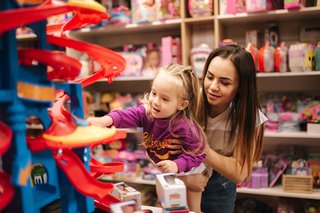
“It’s not just the kids who feel a sense of frustration then”, continues Müller. “The parents and grandparents are disappointed, but they don’t realise that children won’t make a developmental leap if they receive a toy that is too advanced for them. It just results in disinterest and rejection. And retailers like me are at the end of the food chain. We get the used broken item for exchange or return.” There’s no point debating the matter – the customer is king. Especially in the hard-hit brick-and-mortar specialist retail trade. What happens with these returns? Are they repaired? Written off? “We discard goods with a value of around EUR 2,000 to EUR 3,000 each year.” Like many of his fellow retailers, Klaus Müller has given up trying to get the point across. Instead, he has long stopped selling drones and model helicopters in his store. According to Müller, parents only still consider age labels when buying experiment kits. Although not when it comes to Lego Technic – sets recommended by the manufacturer for older children and adults are regularly purchased for younger enthusiasts. “Then dad has to lend a hand.”
This is not something only experienced in the retail sector. Take a look at any parenting blog and you’ll find little regard for age labels there either.
What parenting bloggers are saying
Moderndaddy: I consider age labels a rough guide, which we rarely stick to. As long as a toy isn’t dangerous, I look for things my daughter (eight months) is interested in. For Christmas, she got a book for children aged 12 months and older. We read that several times a day. It’s an activity book that gives you ideas for things to do. She can’t do them yet, but she finds it interesting.
Zuckermom: Rather than focusing on the age labels, I think it’s much more important to think about what my child is interested in. We had some toys suitable for his age, but he wouldn’t touch them, while he really loved toys for older kids.
Re007: It’s better to use your own common sense than to rely on labels and such. If it’s not too dangerous or too difficult, then your child can use it. My daughter has been playing with a marble run for children aged two or three and up since she’s been ten months old.
Pester power

In most cases, Gen Alpha is not yet shopping for itself. The children’s Millennial parents order toys via Facebook, Instagram or TikTok, where they are not getting direct advice. Usually, their child’s every wish is granted – and when it comes to ideas for toys, insights from favourite YouTube and Instagram stars matter more to them than advice from specialist retailers. A quarter of kids are guided by influencers in their own age group when deciding what they want – such as Ryan Kaji, a ten-year-old who tests and rates toys on YouTube and has almost 32 million subscribers to his channel. His videos have amassed nearly 50 billion views to date.
This is a real challenge not only for specialist retailers but also Arbeitsausschuss Kinderspiel + Spielzeug e.V., a committee for children’s play and toys that also advises parents on age-appropriate playthings. Board Member Ingetraud Palm-Walter gave us some insights into the issue.
Interview
Ms Palm-Walter, how do companies decide on age labels?

Ingetraud Palm-Walter: Companies are mainly guided by the provisions of the Toy Safety Directive. This sets out what is classified as a toy and which toys have to meet which safety requirements for which ages. It also stipulates which warning labels must be applied. Some manufacturers assign a particular age because then a warning label does not have to be applied. If companies want to position a product as a gift to celebrate a new arrival, they like to label it as suitable for zero years, even though the child won’t be able to play with it until later. This can cause frustration.
Are these labels reviewed or are companies free to decide on the appropriate age?
Ingetraud Palm-Walter: Safety requirements must be met, but otherwise companies are free to decide. Some are now starting to differentiate between an “age rating” as per the safety standard and a “recommended age”, i.e. the age at which children can actually play with the product. Their reasoning is that the younger age rating shows parents how safe the toy is. This results in different details on the packaging and in the manufacturer’s shop – and leads to confusion among parents.
There are different safety requirements for toys depending on the age label. These, at least, must be checked?
Ingetraud Palm-Walter: Checks are conducted by the trade supervisory authority. All toys must carry a CE marking, which indicates that the safety requirements have been met. If this is not the case and something happens, the manufacturer is liable.
Children grow up so quickly these days – are classic games and toys updated over time to reflect this?
Ingetraud Palm-Walter: Yes, but often we feel that’s more for the market’s sake than the children. For example, manufacturers of building block sets will try to keep the starting age as low as possible so that children don’t get a preference for a competitor. They offer special starter kits for younger kids. However, this can often result in an “age discrepancy”: take, for instance, a toy train with the numbers one to ten printed on its carriages. The look and feel of the toy is aimed at infants but the numbers only make sense for preschool children and older.
For what age groups are the labels really important?
Ingetraud Palm-Walter: When it comes to babies and the under-threes, it’s important to check whether toys have little parts that they could swallow and to be mindful of other safety aspects. But the labels on tabletop games, construction materials and experiment kits also matter. If you give these toys to children before they’re ready for them, they can get so frustrated that they never give these kinds of toys another chance.
Many toy catalogues and stores “sort” toys by age. Do you think that’s a good approach?
Ingetraud Palm-Walter: In principle, being able to compare is always a good thing. But then the age labels have to be reliable too. Our book “Vom Spielzeug und vom Spielen” (English: Toys and Play) provides an overview, with tables showing examples of which toys are suitable for which ages.
Arbeitsausschuss Kinderspiel + Spielzeug e.V. was founded in 1954 by professionals and academics from the fields of medicine, natural science, psychology, education, art and architecture. Today, the spiel gut seal is one of the most important awards for good and highly educational toys in Germany. The committee awards the orange spiel gut seal to toys that meet its assessment criteria and pass a practical test with children. Around 600 new products are tested each year. Manufacturers do not have to pay anything for this assessment.
About the author
Sibylle Dorndorf has been covering the toy industry for almost 30 years. Most recently, the journalist was editor-in-chief of the TOYS family of magazines at publisher Göller Verlag in Baden-Baden, Germany. Her passion: companies that reinvent themselves, brands that credibly position themselves, people who have something to say and products with a future.