

Growing up in fast-forward - Part 2
Recommendations from manufacturers and experts
By Sibylle Dorndorf
What is the relevance of recommended ages when manufacturers design and distribute their toys? How do they decide on the age labels for their products? How much attention do parents and shoppers pay to these? And in which segment or for which age cohort are age labels especially important? The Kindsgut team has the answers:
In which segment or for which age cohort are age labels especially important?

We use various age categories for age grading that cover the different stages of children’s development. From birth to around ten months, infants are developing their cognitive abilities and especially their motor skills. Before they can sit unaided, children are at greater risk of choking, for example if they put things in their mouth and then topple over. The under-threes like to explore their surroundings through sight, touch and other sensory experiences. They grasp items, smell them and put them in their mouth. This can be dangerous if there are small parts that they could choke on. As children become more mobile, they can get to more things, including potential hazards in their environment. Another important stage of development is when children begin to walk. Parents have to be especially vigilant then. With older kids, it’s useful to not only let them play freely and creatively with their toys, but also explain to them how to use them properly and where the limits lie. This completes the circle from the development of a safe toy through appropriate labelling to responsible parenting.
How do you decide on the age labels for your products?
We rely on various sources and criteria when it comes to age determination. Already at the product development stage, we define the target group of children and consider suitability and classification based on safety and risk assessments. For this we draw on ISO/TR 8124-8, a technical report for determining the age classification of children’s products, and the Age Determination Guidelines published by the US Consumer Product Safety Commission (CPSC). These provide a really good overview of the physical and cognitive abilities of children at different ages and the toys that they can safely interact with. By applying these, we ensure that our recommended ages are appropriate for the various developmental stages and in terms of safety.
When it comes to recommended ages, what would you advise parents and shoppers?
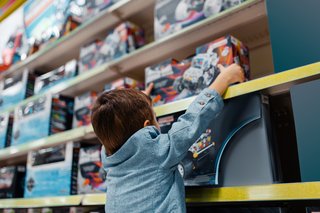
As age labels on toys and children’s items are based especially on safety aspects as well as suitability, we would strongly urge parents to take heed of the recommended ages when shopping. In addition to the recommended ages, toys also carry warning labels that highlight in particular whether a toy is unsuitable for, perhaps, the under-threes for the aforementioned reasons. Given their specific intended use, some toys are designed solely for older children with the relevant abilities. So parents shouldn’t overestimate their children’s abilities.
Kindsgut, founded in 2017, is a German toy manufacturer based in Berlin. Behind the company is a team of mothers, fathers and family people who have made it their mission to offer toys and accessories that not only keep children entertained but also deliver the high aesthetic values sought by parents. Kindsgut products are sold in the Kindsgut online concept store and by many specialist retailers.
What the experts at spiel gut have to say about recommended ages on toys

Regina Witte, educator and daycare centre manager, has been a member of spiel gut and of its board since 1986:
When it comes to recommended ages on toys, it’s important to bear in mind that children’s environments, experiences and impressions have changed radically. When cared for by others, children are often offered opportunities that their families might not be able to provide. Also through mixing with children of different ages and seeing what other families do, children get experiences that they process through play. Young children often have a large vocabulary due to their consumption of media, but with specific words from their own area of experience. Children are nowadays exposed to technology very early on and it is integrated into their everyday lives. However, deficits are apparent in other developmental areas, such as in the emotional realm and in social interaction. Developers and designers decide in advance on the target age group for a product. Tests in this regard are conducted with children using prototypes, and scientific insights are incorporated along with personal and prior experience with similar products. Toys for the under-threes need more careful consideration in terms of the safety requirements. Parents decide on what toys are bought until their children reach a certain age. Quality and sustainability are important purchase criteria, along with the play value and how a toy fosters children’s development. These parents also consider the age label when deciding what toys to buy. However, parents see their children through different eyes and often have no comparisons that allow them to judge what is suitable for a particular age. Toys should be entertaining, but complexity and frustration can take the fun out of them.

Michael Brandl, special needs and play educator, has been a spiel gut member since 1994 and a member of its board since 1999:
Manufacturers are usually free to set and adapt age labels. However, typically they start by identifying a very specific target group. Ages are determined strategically in the case of tabletop games. The main target group here is eight to twelve-year-olds, because games are then also suitable for families and multiple generations. So manufacturers will try to have as many games as possible graded for this age group. In principle, the minimum/starting age is set as low as possible, for example in the case of toys for babies and infants. Sometimes manufacturers achieve this by suggesting that games can be played with older siblings, or parents can demonstrate and join in, etc. This extends the target group. Also, many parents tend to think their children are well able to play with toys even if they’ve not yet reached the recommended age. While children do grow up faster these days, that’s only the case once they’re two-and-a-half to three years of age. But parents make subjective decisions about age suitability already when their children are babies. I think age labels are especially important for toys for very young children and for tabletop games. Companies’ recommended ages are not checked except for toys for the under-threes due to the risk of small parts that could be swallowed.

Norman Kurock, social educator and an expert in tabletop games at spiel gut:
My understanding is that publishers have test families who try out their prototypes. They’re particularly interested in the engagement factor and similar criteria. I don’t know of any guidelines that specify how recommended ages are determined. In terms of tabletop games, I’m not aware of any game where the age label has been corrected downwards. But we can clearly see that games are becoming increasingly complex. While The Settlers of Catan would have been called a demanding game 30 years ago, Catan is now considered a game with a normal difficulty level or a demanding starter game. I think parents often consider their children to be particularly clever and therefore tend to buy a 6+ game because they think their five-year-old will be able to manage it. On the other hand, there are publishers that use a lower age label to increase the customer base. So it’s important to pay close attention. We risk children losing all interest in games if they associate them with failure and frustration. Age labels do not simply cover the intellectual demands of the gameplay, but also the graphics, wording, materials and topic. So we can’t say there’s a definitive age group for which the age labels really matter. I feel it’s important that retailers sort games by the recommended age.

Dr René Michels, radiologist and health informatics specialist, has been a spiel gut tester since 2008, a spiel gut member since 2011 and a member of its board since 2022:
I don't think many parents take heed of the recommended age. Most parents subjectively consider their children to be advanced compared to their peers. Age labels are important because ambitious parents tend to push their children too hard. I feel that age labels on games are really important. If retailers sort toys by age, that might encourage parents to pay more attention to the recommendations.
About the author
Sibylle Dorndorf has been covering the toy industry for almost 30 years. Most recently, the journalist was editor-in-chief of the TOYS family of magazines at publisher Göller Verlag in Baden-Baden, Germany. Her passion: companies that reinvent themselves, brands that credibly position themselves, people who have something to say and products with a future.