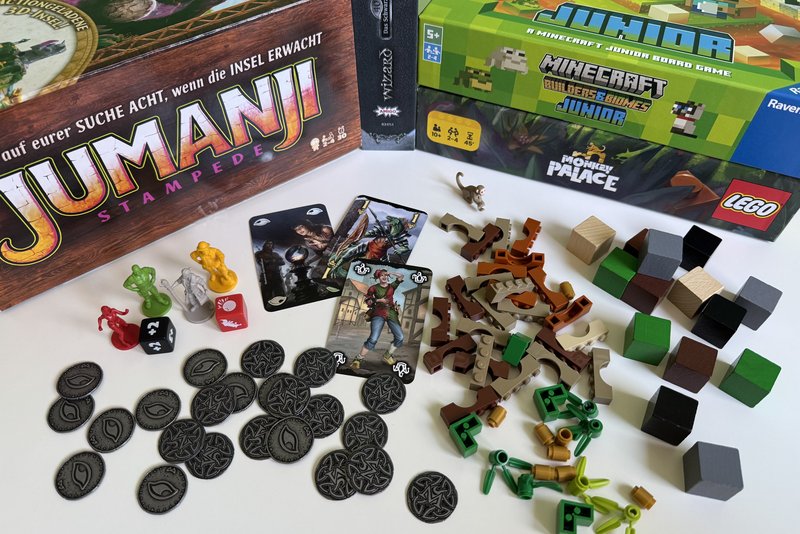


Game highlights in 2025
Must-try games – even without the award to prove it
The new games exhibited at Spiel in Essen in the autumn and Nuremberg’s Spielwarenmesse in late January are all considered part of the same game year in terms of award eligibility. Committees and juries pick their highlights from this pool and decide which should win the respective award. But there are also many other games that are especially noteworthy, fun to play and out of the ordinary.
Games for the whole family
When parents and grandparents sit down to play with children, family games are the way to go. These appeal to all generations and create excitement without asking too much of anyone.
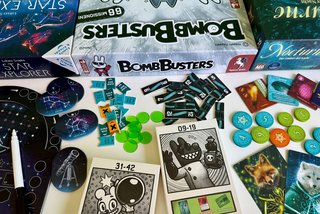
Like in a Bond movie, ticking time bombs have to be defused in Bomb Busters from Pegasus. The players work together to achieve their mission. Each of them have around a dozen blue wires on a rack in front of them. They have to use their deductive powers to find a matching wire held by a fellow player. Then they cut through the wires. Oh no, a red wire – boom! Double detectors, walkie-talkies and many other useful aids are included. With 66 missions, there are always different ways to play. Exciting like 007, but best played with just four people. Nominated for Spiel des Jahres (game of the year)!
Design: Hisashi Hayashi. Illustration: Dom2D.
Note from 13 July 2025: Congratulations to the winner of the award Spiel des Jahres 2025

In Star Explorer from Queen Games, each player is an astronomer exploring the night sky. They can see a part of the pitch-black firmament with illuminated points, as if they are looking through a telescope. Each player’s star disc only shows a small section as well, where they have to trace out the constellation to hand. The interesting feature is that the night sky travels and the next constellations have to be marked in the new sections. Players need to draw in as many star constellations as possible, but the sky disc’s rotation makes this all the more difficult.
Design: Lukasz Szopka. Illustration: Lucrum Games.

The magic of the night casts its spell over proceedings in Nocturne from Kosmos. Fox magicians have to find and collect mysterious objects such as enigmatic eggs, fiery feathers and mirror tiles. The players search in close quarters with their opponents over two rounds that each play out a little differently – twilight and moonlight. Magic markers help them to find their way through the dark forest. The game features an interesting and novel place-and-bid mechanism.
Design: David Iezzi. Illustration: Beth Sobel.

Gloomies, Ravensburger, are little creatures from outer space who love floral accessories above all else. They want to adorn themselves with richly coloured moon lilies, orbit roses and other space flowers. The players start by planting an extraterrestrial flowerbed together. The aim here is to score bonuses. The Gloomies’ order cards detailing their wishes are important – in the second phase, all players now have to harvest the flowers needed to fulfil those orders. Success depends on achieving the optimal interplay between the first and second phases. Spiel der Spiele (Austria’s game of the year award) winner for 2025.
Design: Filippo Landini. Illustration: Justin Chan.

Developing a national park is undoubtedly a mammoth undertaking. And that’s precisely the challenge facing players in Moving Wild from Oink Games. Playing cards are drafted and more and more animals pour into each players’ park. Enclosures are needed, but they must be suitable for the particular animals involved – after all, caging lions with their prey is bound to end in disaster. While some big-mouthed beasts, like hippos, need water in their habitat, others don’t. The design and box size may be minimalistic, but the task to hand sure isn’t!
Design: Chris Priscott. Illustration: Rie Takahashi & Rie Komatsuzaki.

In Castle Combo from Kosmos, players entice nobles and day labourers to their village with the aim of building a thriving, synergistic community. Each character added to the tableau affects those neighbouring it and influences others. A 3x3 grid is formed using playing cards, all with various supporting effects. Two currencies – coins and keys – have to be cleverly used, and players must avoid running out of either and ending up with limited or no moves. Recommended by the Spiel des Jahres jury and a favourite among the games highlighted here.
Design: Grégory Grard & Mathieu Roussel. Illustration: Stéphane Escapa
Ingenious children’s games
For quite some time now, games for children have not been restricted to memory exercises or races with coloured dice. Today’s designers of kids’ games know how to appeal to the under-eights in a variety of ways.

The award-winning Cascadia has now been joined by Cascadia Junior from Kosmos. In the simple gameplay, players draft domino-style hexagonal tiles depicting different landscapes with animals and add them to their environment. Three animals grouped in a family earn the player a bonus token for that animal, which is placed in their own panorama. There’s also a habitat token for three habitats of the same type beside each other. In addition to the exciting tile-laying action, children are encouraged to engage in free play by placing the animal and plant tokens they gain in their own panorama. Nominated for Kinderspiel des Jahres (children’s game of the year).
Design: Fertessa Allyse & Randy Flynn. Illustration: Beth Sobel.
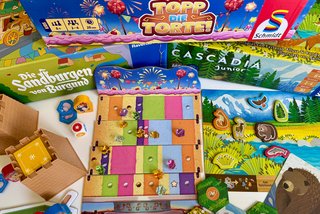
What could young boys and girls enjoy more than getting the chance to be a confectioner? That’s exactly what Topp die Torte from Schmidt Spiele offers them, without any flour or sugar ending up on the kitchen floor. Each player builds their own cake, layer by layer. Each layer has different fruit segments: orange for orange cream, purple for blueberries, etc. The layers have to be arranged on top of each other to form long coloured segments. The coloured segments vary in thickness, and the players have to judge by eye alone how they should be layered to win sugar cubes. Having to look carefully and make a decision for each layer is a successful new mechanism. Nominated for Kinderspiel des Jahres.
Design: Wolfgang Warsch. Illustration: Michel Verdu.
Note from 13 July 2025: Congratulations to the winner of the award Kinderspiel des Jahres 2025
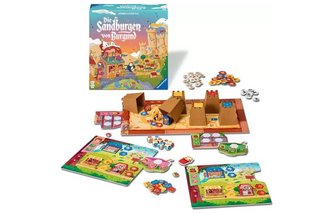
The Castles of Burgundy is considered a challenging classic in the Ravensburger/alea range. The Sandcastles of Burgundy is the children’s version, although the two games have nothing in common in terms of game mechanics. The children’s game plays with the charming theme of beach and sand. All kinds of decorations and cute creatures can be found under six sandcastles. In this memory matching game based on dice rolls, the children look for missing pieces that they then have to transport by cart from the beach to the village. In addition to the child-friendly theme and memory exercise, deciding when and how to use the dice is crucial to the outcome. This elevates the game beyond a memory matching challenge.
Design: Susanne & Stefan Feld. Illustration: Sam Dawson.
Challenging expert games
Playing physical board games has become a popular pursuit for lots of adults in recent years. Instead of being discouraged by elaborate and sometimes lengthy gameplay experiences, many actively seek out such opportunities. Players can immerse themselves in captivating theme worlds during game sessions.
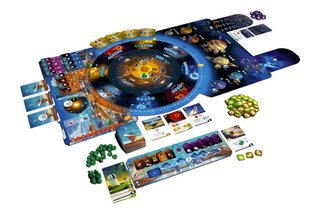
We all agree that there are highly developed lifeforms out there somewhere. When will we encounter them? The movie industry has rehearsed this many times. Now the game world is getting in on the act with Seti, a challenging offering from CGE distributed by HeidelBÄR. The 200 individual and versatile cards and a rotatable solar system ensure an interesting experience that is always different. By scanning sectors, launching probes to distant galaxies and feeding data into a supercomputer, the players find aliens at around the halfway point in the game, bringing a new set of rules into play. The gameplay reflects the theme extremely well. The somewhat challenging rhythm allows for a deeper experience. Given the particularly impressive and immersive overall package, players will hardly notice how much time they’ve spent playing.
Design: Tomáš Holek. Illustration: Ondrej Hrdina, Jirí Kus, Jakub Lang and others

Who wouldn’t want to protect the rainforest? In Life of the Amazonia from Strohmann Games, all players concern themselves with their own jungle. They win rainforest tiles with dense tree cover, lush rivers and swamp areas and add them to their individual tableau. Trees, aquatic flowers and all kinds of creatures can then be placed on these. The gameplay is driven by a bag-building mechanism with four currencies: coins, leaves, water and fruit. Everything is valuable. The resources available to each player in their turn is determined by what they draw from their bag. They have to be flexible, but also need to plan strategically if they are to emerge the winner. The game demands constant decision-making at every turn. Each player is awarded with a piece of protected rainforest that is a sight for sore eyes, not least due to the many beautiful wooden animals.
Design: Jamie Bloom. Illustration: Sophia Kang.
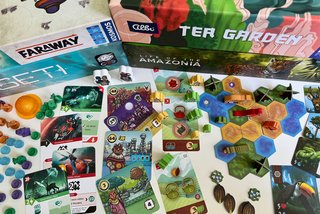
Tea Garden from Huch! takes the perhaps somewhat unexciting theme of tea preparation and turns it into a heated commercial contest. In addition to planting and harvesting the tea, the players also have to ferment and sell it. And it’s worth researching the tea plants. Interestingly, fresh tea declines in quality – fermentation is important because it boosts its quality again. This is just one aspect of the business that players need to keep in mind. The gameplay is varied. In addition to building a deck of cards that go well together, it’s also important that players manage resources well. And side activities are sometimes the key ingredient in the brewing process. There are many factors to consider. The player that best avoids making mistakes will emerge the master of ceremonies at the Asian tea table.
Design: Tomáš Holek. Illustration: Barbora Srp Žižková.
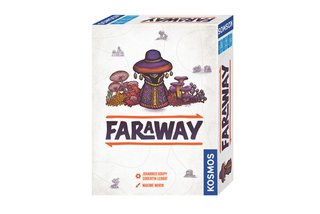
Faraway from Kosmos takes players to distant, exotic lands. They have to find stately chimeras, stones of the auspicious and soothing thistles on the continent of Alulu. By collecting plenty of these, players can satisfy the wishes of a good number of denizens and earn themselves victory points in the process. The catch, however, is that eight region cards are laid from left to right, but are scored in the opposite order – in other words, the sanctuaries collected are never considered in reverse. This innovative system takes time to learn. Few playing the game for the first time will understand how to move forward, literally or figuratively. This very special game mechanism can really be explored from a second play onwards. This game can get addictive! Nominated for Kennerspiel des Jahres (expert game of the year).
Design: Johannes Goupy & Corentin Lebrat. Illustration: Maxime Morin.

Ocean adventure. In Endeavor: Die Tiefsee (The Deep Sea), a game by Frosted Games and Board Game Circus, players take control of submarines and explore the depths of the ocean. There are always new discoveries to report. From large animals such as sharks and whales to intricate cave systems, the depths of the ocean are teeming with life. Each section has its own requirements, which players must fulfil in a race against each other. Thanks to the modular tile system, the depth of the sea changes constantly. To succeed, players must assemble a seaworthy crew. With this crew, progress is made in areas such as sonar, marine protection and publication. The range of scenarios, which build up over time and can be played solo or cooperatively, is varied and exciting, and thematically realistic.
Authors: Carl de Visser und Jarratt Gray. Illustration: Maruša Gorjup und Fahed Alrajil.
Note from 13 July 2025: Congratulations to the winner of the Award Kennerspiel des Jahres 2025!
Various game awards are given out annually, all with the intention of garnering attention for good new games.
In Germany, the Spiel des Jahres has been presented each year by an independent jury since 1979.
- This year’s ceremony will be held in Berlin on 13 July.
- It will be livestreamed from 6 p.m. on the association’s website and on YouTube.
In Austria, the Spiel der Spiele award has been presented by the Wiener Spiele Akademie association since 2001.
- This year’s winner was Gloomies designed by F. Landini for Ravensburger.
In France, the As d’Or critics’ award has been presented at the annual Festival International des Jeux since 1988.
- This year’s winner in the Family Game category was Odin designed by Y. Goh, H. S. Hwang and G. Kim for Helvetiq.
This autumn, the Deutscher Spielepreis (voted on by the public) will be presented at Spiel in Essen.
- Online voting will remain open until the end of July.
About the author
Peter Neugebauer is still a “big kid” through and through. In early childhood, his parents introduced him to board games. And games were obligatory and always welcome as presents for Christmas and on his birthday.He didn’t stop playing, not even during his years of study or working life. Early on, he reviewed new products, initially in trade journals, then also in daily newspapers and, for almost 40 years, in industry magazines. He can’t live without playing.