

Ship ahoy!
Exploring the world of model boat and ship building
By Peter Thomas
What do 17th-century British admirals and present-day secondary school students looking forward to their six-week summer holidays have in common? A passion for model ships. However, the miniatures themselves are very different. A good 400 years ago, navies used static models to illustrate new projects in three dimensions, while today’s remote-controlled speedboats with high-powered engines are all about pure dynamism.
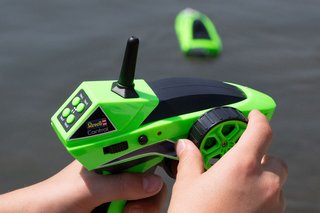
Hurricane, the toy boat in the Revell Control range, is almost 50 centimetres in length and can race at speeds of up to 45 km/h. As a ready-to-run electronic model, it comes fully assembled and equipped, including with a 7.4 V battery with 2000 mAh capacity. Just unbox, charge, insert batteries into the 2.4 GHz remote control and it’s time to hit the water. In the warmth of the afternoon sun, the boat darts around the slow-moving river, leaving spray in its wake that sparkles in the light – guaranteed summer fun!
A focus on the classics
Given the availability of these attractive ready-to-run models, what’s the situation with traditional model boat and ship building? That scene is healthy and vibrant, and has also experienced considerable advancements in recent years thanks to electronic technology. This segment is mostly the domain of dedicated adult modellers. They frequently use a kit for their projects and then customise the models to their liking. This holds equally for static models destined for display cases and shows as well as fully functioning boats for use on water.
The technical possibilities are immense. In addition to traditional screw drives, there are also model vessels with, for example, a working Voith Schneider Propeller (VSP). This all-rounder offers linear drive, but can also provide thrust in any direction, allowing a model harbour tugboat to turn on the spot just as impressively as the original.
Harnessing wind power
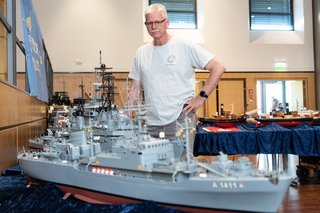
Model boat and ship building thrives on variety and provides an outlet for personal expression. This is reflected in the products available from specialist retailers, which stock everything from complete kits to numerous components and raw materials. 3D printing is also playing an increasingly major role. “Coming up with technical solutions” is especially important for working models – that’s according to Karsten Widera, chairman of Modellbau-Club Mainspitze, a model building club based in Ginsheim (near Mainz). Given the town’s location on the River Rhine, the club’s modellers meet regularly to sail their ships and boats. Cutters and yachts, service vessels and tugboats glide along the water, creating a fantastic spectacle for the kidults in their comfy deckchairs as well as passers-by of all ages.
Questions about the technical aspects are gladly answered in great detail – for example regarding the drive system powering the slender sailboat that Karsten Widera glides elegantly over the water using a multi-channel remote control. “There’s none”, says the modeller with a grin. Like the full-size version, his boat relies solely on wind power. The onboard electronics adjust the sails and rudder in response to a light press of the levers on the remote control, and the model steers a precise course towards the shore.
Timeless appeal

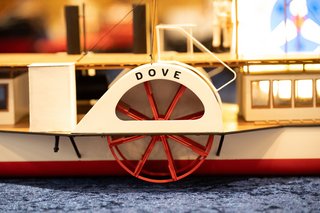
In addition to being great fun, today’s sail-powered model boats have interesting historical parallels. Before the advent of remote-controlled miniature versions with electric drives, there were already toy and model boats and ships with other means of propulsion. These include speedboats with a wind-up motor and screw drive as well as pop-pop boats with a simple pulsating water engine powered by a tea light.
There’s also a long tradition of sail-powered model boats. Jardin du Luxembourg, a Parisian park, is known worldwide for this chapter of toy history: against a magnificent backdrop, the practice of sailing little boats in the park’s octagonal pond has persisted for two centuries. The miniatures are still made by hand to this day. Cotton sails provide the propulsion and a lead-weighted keel the necessary stability. Known as les voiliers du Luxembourg, these colourful sailboats can be rented by children and adults alike with an interest in history and engineering.
Impressiveness and gratitude
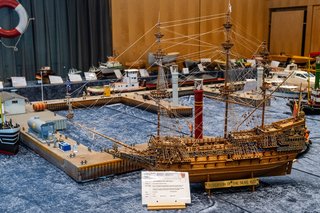
The history of model ships, mainly found in churches and public buildings in northern Germany, goes back even further than the sailboat tradition in the Parisian park. One famous example are the model warships at Bremen’s town hall, the oldest of which dates from the mid-16th century. The meticulously crafted and richly detailed miniatures symbolise the Hanseatic City’s commercial success, while evoking the dangers of maritime trade – with their numerous cannons.
Similar model ships can be found in many churches along the coast and on the islands. Known as votive ships, these models were usually presented as gifts by ship owners, captains and high-ranking seamen. They were also intended to impress. At the same time, they had an important function in religious practice, as it was hoped they would ensure protection on the next journey or they were an expression of gratitude for a safe return home.
Many modellers still design and build miniature ships with similar attention to precise detail today. The models with the very finest details are not intended to be sailed on water. Rather, these are fascinating objects for display in glass cabinets or exhibitions. Not every material is suitable for the water, either: in addition to plastic and wood, paper, cardboard and more may be used in model ship building.
Getting started is easy
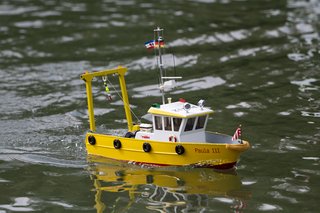
If you’ve ever dreamed of sailing your own model boat or ship in the summer, then it’s easy to make this a reality. There are many kits and fully assembled models to choose from. Modern remote controls, drives and other electrical and electronic components make it easier than ever to operate these boats. They also stay going for longer thanks to high-capacity batteries and efficient motors.
For those who love maritime models, the particularly nice thing is that you can still work at home on further upgrading your miniature over the winter after a summer of voyages. There are certainly plenty of ideas for how this can be done and you can tap into a lively community for brainstorming. The numerous manufacturers and retailers have the components and materials needed.
About the author
Telling stories about technology and people: This has fascinated the journalist, author, cultural scientist and lecturer for more than 30 years. Technical toys are always in focus, from construction kits to interactive digital educational toys. After studying and working as a research assistant at university, Peter Thomas writes for daily newspapers, magazines and corporate publications in German and English-speaking countries. In addition to the world of games, his focus is on mobility, security, energy and medical technology.