

Nuremberg Toy Region
ToyHistory: The economic history of the German toy industry
Editor's note
To mark the 75th edition of Spielwarenmesse in 2026, we are expanding the Spirit of Play online magazine to include a new section called 'Toy History'. To kick things off, we take a look at the historical circumstances that established Nuremberg as the home of the world’s leading toy trade fair. The two web summaries, 'Nuremberg toy region' and 'Toy industry locations: Fürth and Zirndorf', and the research paper ‘Toy city Nuremberg’ (see PDF Download below) were researched by Dr Helmut Schwarz, an economic historian and former director of the Nuremberg Toy Museum.
By Dr. Helmut Schwarz (1952–2022)
Toy manufacturing and trade in Nuremberg can look back on a tradition of over 600 years. The city’s tax lists already mention two “Tockenmacher” in 1400, who made small clay figures and turned dolls. Other figurative toys made of alabaster, wax and papier-mâché followed over time. In the 17th and 18th centuries Nuremberg craftsmen were already producing elaborate dollhouses, mechanical metal toys and other technical playthings.

Nuremberg Merchants sold these products domestically and abroad. Thanks to their extensive trade networks the city also developed into a distribution hub for wooden toys from other toy regions. Together with local products these formed a fixed component of the so‑called “Nuremberg tat” (Nürnberger Tands). A good overview of the pre-industrial toy assortment is provided by the catalogs of the Nuremberg mail-order pioneer Bestelmeier, through which, from 1793, toys could even be ordered by post.
Center of the metal toy industry
During industrialisation the Nuremberg toy trade grew enormously: in 1914 there were 243 toy businesses in the city. Numerous tinplate toy factories such as Hess, Issmayer, Carette, Plank, Günthermann and especially the Gebrüder Bing made Nuremberg the centre of the metal toy industry. Their trains, steam engines, ships, airplanes, cars and mechanical figures were expressions of a technology-driven civilisation.
Stronghold for tin figures, wooden toys, games, model railways
In addition, Nuremberg was home to renowned manufacturers of tin figures (Heinrichsen, Haffner), wooden toys (Baudenbacher, Hacker) and games (Spear, Abel‑Klinger). In the wake of Nuremberg’s expansion a differentiated tinplate toy industry also developed in the neighbouring towns. In numerous workshops, rattles, children’s trumpets, spinning tops and money boxes as well as mechanical animal figures and vehicles were produced. Well-known manufacturers included GAMA and Götz & Sohn in Fürth as well as the Zirndorf firms Bolz, Rohrseitz, Seidel and Brandstätter. Over 100 Nuremberg–Fürth trading houses such as Bechmann & Ullmann, Bauer, Kohnstam, Dressel and Eisenmann ensured worldwide export. Despite the two world wars, despite currency devaluation, the Great Depression and the persecution of Jewish toy entrepreneurs in the Nazi era, the Nuremberg–Fürth toy industry was able to hold its own on the global market until well into the 1960s. Schuco became the largest toy factory in Europe. Trix, Bub, Arnold, Fleischmann and Lehmann made Nuremberg a model railway city. Structural change and globalization, however, have left deep marks in the last four decades: tinplate toy production has almost completely ceased.
Middle Franconia remains the centre of the German toy industry
Successful companies such as Playmobil, Bruder and the industry leader Simba‑Dickie with the Franconian heritage brands Schuco, BIG, Trix and Lehmann nevertheless ensure that Middle Franconia has remained the centre of the German toy industry. The international Spielwarenmesse as the world’s most important trade fair for the industry also contributes significantly to this outstanding position. In addition, many associations of the German toy industry and trade have long had their headquarters in Nuremberg. Of particular importance is VEDES, based in Nuremberg since 1929, today the largest specialist retail organisation for play and leisure in Europe.
[Manuscript completed by the author Dr. Helmut Schwarz in November 2017]
Georg Wenzel: Die Geschichte der Nürnberger Spielzeugindustrie. Diss. Nürnberg 1967.
Eckehard Wiest: Die Entwicklung des Nürnberger Gewerbes zwischen 1648 und 1806. Stuttgart 1968.
Heidi A. Müller: Ein Idealhaushalt im Miniaturformat. Die Nürnberger Puppenhäuser des 17. Jahrhunderts. Nürnberg 2006.
Thomas Stauss: Frühe Spielwelten. Zur Belehrung und Unterhaltung. Die Spielwarenkataloge von Peter Friedrich Catel (1747‐1791) und Georg Hieronimus Bestelmeier (1764‐1829). Hochwald 2015.
Spielzeugmuseum Nürnberg (Hrsg.): Paradestücke. Zinnfiguren aus Nürnberg und Fürth. Nürnberg 2000 ( = Schriften des Spielzeugmuseums Nürnberg, Band IV).
Marion Faber: Nürnberg – ein Platz für Spiele. In: Helmut Schwarz/ Marion Faber: Die Spielmacher.
J.W. Spear & Söhne: Geschichte einer Spielefabrik. Nürnberg 1997, S. 24‐43.
Marion Faber: Spielzeug für die Welt. Nürnberg und die deutsche Spielwarenindustrie 1900‐1914. In: Mitteilungen des Vereins für Geschichte der Stadt Nürnberg. Bd. 100. Nürnberg 2013, S. 509‐543.
Helmut Schwarz/ Marion Faber: C. Baudenbacher. Erste Nürnberger Holzspielwarenfabrik. Firmengeschichte und kommentiertes Musterbuch, Nürnberg 2008 ( = Schriften des Spielzeugmuseums Nürnberg, Band VII).
Swantje Köhler: Christian Hacker. Holzspielwaren‐Fabrik in Nürnberg. München 2009.
Jürgen und Marianne Cieslik: Lexikon der deutschen Blechspielzeugindustrie. Jülich 2014.
Helmut Schwarz / Marion Faber: Bewegte Zeiten/ Moving Times. Ernst Paul Lehmann Patentwerk – Geschichte einer Spielwarenfabrik. Nürnberg 2003 ( = Schriften des Spielzeugmuseums Nürnberg, Band V).
Andreas A. Berse: Die Schuco‐Saga. 100 Jahre voller Wunderwerke. Bielefeld 2012.
Vedes (Hrsg.): 75 Jahre Vedes – 75 Jahre spielen. Nürnberg 1979.
Fritz Drescher: Die ersten 25 Jahre der Nürnberger Spielwarenmesse. Bamberg 1976.
Spielwarenmesse Nürnberg.
Citation suggestion
Schwarz, Helmut: Nuremberg Toy Region, Manuskript vom Autor abgeschlossen im November 2017;published online posthumously on June 24, 2026 in: Spirit of Play online magazine. Spielwarenmesse Group, Nuremberg. Online: https://www.spielwarenmesse.de/de/magazin/toyhistory/helmutschwarz-toy-region-nuernberg (accessed: DD Month YYYY).
Toy industry locations Fürth and Zirndorf
The proximity of Fürth and Zirndorf to Nuremberg, the ‘toy capital’, encouraged the development of their own toy-making industries. In the course of industrialisation, from the mid-19th century onwards a significant toy manufacturing industry developed here. In parallel, numerous wholesale and export companies such as Ullmann & Engelmann, Borgfeldt, Bierer, Eisenmann or Kohnstam gradually emerged, which provided worldwide distribution for the regionally produced toys.
Tin figures from Fürth
The production of tin figures was one of Fürth’s characteristic branches. The best-known firms in this field were Allgeyer, Haffner, Heinrich, Rupprecht and Schildknecht. Until the First World War, millions of civilian figures and tin soldiers left the Fürth workshops every year. After the end of the war, however, tin figures were no longer in demand as toys and most of the workshops had to close.
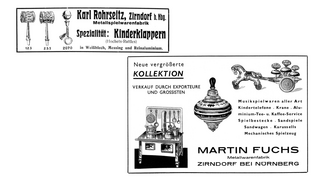
Tin-stamping factories in Zirndorf and Fürth
More sustainable was the success of the numerous manufacturers of tinplate toys: from the founding era in the 1870s until the decline of this toy category about 100 years later, the production of metal toys dominated in Fürth and Zirndorf. Dozens of tin-stamping factories (called “Blechbadscher” in dialect) produced a wide range of simple toys here: rattles, spinning tops, children’s trumpets, sabres, little bells, sand molds, children’s jewelry, toy cookware. Zirndorf specialties included tin and humming tops, music boxes and money boxes. The most important firms here were Zimmermann, Bolz, Rohrseitz, Seidel, Fuchs, Wünnerlein and Brandstätter.
Plastic replaced tinplate toys
Outstanding among the Fürth manufacturers of mechanical tinplate toys is the company Georg Adam Mangold (GAMA), founded in 1881. During the economic miracle era it rose with large-format limousines and steerable commercial vehicles to become one of the most important German toy producers. Company owner Hans Mangold played a key role in the founding of the Nuremberg Toy Fair in 1949/50. Other important manufacturers from Fürth were Götz & Sohn (summer toys, doll articles, vehicles), Neuhierl (racing cars, cars, Carrera track), Höfler (railway sets, cars) and Kleefeld (games). Only those firms that launched innovative and high-quality plastic articles survived the demise of the tinplate toy industry. Highly successful examples are the BIG Bobby-Car, the toy vehicles from the Burgfarrnbach-based company Bruder and, above all, the Playmobil figures from the Zirndorf Brandstätter Group.
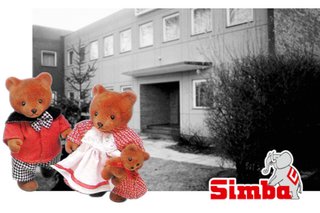
Success story of the Simba Dickie Group
Another success story in recent decades has been the Simba‑Dickie Group. This company goes back to the toy manufacturer Fritz Sieber from the Erzgebirge, who founded Simba Toys in Fürth in 1982 together with his son Michael. As one of the first German manufacturers, Simba had production outsourced to the Far East at low cost. Through numerous acquisitions (including Dickie, BIG, Schuco, Noris‑Spiele, Eichhorn, Jada) a broadly positioned corporate empire emerged, which today ranks among the five largest toy companies in Europe. In 2013 the company Sieber & Sohn GmbH & Co. KG, founded by Michael Sieber and his son Florian, bought the Göppingen traditional company Märklin with the formerly Nuremberg model railway brands Trix and LGB.
[Manuscript completed by the author Dr. Helmut Schwarz in December 2017]
Barbara Ohm: Fürth. Geschichte einer Stadt. Fürth 2007
Erhard Schraudolph: Vom Handwerkerort zur Industriemetropole. Industrialisierung in Fürth vor 1870. Ansbach 1993 ( = Diss. Bayreuth, 1992)
Karl Arnold: Fürther Spielwaren‐Produktion. Hammerer und Kühlwein, Josef Neuhierl, Robert
Rühl, GÖSO. In: Fürther Geschichtsblätter. Jg. 58, Heft 3 (2008), S. 71‐97
Ders.: Vom Blechspielzeug zum Bobby‐Car. Die Metallspielwarenfabrik Johann Höfler Fürth. In:Fürther Geschichtsblätter. Jg. 59, Heft 4 (2009), S. 103‐117
Walter Ley: Fürther Spielwarenhersteller im vergangenen Jahrhundert In: Fürther Geschichtsblätter.Jg. 59, Heft 4 (2009), S. 118‐133
Ulrich Schweizer: GAMA – die Spielzeuge von 1882 bis 1945. Mülheim 2010
Helmut Schwarz: Mut zum Handel(n). Moko – Geschichte des Exporthauses M. Kohnstam &Co. In: Pieter Kohnstam: Mut zum Leben. Eine Familie auf der Flucht in die Freiheit. Würzburg 2016 ( = Franconia Judaica. Bd. 10), S. 183‐262
Sabine Finweg/ Veronika Dorrer: Zirndorf und seine Blechspielzeug‐Industrie. Erfurt 2002
Irmtraud Eberhard: Die Spielwarenindustrie von Zirndorf. In: Mitteilungen der Fränkischen Geographischen Gesellschaft. Bd. 33/34 (1986/87), S. 383‐402
Martin Schramm (Hrsg.): Spielzeugträume. Die Geschichte der Firma Bruder in Fürth. Eine Ausstellung im Stadtmuseum Fürth Ludwig Erhard. Fürth 2012
Felicitas Bachmann: 30 Jahre Playmobil. Königswinter 2004
Citation suggestion
Schwarz, Helmut: Toy industry locations Fürth and Zirndorf, manuscript completed by the author in December 2017; posthumously published online June 24, 2026 in: Spirit of Play online magazine. Spielwarenmesse eG, Nuremberg. Online: https://www.spielwarenmesse.de/de/magazin/toyhistory/helmutschwarz-toy-region-nuremberg (accessed: DD Month YYYY).
About the author
Dr. Helmut Schwarz (5 September 1952 – 20 February 2022) was an economic historian and headed the Toy Museum Nuremberg from 1994 to 2014. Together with his team he modernised the museum, expanded the children’s play area, created the museum playground with café and the virtual depot. He also personally campaigned for the German Games Archive from Marburg to find a new home in Nuremberg. Numerous publications on the history of the toy industry came from his pen.
ToyHistory – The beginnings of the Spielwarenmesse
From 2016 Dr. Helmut Schwarz conducted research on corporate history on behalf of Spielwarenmesse eG. In particular, he worked out the prerequisites and factors that led to the founding of the specialist trade fair in Nuremberg. The manuscripts he completed are being published by the trade fair team in 2026 in the online magazine Spirit of Play in grateful remembrance of the much-valued and humorous researcher and preserver of knowledge.
Overview of the series
The series will consist of nine web summaries and seven research papers examining the origins of the Toy Fair.
ToyHistory 01: Nuremberg Toy Region | 24 June 2026 (see above)
- Web summary: Toy Region Nuremberg (November 2017)
- Web summary: Toy Industry Location Fürth and Zirndorf (December 2017)
- PDF Research paper: Toy City Nuremberg (January 2017) - Available in German only.
ToyHistory 02: Toy-making regions in Germany | 13 July 2026
- Web Summary: Toy-making region Thuringia (November 2017)
- Web Summary: Toys from the Saxonian Ore Mountains (November 2017)
Announcement for 27 July 2026: ToyHistory 03: Toy-making cities in Germany
Württemberg – Berlin and Brandenburg an der Havel
Delve even deeper into the history of the toy industry: the world-famous Spielzeugmuseum displays the world in miniature across 1,400 square metres, with a wealth of extraordinary exhibits from antiquity to the present. Alongside an imaginatively designed children's area on the top floor, the museum also offers a large outdoor playground and a museum café in the courtyard.
Location: Spielzeugmuseum Nürnberg, Karlstrasse 13–15, 90403 Nuremberg
Exhibition: Games-Geschichte(n), 20 February to 13 September 2026
Visit the Spielzeugmuseum Nürnberg website for more information.