

Toy-making regions in Germany
ToyHistory: Thuringia – Saxon Ore Mountains
Editor's Foreword
To mark the 75th anniversary of the Spielwarenmesse, we are expanding the Spirit of Play online magazine to include the “ToyHistory” section. To kick things off, we look back at the historical circumstances that made Nuremberg the home of the world’s leading toy trade fair. The research was conducted by Dr. Helmut Schwarz, an economic historian and former director of the Nuremberg Toy Museum.
Toy-making region: Thuringia
By Dr. Helmut Schwarz (1952–2022)
Toy manufacturing and trade in Nuremberg can look back on a tradition spanning more than 600 years. As early as 1400, the city’s tax records mention two “Tockenmacher” who made small clay figures and turned dolls. Other figurative toys made of alabaster, wax, and papier-mâché followed over time. In the 17th and 18th centuries, Nuremberg craftsmen were already producing elaborate dollhouses, mechanical metal toys, and other technical gadgets.
The early heyday of the Thuringian toy industry before 1914
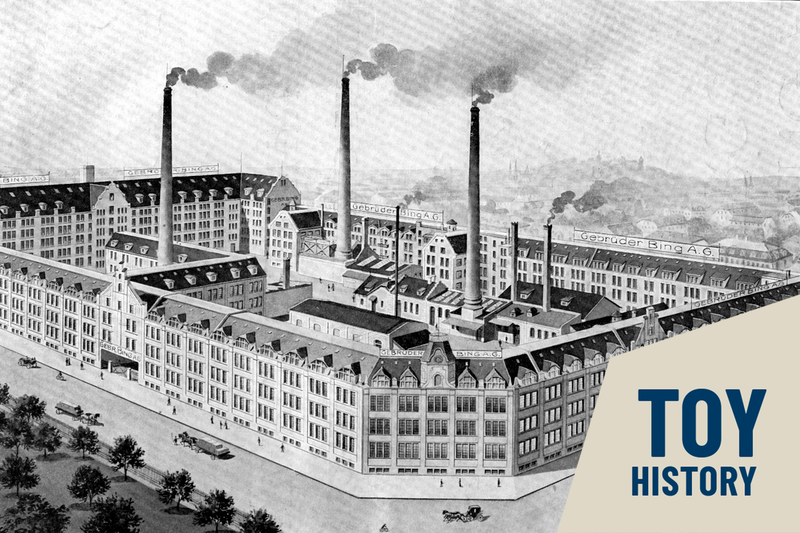
During the heyday of the Thuringian toy industry before World War I, approximately 30,000 to 35,000 people in the Sonneberg district made their living from toy manufacturing. About 20 percent of global toy production took place here. Numerous trading companies distributed the immense variety of Thuringian toys (some export firms carried up to 40,000 items!) all over the world. At that time, Sonneberg could rightly call itself the “World Toy City.” The enormous scale of toy production was due to the interplay between factory operations and cottage industries. But it was also due in no small part to the new materials papier-mâché and porcelain. These were used primarily for the mass production of figurative toys and doll heads starting around 1800 and 1850, respectively. Factories such as J. D. Kestner (Waltershausen), Simon & Halbig (Gräfenhain), Armand Marseille (Sonneberg), or the Heubach brothers (Lichte) supplied porcelain heads to workshops for doll production.
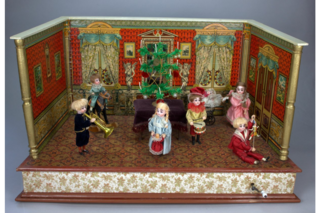
These workshops, in turn, often sourced eyes, hair, shoes, and clothing from highly specialized small businesses and home-based artisans. Geographically as well, toy manufacturing in Thuringia was characterized by specialization. Many product categories and subcategories were produced primarily in specific locations: For example, Schalkau supplied musical toys and display toys such as menageries and farms; Crock supplied hand puppets; Manebach supplied masks and carnival items; Eisfeld supplied horses and carriages; and Lauscha supplied glass toys. Steinach produced toy ships, wooden building sets, and pyramid and cube games. The Anker wooden building sets from the firm Friedrich Adolf Richter & Cie. in Rudolstadt achieved worldwide fame. After World War I, the Thuringian toy industry lost its former leading position. The Great Depression and the isolation from international markets during the Nazi era hit it hard. Under pressure from the socialist restructuring of the economy after the war, many manufacturers relocated to West Germany. By 1972, all toy companies had been nationalized and consolidated into large production units.
The second golden age of the Thuringian toy industry before 1990
Through extensive support measures, the government succeeded in making Sonneberg the center of the GDR’s heavily export-oriented toy industry. The focus was on dolls, plush toys, wooden and plastic toys, and model trains. Starting in 1981, this was the headquarters of the VEB Kombinat Sonneberg. It accounted for 90 percent of the GDR’s toy production and employed 27,000 workers across more than 900 facilities throughout the country.
This toy empire collapsed after reunification, but Thuringia’s great toy-making tradition lives on in numerous reprivatized or newly founded companies in the model train, plush toy, doll, and wooden toy industries.
[Author Dr. Helmut Schwarz completed the manuscript in November 2017.]
References
Reinhild Schneider: Kleine Welten. Die Sammlung des Deutschen Spielzeugmuseums. Sonneberg 2015
Maria und Dieter Leipold: Frühes Spielzeug aus Thüringen und dem Erzgebirge. München 2012
Reinhild Schneider (Hrsg.): Von Sonneberg in alle Welt. Armand Marseille und die Ära der Porzellankopfpuppen. Herausgegeben anlässlich der Ausstellung vom 14. Mai bis 29. August 2010. Sonneberg 2010
Renate und Otto Hahn: Sonneberger Spielzeug – Made in Judenbach. Münster 2010
Manfred Bachmann: Zur Geschichte des Holzspielzeugs in Deutschland. In: Karlheinz W. Kopanski (Hrsg.): Hampelmann & Matrjoschka. Holzspielzeug in Deutschland und Russland. Kassel 1998, S. 68‐97
Gerhard Kaufmann (Hrsg.): Thüringen – Spielzeug aus Sonneberg. Die Tradition der Herstellung von Spielzeug in Stadt und Land Sonneberg. Hamburg 1997
Jutta Arsenova/ Gudrun Volk: Zur Geschichte der Sonneberger Spielzeugindustrie. In: Wolfram Metzger (Hrsg.): Spielzeug und Handwerkskunst aus Thüringen und dem Erzgebirge. Bruchsal 1991, S. 235‐265
Jürgen und Marianne Cieslik: Cieslik's Lexikon der deutschen Puppenindustrie. Jülich 1989
Suggested Citation
Schwarz, Helmut: Toy-making region Thuringia, manuscript completed by the author in November 2017; published posthumously online on July 13, 2026, in: Spirit of Play Online Magazine. Spielwarenmesse Group, Nuremberg. Online: www.spielwarenmesse.de/de/magazin/toyhistory/helmutschwarz-toy-making-regions (Accessed: DD Month YYYY).
Toys from the Saxon Ore Mountains
The Saxon Ore Mountains are the region of origin for an extraordinary variety of wooden toys and Christmas folk art items. These include incense burners, angel lanterns, Christmas pyramids, nutcrackers, and much more. Both are closely linked to the decline of mining, which had been practiced here since the Middle Ages. As a new source of income, a widespread cottage industry of woodcarvers and woodturners emerged during the 18th century. These products were initially sold largely by merchants from Nuremberg and later by local distributors.
Trading towns of Grünhainichen, Olbernhau, and Seiffen
In the settlements surrounding the trading towns of Grünhainichen, Olbernhau, and Seiffen, a wide variety of simple wooden toys was produced under precarious conditions: animals, soldiers, rattle dolls, music boxes, jumping jacks, and rocking toys.
Starting around 1800, a new woodturning technique was introduced in Seiffen: the hoop or split-ring turning method. This significantly reduced the cost of mass-producing animals and figures for the popular dioramas depicting arks, farms, sheepfolds, hunts, markets, and villages.
Packaged in chipboard boxes or cardboard cartons, these mass-produced “boxed goods” were sold worldwide through large publishing and export firms. Originating in Dresden’s artistic circles and driven by the pressure of increasingly difficult export conditions, Seiffen miniature toys emerged around 1905 as a new, systematic category of toys.
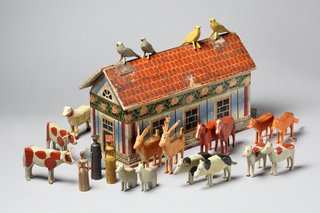
The idea of selling tiny toys in matchboxes was quite original. In the last third of the 19th century, the factory system began to replace cottage industry. In Olbernhau and the surrounding area, numerous workshops produced mainly children’s furniture, toy theaters, and toy vehicles. In nearby Rothenthal, skittles sets and dollhouse kitchen accessories were manufactured. Wooden building sets and Fröbel-style toys and educational materials were primarily manufactured in Oberseiffenbach (S. F. Fischer) and Blumenau (Reuter, Engel & Co.).
In Grünhainichen and the surrounding area, the production of horse stables, toy stores, and dollhouses took on particular significance. Eppendorf was known for doll furniture, and Borstendorf for chess and board games. The high-quality large-scale toys produced by Moritz Gottschalk in Marienberg achieved a prominent position. In Zöblitz and Olbernhau, some factories even manufactured tin toys such as children’s toy stoves and dollhouse kitchen accessories.
On the eve of World War I, some 50 towns were part of the Erzgebirge toy-making region. More than 1,100 companies produced toys here with a total annual value of about 10 million Reichsmarks. In Thuringia, the total value amounted to 45 million RM, and in Nuremberg-Fürth to 25 million RM.
The impact of the World Wars on the Toy-making region
World War I, inflation, and the Great Depression hit the Erzgebirge toy-making region hard and exacerbated the difficult situation faced by cottage industry operators. Government support measures and efforts to improve product quality through better training for toy makers achieved only modest success by the time World War II began.
In the German Democratic Republic (GDR), toy manufacturing was nationalized and placed on a new footing through the establishment of production cooperatives. Products from the Ore Mountains played an important role in East Germany’s exports. After reunification, state-owned enterprises were reprivatized, and new companies were established in both production and trade. Shaped by strong family traditions, small, mostly artisanal businesses continue to this day to produce both traditional and modern forms of Erzgebirge toys and Christmas folk art.
[The author, Dr. Helmut Schwarz, completed the manuscript in November 2017.]
Miniatures from the Ore Mountains for children’s rooms by Urs Latus
The start of the industrial age also confronted the production of miniature toys from Saxony with a pivotal decision: artisanal craftsmanship or mass production? Urs Latus provides a well-founded overview of how handcrafted miniature toys from Saxony first conquered children's rooms and then the global market. Based on his dissertation, he demonstrates how early system toys captivated both children and adults alike. He also presents the marketing strategies targeting collectors and tourists, as well as the economic and social backgrounds of the manufacturing families in the Ore Mountains.
Urs Latus: Erzgebirgische Miniaturen fürs Kinderzimmer. Eine Erfindung aus Dresden. Published by the Saxon State Office for Museums. Dresden 2018. Available in German only.
To the book
References
Urs Latus: Erzgebirgische Miniaturen fürs Kinderzimmer. Eine Erfindung aus Dresden. Herausgegeben von der Sächsischen Landesstelle für Museumswesen. Dresden 2018.
Cordula Bischoff/ Igor Jenzen: 100 Jahre Wendt & Kühn. Dresdner Moderne aus dem Erzgebirge. Katalogbuch zur gleichnamigen Ausstellung im Museum für Sächsische Volkskunst Dresden. 20. Juni 2015 bis 10. Januar 2016. Chemnitz 2016
Ulrike Knoll: Vom Kindertraum zum Sammlerobjekt. Puppenstuben, Puppenhäuser & weitere Erzeugnisse der Spielwarenfabrik Moritz Gottschalk Marienberg aus der Sammlung Knoll. Dresden 2016
Ursula Michalke: Miniaturen aus dem Erzgebirge. Emil Helbigs Flachschnitzerei und ihre Tradition. Husum 2013
Maria und Dieter Leipold: Frühes Spielzeug aus Thüringen und dem Erzgebirge. München 2012
Konrad Auerbach: Das historische erzgebirgische Spielzeugland. Ein Wegbegleiter durch die Geschichte der Spielwarenherstellung im sächsisch‐böhmischen Erzgebirge. Seiffen 2010
Thomas Fiedler/ Walter Neumann: Seiffener Volkskunst in der Zündholzschachtel. Eine Seiffener Besonderheit. Seiffen 1998 ( = Schriftenreihe des Erzgebirgischen Spielzeugmuseums. Heft 10)
Marion Faber: Erzgebirge. In: Karlheinz W. Kopanski (Hrsg.): Hampelmann & Matrjoschka. Holzspielzeug in Deutschland und Russland. Kassel 1998, S. 216‐217
Manfred Bachmann: Zur Geschichte der Seiffener Volkskunst. In: Wolfram Metzger (Hrsg.): Spielzeug und Handwerkskunst aus Thüringen und dem Erzgebirge. Bruchsal 1991, S. 33‐49
Manfred Bachmann: Spielzeug aus dem Erzgebirge. In: Volker Kutschera (Hrsg.): Spielzeug, Spiel und Spielereien. Katalog zur Ausstellung in der Schallaburg vom 25. April‐2. November 1987. Wien 1987, S. 101‐114 ( = Katalog des Niederösterreichischen Landesmuseums. Neue Folge 185)
Karl Ewald Fritzsch: Zur Geschichte des erzgebirgischen Spielzeugs. Sonderdruck aus der Zeitschrift „Sächsische Heimatblätter“. Dresden 1967.
Suggested Citation
Schwarz, Helmut: Toys from the Saxon Ore Mountains, manuscript completed by the author in November 2017; published posthumously online on July 13, 2026, in: Spirit of Play Online Magazine. Spielwarenmesse Group, Nuremberg. Online: www.spielwarenmesse.de/de/magazin/toyhistory/helmutschwarz-toy-making-regions/ (Accessed: DD Month YYYY).
About the author
Dr. Helmut Schwarz (September 5, 1952 – February 20, 2022) was an economic historian and served as director of the Nuremberg Toy Museum from 1994 to 2014. Together with his team, he modernized the museum, expanded the children’s play area, and created the museum playground with a café and the virtual storage facility. He also personally championed the effort to bring the German Toy Archive from Marburg to a new home in Nuremberg. He authored numerous works on the history of the toy industry.
Toy History – The Beginnings of the Toy Fair
Starting in 2016, Dr. Helmut Schwarz conducted research on the company’s history on behalf of Spielwarenmesse eG. In particular, he identified the conditions and factors that led to the founding of the trade fair in Nuremberg. The trade fair team will publish the manuscripts he completed in 2026 in the online magazine *Spirit of Play* to mark the 75th anniversary of the Spielwarenmesse, thereby honoring a significant custodian of knowledge regarding German toy and economic history.
Overview of the series
The series will consist of nine short online articles and seven research papers exploring the origins of the Toy Fair Nuremberg.
ToyHistory 01: Toy Region Nuremberg | 24 June 2026
- Web Summary: Spielzeugregion Nürnberg (November 2017)
- Web Summary: Spielwarenstandort Fürth und Zirndorf (s.u.) (Dezember 2017)
- PDF Technical Article: Spielzeugstadt Nürnberg (Januar 2017)
Toy History 02: Toy-making regions in Germany | 13 July 2026 (see above)
- Web Summary: Toy-making region Thuringia (November 2017)
- Web Summary: Toys from the Saxon Ore Mountains (s.u.) (November 2017)
Announcement for July 27, 2026: Toy History 03: Toy-making cities in Germany
Württemberg – Berlin and Brandenburg at the Havel river
Delve even deeper into the history of the toy industry: the world-famous Spielzeugmuseum displays the world in miniature across 1,400 square metres, with a wealth of extraordinary exhibits from antiquity to the present. Alongside an imaginatively designed children's area on the top floor, the museum also offers a large outdoor playground and a museum café in the courtyard.
Location: Spielzeugmuseum Nürnberg, Karlstrasse 13–15, 90403 Nuremberg
Exhibition: Games-Geschichte(n), 20 February to 13 September 2026
Visit the Spielzeugmuseum Nürnberg website for more information.