

Spielwarenmesse - A Success Story
Whoever visited the Spielwarenmesse in Nuremberg at the beginning of the year discovered more than just new products: an exhibition traced the development of the industry from its beginnings to the present day. It made clear how a post-war vision evolved into a globally influential platform.
In the late 1940s, at a time when Germany was rebuilding both economically and socially, four leading figures of the toy industry laid the foundation for what would become a global success story. In 1949, Carl Ehmann, representing Märklin, Ernst Theodor Horn, Chief Executive Officer of the German Toy Industry Association, Arno Drottboom, Director of VEDES, and Hans Mangold, representing GAMA shared an ambitious goal: to create a central trade fair for the toy industry in Nürnberg.


Just one year later, in March 1950, the first “Deutsche Spielwaren-Fachmesse“ (The German Toy Fair) opened with 351 exhibitors and more than 4,300 visitors. The fair was officially opened by Ludwig Erhard, Federal Minister of Economic Affairs, underlining its economic significance from the very beginning. Following this successful premiere, the Fair Committee and 46 companies founded a cooperative, Spielwarenmesse eG, led by Ernst Theodor Horn and Fritz Drescher as Managing Board Members.
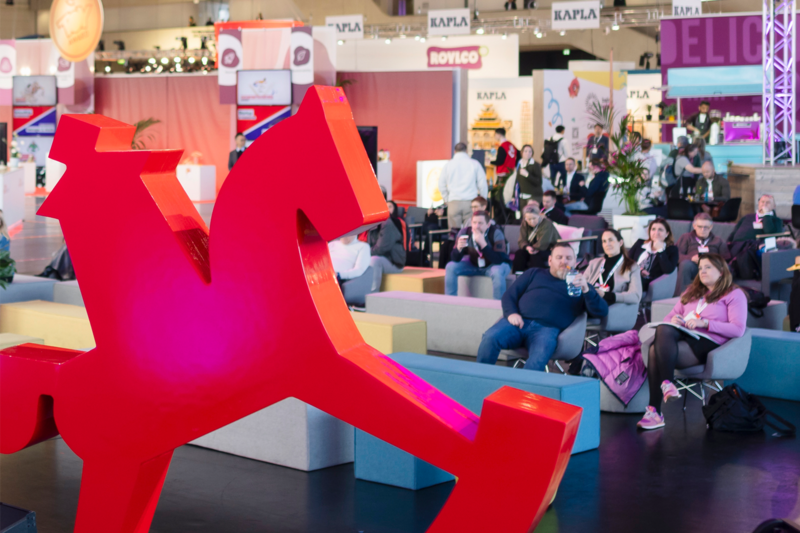
The years that followed were defined by strong growth and increasing international reach. In 1951, the rocking horse replaced the Nürnberg city tower as the fair’s symbol. Under the long-standing leadership of Fritz Drescher, who became sole Managing Director in 1956, visitor numbers rose steadily, surpassing 10,000 for the first time in 1957. A decisive step came in 1958, when the event was renamed „Internationale Spielwarenmesse Nürnberg“ (International Toy Fair Nürnberg) and opened its doors to exhibitors from around the world. This internationalisation gained further momentum in 1973, when the fair moved to the newly constructed exhibition center in Nürnberg-Langwasser, enabling a clear product group structure for the first time. From 1974 onwards, Dr Benno Korbmacher, Chief Executive Officer of the German Toy Industry Association, strengthened the fair’s global standing as Managing Director, negotiating continuous expansion of the exhibition grounds.


By the late 1970s and 1980s, the International Toy Fair had firmly established itself as the world’s leading industry platform. Visitor numbers exceeded 30,000, and the number of exhibitors continued to grow, supported by new halls such as the Frankenhalle, opened in 1984. The international character became unmistakable in the 1990s, when more than 2,000 exhibitors, nearly half of them from abroad, presented their products. During this period, Gerd Bise took over as Chair of the Executive Board in 1996, overseeing a modernisation of branding and global marketing. In 2001, the fair was opened by Gerhard Schröder, Federal Chancellor of Germany, followed in 2003 by Johannes Rau, President of Germany. In 2004, new flagship formats such as the InnovationCenter, the ToyAward and the Industry Forum were introduced, reinforcing the fair’s role as a driver of innovation and knowledge exchange.


The years that followed brought further development in leadership and structure. Dr Hans-Jürgen Richter assumed executive responsibility before Ernst Kick was appointed Chair of the Executive Board in 2003, guiding the fair through further expansion and its 60th anniversary in 2009, opened by Dr Angela Merkel, Federal Chancellor of Germany. Even the unprecedented challenges of the coronavirus pandemic could not halt its forward momentum: when physical events were impossible in 2021 and 2022, digital formats ensured global connectivity. In 2021 a new leadership trio, Christian Ulrich, Florian Hess and Jens Pflüger steered the fair into a new era.
In 2025, Spielwarenmesse eG celebrated its 75th company anniversary with a new hall concept and the debut of Hall 3C. And in 2026, the Spielwarenmesse takes place in Nürnberg for the 75th time — a powerful testament to vision, leadership and the enduring global spirit of play.