

75th Anniversary – Part 3: Founding Exhibitors
Our gratitude goes out to Tipp-Kick, Teddy-Hermann and rolly toys
By Sibylle Dorndorf
When toys captivate both heart and mind, they usually bear an unmistakable signature. Their appeal lies in a blend of timeless design, cultural significance, nostalgia, and the promise of quality and functionality that transcends fleeting trends. These products do not merely follow the spirit of the times—they shape it. We are talking about classics that stand out through their functionality and unique narrative. These iconic products are at home both in the luxury segment and in the toy industry.
What fascinates us about classics is their timeless originality …
Our third journey back to the founding years of Spielwarenmesse begins on a green felt pitch with a ball that isn’t round. Tipp-Kick has boasted a loyal fan base and addictive potential for more than a century. The story continues in the teddy universe, enchanting collectors, enthusiasts, and young and old alike. Teddy-Hermann has been crafting happiness—an ursine charm offensive—for over a hundred years. And it ends in the realm of trucks, tractors and ride-on vehicles. At rolly toys, robust four-wheelers with a name and reputation take centre stage. It’s an Eldorado for farmers, truckers and firefighters.
Tipp-Kick – The Square Must Go Into the Round
Where We Come From
Two teams, two goals, one ball: football is a passion. Whether on a green pitch or a felt mat. That was the thought of Karl Mayer from Stuttgart in 1924, who filed a patent for a football board game with standing figures whose feet can execute kicking movements. Export merchant Edwin Mieg bought the idea but would never see Tipp-Kick’s success for himself. In 1948, his sons Peter and Hansjörg took over the company, ensuring the game was always on the shelves at just the right moments. The breakthrough came in 1954 with the legendary World Cup miracle of Bern: 180,000 Tipp-Kick games were sold. The Bundesliga kicked off in the sixties, and in 1974 the German national team won its second world title on home soil. Tipp-Kick was already writing German football history.
Who We Are
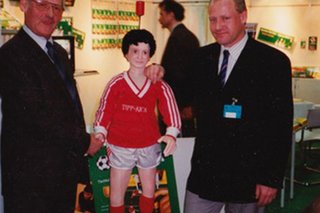
They may not have coined the term ‘kicking’, but the Mieg family has brought it to life for three generations. Since the 1990s, Germany’s smallest toy factory has been run by cousins Mathias and Jochen Mieg. Tipp-Kick continues to adapt to major football events with customised editions. In parallel, promotional editions for companies, from small batches to large orders, keep the brand in the public eye. The client list includes illustrious names such as Nutella, Puma, ARD Sports Studio, Die Toten Hosen and numerous well-known football clubs.
For the Women’s World Cup in 2011, the Miegs launched female Tipp-Kick figures for the first time—a clever and forward-looking move, as women’s football continues to grow in popularity and commercial appeal, driven by the societal relevance of equality and empowerment.
Mathias Mieg … in his own words
Mathias Mieg, what do we know about Tipp-Kick’s first appearance at the fair?
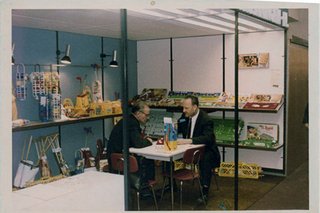
Unfortunately, there are no eyewitnesses left. We’re already producing Tipp-Kick in the fourth generation. I first attended Spielwarenmesse in the 1970s. As children, the fair was always like a second Christmas for us. Our fathers returned from Nuremberg laden with books and games they’d swapped with other exhibitors. Back then, many orders were written at the fair itself, and when Spielwarenmesse was over, you had a good sense of whether it would be a good or less good year.
The toy industry is a big family, and Spielwarenmesse is like a family reunion. What do you look forward to each year?
For as long as I can remember, we’ve met fellow manufacturers in Nuremberg, though sadly fewer retailers these days. The retail landscape has changed a lot in recent years, making it all the more important for us to forge new contacts at Spielwarenmesse every year.
Is any product that Tipp-Kick presented at the first Spielwarenmesse still available?
What can I say: Tipp-Kick turned 100 in 2024—it’s our perennial favourite!
What do you wish for Tipp-Kick and Spielwarenmesse?
Tipp-Kick is over 100 years old, Spielwarenmesse is celebrating its 75th edition. I wish for both of us to always stay on the ball.
Teddy-Hermann: Welcome to the Cuddle Universe
Where We Come From
Teddies and more: Since 1912, Teddy-Hermann has been putting smiles on the faces of children and adults alike with lovingly designed, high-quality plush animals. The family business was founded by Bernhard Hermann in Sonneberg, Thuringia, then Europe’s toy capital. After World War II, Teddy-Hermann relocated to Hirschaid near Bamberg, where premium plush animals continue to be made with care—now in the fourth generation.
Who We Are
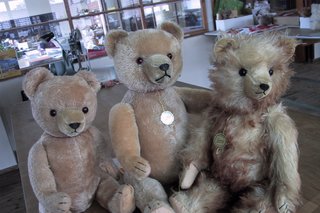
The Teddy-Hermann collection impresses not only with outstanding quality and naturalistic design, but also with its unmistakable character. In the early days, jointed teddy bears and mohair animals were the focus, but over the years, an impressive variety has emerged: from classic teddies to lifelike dogs and cats, right up to trendy newcomers such as capybaras. Collectors are enchanted by the Hermann Teddy Original bears, crafted 100% in Germany at the Hirschaid manufactory. The Teddy-Hermann range has grown, but what defines the products has remained: high quality, design in tune with the times, and close ties to specialist retailers. These have been the company’s success factors for over 110 years.
Dorothee Weinhold … in her own words
Dorothee Weinhold, what do we know about Teddy-Hermann’s first appearance at the fair?
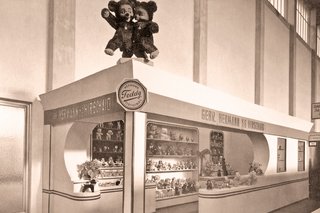
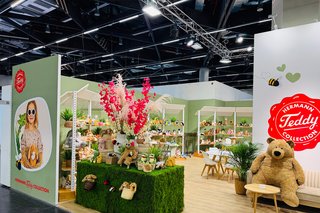
Our great-grandfather Bernhard Hermann was already present at the Leipzig Trade Fair in 1948. When the first Spielwarenmesse took place in Nuremberg, it was only natural for him to participate. In the 1950s, our teddy bears were especially sought after, as were poodles, lambs and penguins. We actually still have photos from those early days. The stands were always modern and welcoming—hospitality has always been part of Teddy-Hermann.
Direct eyewitnesses no longer live today, but many stories have been passed down: about the special spirit of optimism after the war, about cheerful evenings with buyers, about the popular poodles, and about how proud the family was to be part of the first Spielwarenmesse in Nuremberg.
The toy industry is a big family, and Spielwarenmesse is like a family reunion. What do you look forward to each year?
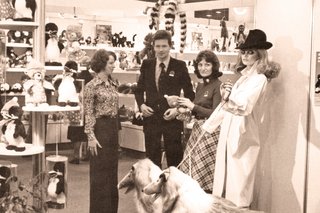
I look forward to the encounters every year. For me, Spielwarenmesse is like a big family gathering for the industry. Many of our customers have been with us for decades, some even across generations. My ritual? On the first morning, I take a walk through the halls, feel the special energy of the fair, and look forward to five intense days of inspiration and exchange.
Is any product that Teddy-Hermann presented at the first Spielwarenmesse still available?
Our first products were classic teddy bears, and we still offer them today. Of course, their design has evolved, but the typical Hermann bear remains part of our range. Even though the teddy bear itself has become more modern, the spirit of creating a lifelong friend endures. It’s precisely this blend of tradition and zeitgeist that defines us to this day.
What do you wish for Teddy-Hermann and Spielwarenmesse?
The fair is not just a place for business, but also a place for exchange, inspiration and friendship. For our family business, Spielwarenmesse has always been of central importance: it is a stage, a meeting point, and a showcase to the world. Of the roughly 350 exhibitors who attended the first Spielwarenmesse, fewer than 20 are still present today—and Teddy-Hermann is one of them. This continuity makes us very proud and shows how closely tradition, quality and innovative spirit are linked. We remain successful because, as a family business, we work with great passion, always keep our customers’ needs in mind, and consistently focus on quality, design and comprehensive service for our retail partners. And, of course, because we have exhibited at Spielwarenmesse for 75 consecutive years. Being honoured as a founding exhibitor fills us with gratitude and pride—and also with a touch of childlike wonder, just as I felt back then when I was so eager to be part of it. Thank you, Spielwarenmesse!
Unforgettable and Amusing Moments
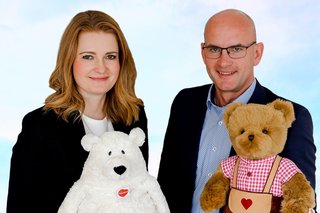
Dorothee Weinhold, Teddy-Hermann: I have been fascinated by Spielwarenmesse since childhood. It was always a promising, almost magical place I longed to visit. As a little girl, I watched in awe as my mother Margit Drolshagen—then managing director of Teddy-Hermann—travelled to the fair in Nuremberg year after year. I desperately wanted to go along to see all the teddy bears, dolls and toys for myself. My curiosity was so great that I tried to sneak in hidden inside a box—or at least, that was the plan. Of course, my attempt didn’t go unnoticed, and I ended up spending the whole day in the children’s area at the fair. But even that couldn’t dampen my love for Spielwarenmesse. Today, many years later, I have the privilege of attending as managing director of Teddy-Hermann, together with my cousin Bernd Mischner—the excitement remains unchanged.
rolly toys: Tradition on Four Wheels
Where We Come From
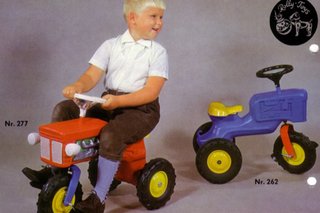
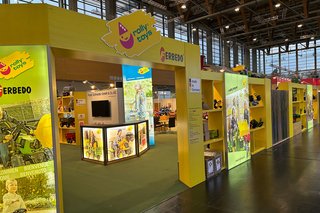
Franz Schneider GmbH & Co. KG, known by the brand name rolly toys, has been based in Neustadt bei Coburg in Upper Franconia since 1938, now firmly rooted in its third generation of ownership. The rolly toys brand is a fixture in the toy world. Founded in 1938 by Franz and Rosa Schneider, the company began by manufacturing toys for the doll industry. In the 1950s, production expanded to include roly-poly figures, which soon became the company’s trademark. In the 1960s, the Schneiders added children’s vehicles to their range, and later cars were included. The focus eventually shifted to agricultural toys. The launch of the first ride-on Unimog at Spielwarenmesse in the 1990s marked a major milestone in the company’s history. Today, rolly toys is the globally recognised brand for robust pedal tractors and children’s vehicles.
Who We Are
Managing Partner Frank R. Schneider, who leads Franz Schneider GmbH & Co. KG in the third generation, is loyal to the company’s roots—a champion of development and production ‘Made in Germany’ in his hometown of Neustadt. The popularity of these vehicles with authentic functional accessories extends far beyond national borders. Children around the world drive and play with rolly toys. Thanks to their variety, quality and functionality, these pedal vehicles are in use on all five continents.
Frank R. Schneider is rightly proud that all leading agricultural machinery manufacturers—from John Deere, Deutz and Claas to Fendt and Caterpillar—trust in the Neustadt company as a licensee. rolly toys not only has what it takes to play, but also the licences to do so.
Frank R. Schneider … in his own words
Frank R. Schneider, what do we know about rolly toys’ first appearance at the fair?
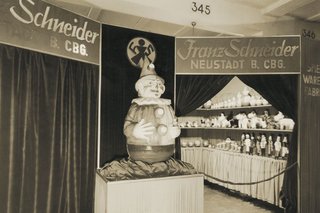
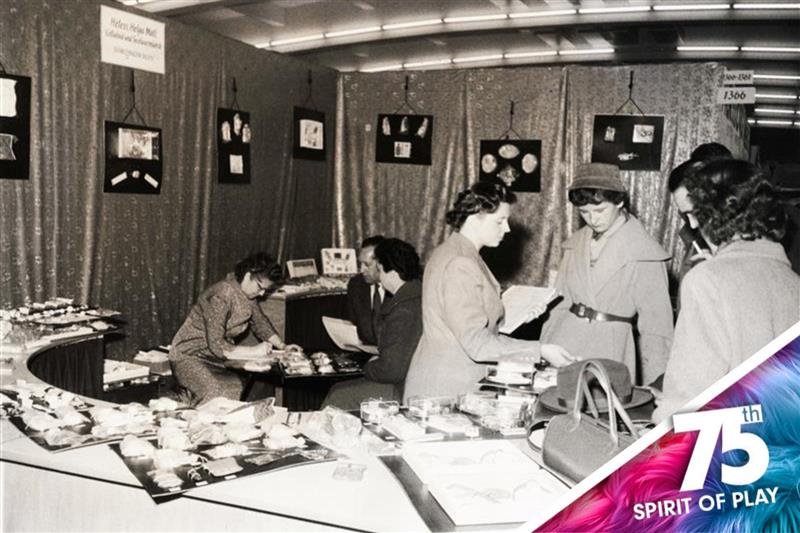
Back then, it was a rather small stand in the Wieseler Haus. Sadly, there are no photos, but the images of our 1953 stand give a good impression. My father Gernot Schneider was already present at the first Spielwarenmesse, at a time when the current strict rule of entry from age 16 was interpreted a little more generously.
The toy industry is a big family, and Spielwarenmesse is like a family reunion. What do you look forward to each year?
The old Spielwarenmesse slogan used to be: In Nuremberg, everyone is there, in Nuremberg, you meet everyone. It describes what makes Spielwarenmesse special—then and now. And that’s exactly what we look forward to: meeting customers, exhibitors and everyone involved in the industry in Nuremberg. In the toy world, the best comes not at the end, but at the beginning of the year—and that’s Spielwarenmesse in Nuremberg. Which other industry can say the same?
Is any product that rolly toys presented at the first Spielwarenmesse still available?
Yes, though not in the same material as in 1950. Back then, embossed cardboard was used—plastic was introduced from 1954 onwards. Our roly-poly figure, which has been the symbol of our rolly toys brand since then, remains a traditional part of our range even decades later.
What do you wish for rolly toys and Spielwarenmesse?
Spielwarenmesse is an absolute must for us—it is and remains the central meeting point for the industry. I have attended every year for over 40 years and have served as a member of the Supervisory Board since 2014. At Spielwarenmesse, you meet everyone. This is where the business of tomorrow is made, and we are glad and grateful to be part of this success story—yesterday, today and tomorrow.
Unforgettable and Amusing Moments
Frank R. Schneider, rolly toys: My father smuggled me into the fair for the first time in 1984, when I was 14, after years of persistent pleading. That was when I truly caught the Spielwarenmesse bug! I’ve attended every year since, following in my father’s tradition, who this year celebrates his 75th year of participation together with Spielwarenmesse.
Meet further founding exhibitors
75th Anniversary – Part 1: Founding Exhibitors
Our gratitude goes out to Heless, Glocken-Huck and Loquai Holzkunst
75th Anniversary – Part 2: Founding Exhibitors
Our gratitude goes out to Ravensburger, Märklin und Haba
75th Anniversary - Part 4: Founding Exhibitors
Our gratitude goes out to Emwe Rathgeber GmbH and Peter Bausch GmbH & Co. KG
75th anniversary
Celebrate the big anniversary of the Spielwarenmesse with the global toy industry and all exhibitors in Nuremberg from January 27 to 31, 2026!
To the anniversary website
About the Author
Sibylle Dorndorf has been writing about the toy industry for almost 30 years, most recently as editor-in-chief of the TOYS magazine family at Göller Verlag, Baden-Baden. Her passion: companies that reinvent themselves, brands that position themselves credibly, people who have something to say and products with a future.