

Start-ups part 6: Are they top dogs or rebels on the shelves?
Start-ups offer retailers innovative products and fresh ideas
By Sibylle Dorndorf
The brand landscape is becoming increasingly diverse – retailers are more challenged than ever to act as curators when it comes to product selection. Those who meet buyers’ desire for inspiration on the shelves attract attention and win new customers. Young brands, in particular, are in demand. They occupy niches that established brands cannot credibly serve.
Love brand instead of boredom
Placing love brands is a mega trend, as confirmed by retail experts. A product range strategy that gives young brands a perspective in the form of listings offers potential and opportunities for differentiation. Especially through newcomer brands, which, by the way, include not only brands from startups but also those launched by influencers, retailers can set valuable impulses. Despite these insights, the retail sector still largely focuses on the placement of well-known top dog brands.
The chicken and the egg
Anyone who wants to curate an innovative product range must bring a breath of fresh air to the shelves—and accept that startups are not disruptive factors, but rather the ticket to a future-oriented assortment. In reality, however, things look different: For a startup, securing a spot on the shelf is reminiscent of the classic chicken-and-egg dilemma—the problem of cause and effect. It’s not impossible, as numerous success stories show. For ambitious founders, the key is to understand how retail works. Those who want the future must make it feasible. Only in this way can startups catapult themselves onto the shelves.
The ABCs of Getting Listed
Retail thrives on sell-through. A product needs to move—and as quickly as possible. In industry jargon, this is called space productivity. Placement and visibility in retail are only granted to those who can meet this criterion. Anyone who generates less revenue over time than a comparable, already listed product loses out. Margins, turnover rates, placements—a retailer doesn’t think in visions, but in: Orderable. Deliverable. Affordable. And above all: Will the customer buy it?
Startups are like the icing on the cake
With innovative, surprising products as a decorative addition to a solid core assortment, a retailer can achieve a unique selling proposition. To access these “icing on the cake” products, retailers must think entrepreneurially and stop measuring startups by corporate standards. That is fundamentally the wrong approach. Startups are not supplicants. They are strategic partners. Provided they are given the opportunity.
Looking beyond the horizon

Nomoo founder Rebecca Göckel was given this opportunity—but it was by no means handed to her. She started out with a small ice cream machine at Cologne’s Barbarossaplatz. Today, she supplies supermarkets. In the early years, she personally visited around 3,000 of them, tirelessly pounding the pavement to present her plant-based organic ice cream and her production process—constantly working to win people over. Today, as co-founder and managing director of Nomoo, she is also responsible for sales and PR at the young company. She still enjoys being out on the shop floor.
Grocery retail as an innovation showcase
In the grocery retail sector, a shift in thinking regarding startups seems to have taken place. Whether this is a result of price negotiations with branded goods manufacturers or stems from genuine conviction is debatable.
Retail giant Rewe set initial signals with ReweLution. Currently, the company is rebranding and rolling out the Startup Lounge nationwide: “Variety in the product range is a clear differentiator for Rewe. And that includes innovative products. Young companies react lightning-fast to nutrition trends or even create them. However, they naturally still lack important contacts, industry knowledge, and the professionalism required for marketing,” says Daniel Kniel, Managing Director of Full Assortment Merchandise at Rewe Group Buying.
Selda Morina, Head of Start-up Lounge National / Innovation Management, is the central contact for interested startups across Germany. She coordinates the selection and listing process together with the already established regional contacts at Rewe branches. Together, they form the Startup Lounge team and decide which products will be tested. The new products are expected to be available in a large number of Rewe stores starting in November.
Trendsetters in retail with startups
Edeka has also been experimenting with formats to support startups for quite some time. The original initiative, FoodStarter, was renamed Edeka StartHub in 2024, seven years after its launch. The Austrian Spar Group is considered a pioneer in this field; since 2018, it has been actively promoting innovative startups through its Young & Urban program. The program aims to enrich the product range of its own supermarkets—Spar, Eurospar, and Interspar—with the latest trends. Thanks to Young & Urban, the Austrian market leader had products on the shelves early on that have since become established in German grocery retail as well—such as Neoh’s sugar-free chocolate bars—or have become standard items in Austria, like Neni’s oriental specialties.
Looking for startup sparring partners
Rebecca Göckel also managed to get Nomoo onto store shelves. But at first, she too encountered closed doors in retail. “Come back when you’re well-known,” she was told. The problem is: once newcomer brands are well-known and established, they don’t come back. By then, they’re with a competitor who took them seriously—or they’ve built their own distribution channels. In times of e-commerce and social media, this is challenging but possible. And with the innovative brand, the young target groups who are looking for such products follow as well.
Rethinking vegan ice cream

Rebecca Göckel’s commitment has paid off. Central buyers such as Alnatura and Metro have begun collaborating with Nomoo OHG. Today, the cult ice cream brand is available in more than 1,500 supermarkets. The young entrepreneurs, with a team of 25, offer more than nine different ice cream varieties, have launched the best vegan vanilla ice cream, and are expanding into Austria and Switzerland. Rebecca Göckel also wants to encourage other founders to pursue their path into retail with determination: “Our experiences with retail listings are very mixed—from inspiring to sobering. Some buyers meet us at eye level, provide valuable feedback, share data, and actively support us with marketing activities. These partnerships are extremely valuable and motivating. Others, however, treat young brands like established large corporations and demand listing fees that are hardly affordable for startups. In day-to-day business, there’s not always enough room to truly unlock the potential of an innovative and strategic assortment partner together with startups. Margin pressure often dominates cooperation. To succeed here, you need a thick skin—and a clear vision. But with a lot of perseverance, good arguments, and continuous product development, (almost) every customer can eventually be won over.”
Ice cream without milk? That can’t possibly taste good. But Jan Grabow and Rebecca Göckel thought otherwise in the summer of 2016. That’s how the idea for Nomoo was born. Before the ice cream industry even took notice, the founders were already practicing their craft as ice cream makers in a rented kitchen in the heart of Cologne after every lecture. They wanted to prove that sustainable and vegan products can be delicious. They spent countless nights and tasted countless spoonfuls until the flavor and texture surpassed everything previously available in supermarkets. The proof was there: vegan ice cream can be delicious. In 2018, Nomoo OHG was founded.
Retail as a growth accelerator

Retail—across all industries—needs alternative concepts. Startups have the potential to shape assortments sustainably. For young companies, initiatives like those from Rewe, Edeka, and Spar provide access to a broad distribution network and presence on the shelves of major retail chains—which can be a decisive growth accelerator. Feedback from thousands of customers helps to optimize products more quickly, and the planning security provided by larger purchase volumes enables investment in production and marketing.
Startups in the toy industry
In the toy industry, initiatives like those mentioned above are (still) not in sight. That’s a pity—and hard to understand. Success stories like that of tonies SE (as described in Startups Part 5 in Spirit of Play) demonstrate just how important and lasting the market impulses generated by the innovative power of founders can be.
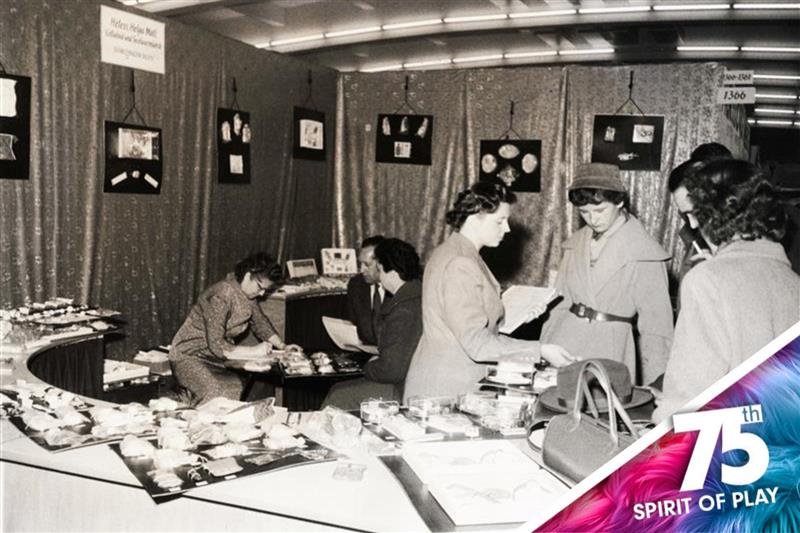
Since 2020, Spielwarenmesse has been a pioneer with the StartupArea in Hall 3A. This highly frequented and much-noticed Special offers founders the opportunity to present themselves alongside other startups and tap into new sales markets.
A complete package tailored to young companies facilitates up to three trade fair participations and enables newcomers to enter an international business environment.
With the Young Innovators trade fair program, the Federal Ministry for Economic Affairs and Energy (BMWi) enables young, innovative companies based in Germany and less than ten years old to participate in leading international trade fairs in Germany under favorable conditions. A percentage of eligible expenses for rental and stand construction at joint booths is subsidized. The eligible leading trade fairs are determined annually by the BMWi. The list of eligible events includes trade fairs in Germany with a high level of internationality among exhibitors and visitors—such as Spielwarenmesse—as well as fairs with an innovative character.
The list of eligible events and detailed information about the funding conditions can be found on the website of the BAFA.
Startup Articles Overview
Startups Part 1: In the beginning was the idea
About innovative strength, success and the risk of failure
Startups Part 2: Founding in the toy industry
Smartek – From company foundation to universal genius
Startups Part 3: Welcome Zebras and Unicorns
Zoological diversity and the potential of start-ups in times of multiple crises
Startups Part 4: The vision of a better world
Agnawool – Social responsibility over profit maximisation
Startups Part 5: Even global players start small
The success story of tonies and what founders can learn from it
Start-ups Part 7: The pulse of the future
How start-ups are driving change in the toy industry
The StartupArea at the Spielwarenmesse enables young companies to network with new business contacts. Start-ups can use this special area in Hall 3A to present their product ideas to the toy industry.
StartupArea package for international companies
Prerequisite: Founded no more than five years ago.
Offer includes 6 m² of booth space with equipment.
Young Innovators funding programme for German companies
Support from the Ministry of Economic Affairs.
Offer includes up to 15 m² of stand space.
About the author
Sibylle Dorndorf has been covering the toy industry for almost 30 years. The journalist last worked as the editor-in-chief at the TOYS family of magazines of the Göller Verlag publishing house from Baden-Baden, Germany. Her passion: Companies that reinvent themselves; brands that credibly position themselves; people who have something to say; and products with a future.