

The Power of Play
Premiere of the Value of Play conference in Nuremberg
Commentary by Daniele Caroli
The Value of Play conference, held during the 75th Spielwarenmesse, went into various aspects of the toys and games world thoroughly. From the educational contents to the employment of gamification, from the kidults trend to the importance of play in times of war, the speakers successfully involved the audience in their perspectives
Notwithstanding the early hour of 8 a.m. on 28 February 2026, the attendance in the Nuremberg exhibition centre’s Hall 3A was high: made up of exhibitors, visitors and representatives of the media, a very attentive audience. And expectations were met, since all the speakers resulted able to involve us in their perspectives on the mysterious world of play. Why mysterious? Because play is a vital part of both humans’ and animals’ life experience and still its origins and motivations are not clear.
More than mere entertainment

It is proper for a leading international trade fair such as the Spielwarenmesse to go beyond the horizon of the business to investigate what toys and games do actually mean for their users, be they children or adults. After being considered as mere entertainment that might even distract kids from more meaningful activities, in the last century play started being valued for its positive effects on growth, education, social behaviour, even health (both physical and mental).
There is an aspect that every year pleasantly surprises me at the Spielwarenmesse: the passionate and enthusiastic approach of most of the people taking part, exhibition staff included. They are working, right, but also seem like having a party. I think it shows that what they are dealing with is more than products, it is healthy entertainment, inspiration, a bit of happiness eventually. Staging a conference about this definitely fits.
The competences promoted by play
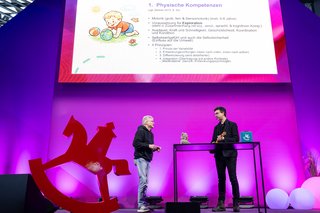
The event began with a dialogue on why play matters between two German professors, Martin Geisler and Jens Junge. As an introduction, Geisler played a few notes on an ukulele, then they quoted Huizinga and Nietzsche who both had appreciated the role of play in humans’ life. There are six essential competences promoted by play: physical, developmental of language, cognitive, emotional, social and cultural. Play is also trying to be somebody else, somewhere else, and a necessary luxury too, according to Junge. Both speakers agreed we need to go back to playgrounds that children create themselves, like in the woods.
Toys and games are better than devices

The educational value of play was the main theme of the speech by Pablo Busó of the Spanish AIJU, Technological Institute for Children’s Products & Leisure. He showed alarming figures concerning children’s evolution to more sedentary life in Spain and other countries, due to increased time spent on displays. Excessive screen use causes a series of problems, including obesity, sleep disorders, irritability, socialization difficulties, myopia. Children however would basically prefer activities like being with friends, practicing sports, listening to music or playing outdoors rather than watching television or playing videogames. Research by AIJU and UCM (2024) reveals that toys and games are better than devices as regards both learning and understanding other children.
Gamification generates motivation
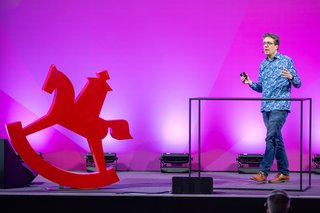
Thomas Voit of Nuremberg’s Technische Hochschule tackled the subject of gamification, i.e. the use of game design elements to generate motivation with help of the EMPAMOS tool kit. After industrial automation took over physical tasks in the 19th century and office computers cognitive tasks in the 20th century, now artificial intelligence aims at controlling creative tasks. What is left for humans? The fun parts of the job (meaning, competence, autonomy, social relatedness) can be easily lost. According to Voit, in order to bring back positive elements to work we need to start thinking like a game designer. Employing AI, the instructions of 8,300 games were studied to recognize patterns: 97 elements were found to represent the fun part of games. They are also elements of real life and can be introduced into non-game activities, like VR training, identifying valuable AI use cases, sparking young people’s interest in history.
Kidults drive the market growth

The kidults trend that is reshaping the market was dealt with by Finnish researcher Katriina Heljakka, who is a member of the Spielwarenmesse TrendCommittee. Toys were once bought for children only, now adults constitute the biggest share of the market. The term “Kidult”, which entered toy trade discourse in 2013, is widely accepted since 2023. For the first time in toy history, the industry’s most valuable customer is an adult buying for himself– adults in 2025 accounted for 28-28.5% of global toy sales and they drive the market growth. This has changed the outlook for industry and retail: kidults stabilize the market by granting higher margins, predictable cash flow, lower reliance on Q4 sales.
Toys in war scenarios
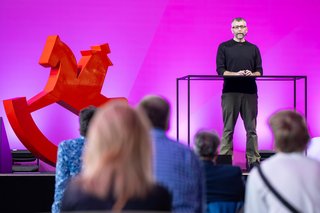
After discussing such varied issues, the conference ended on a sombre note. Brian McCarthy of the War Toys organisation showed us dramatic pictures and children’s drawings depicting toys in war scenarios. He emphasised the importance of play in times of war. To help disadvantaged children worldwide, he encouraged the development of extremely low-cost toys, providing toy designs and tools to generic toy manufacturers. Peace can be promoted by confronting war, and it is important to educate children about it in an age-appropriate way. Play provides a safe space for this, where emotional stability can be restored.
Conclusion
The Value of Play Conference helps to make toy industry stakeholders aware of the benefits they can bring to mankind. Their products are not just fun – although fun they have to be – but also designed to promote the skills and intelligence of a person, no matter which age they are addressing.
The Value of Play Conference explores various aspects of the value of play and demonstrates how playful approaches can foster education, upbringing, and personal development.
Key topics include:
- Playful education and learning
- Kidults (adults who play)
- Teaching cognitive, social, and emotional skills through play
- Playing at work and in extreme situations
The program is organized in cooperation with DVSI.
Host:Dr. Volker Mehringer, play and toy researcher in the field of childhood and youth education at the University of Augsburg
Topics and speakers
Playfully Competent: An Improvised Dialogue on Why Play Matters
Speakers: Prof. Dr. Geisler, Professor of Culture and Media at Ernst Abbe University of Applied Sciences (EAH) Jena;
Prof. Dr. Jens Junge, Director of the Institute for Ludology
A relaxed, entertaining and scientifically sound dialogue about the importance and key skills of play, based on improvisational theatre
Power of Play: How play boosts education – a talk
Speakers: Pablo Busó (Spain), Head of the User Research Department at the AIJU Institute;
Dr. Volker Mehringer
A practical discussion about the importance of playful skills in school, education and developmental psychology
Professional Play: How Gamification Transforms Workplaces
Speaker: Prof. Dr. Thomas Voith researches gamification at the Technical University (TH) of Nuremberg
How game-typical mechanisms become effective in non-game contexts (e.g. motivation, product development, user guidance) – explained using the ‘Empamos’ game principle
Between Nostalgia and Lifestyle: How Adult/Kidults Players Reshape the Market
Speaker: Katriina Heljakka (Finland), researcher in toys and play at the University of Turku
How retailers and brands are strategically exploiting the growing segment of adult consumers – with international examples
Play as Refuge: Meaning and Impact in Times of Conflict
Speaker: Brian McCarty (USA), Gründer und Geschäftsführer WarToys
Insights into the humanitarian work of a photographer: The value of play for children in crisis situations – illustrated through pictures, stories and project examples
About the author:
Italian journalist Daniele Caroli has been editor-in-chief and contributor to international trade magazines in the nursery products and toy businesses since 1994. He was President of BCMI (Baby Care Magazines International) and of ITMA (International Toy Magazines Association). Previously, he had worked as a journalist in music and consumer electronics periodicals.