

Games Stories from the Museum
Exhibition at the Toy Museum demonstrates the close relationship between analog and digital play
Board games and video games have always reflected stories from real life, while “Games-Geschichte(n)” tells stories of analog and digital games that connect them. That is the promise of the special exhibition from the Nuremberg Toy Museum, on display until 13 September. The show reveals the close intertwining of electronic and analog play and game ideas. “It is clever and sophisticated. It dispels the opposition between analog and digital; both belong together,” said Thomas Eser, head of the city’s museums, at the opening.
A true thriller: how the alien E.T. failed as a PC game
A museum especially wants to tell exciting stories. A spectacular flop and its consequences provide the perfect spark — a humiliation that still hurts the pioneer of entertainment electronics, the American company Atari. In 1982 Steven Spielberg’s blockbuster E.T. hit the cinemas. Atari rushed to produce a console game in time for the Christmas season — in just five weeks. The result was a cartridge called “E.T. the Extra-Terrestrial.” The alien failure was mainly the disastrous reception: the company was left with thousands of unsold cartridges. The disgrace was quietly buried in a New Mexico desert landfill; 1,200 copies were interred there. The Nuremberg Toy Museum managed to secure such a copy on loan from the Deutsches Filminstitut & Filmmuseum Frankfurt. A dedicated display case mercilessly recounts the flop. Sand from New Mexico still clings to the game.
Pentomino and Tetris
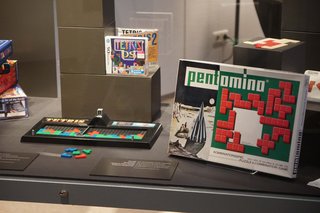
Actually, the connection between board games and video games is a comprehensive success story. The greatest of these involves the American mathematician Solomon W. Golomb, who coined the term Pentomino for a particular polygon made of five equal squares. From this came a patience game of the same name, also called the Pentomino puzzle. Board game fans appreciate it, but the video game that Russian programmer Alexey Pajitnov released in 1984 is known to every child today: Tetris, the reaction game with the falling tetrominoes, early on demonstrated the enormous addictive potential that can lurk behind gaming enthusiasm. The Nintendo Game Boy is also on display in the case: the mobile console that made Tetris world-famous.
Dr. Manuel Seitenbecher, the new head of the Toy Museum, points to a large screen at the entrance to the special exhibition showing the WDR Funkhaus Orchestra. If you listen closely, you notice that games really touch all the senses. The Tetris melody that accompanies the Game Boy game is interpreted here by the classical orchestra. It is based on the old Russian folk song “Korobeiniki” and was composed by Hirokazu Tanaka. Everyone knows the sound, but not everyone can immediately place it.
Back and forth: analog and digital switch sides
“The eleven larger and smaller display cases in the exhibition tell stories from the world of computer and social games. It’s about cultural histories of the global circulation of game elements and about the success stories of companies and game characters,” introduces Sebastian Pfaller from the House of Play into the exciting special exhibition.

"Female empowerment" made its playful entry into the gaming scene early on — exhibits in the show make this clear: a pink game console, female football players, gender-inclusive Scrabble, the Tomb Raider series with its heroine Lara Croft (one of the best‑selling game series in the world) ... Even more striking, however, is the mutual interplay between play spheres: a display case shows the worlds in which Super Mario works as a plumber and defeats enemies. A small Game Studies library reveals that much thought and writing have gone into games and play. Playing educates — there is evidence for that as well. And because fun, whether at the table or on a device, always creates the biggest buzz, the exhibition includes a cozy, living‑room‑style gaming area.
Games follow board games; board-game inventors use video game and film licenses
“Video Killed the Radio Star” is a song by the British new-wave band The Buggles, released in 1979. It is world-famous as the first music video shown on MTV in the U.S. on 1 August 1981. The song tells of the perennial fear that machines could replace the human and warm elements in art. Lines like “rewritten by machine on new technology” capture that fear. The narrative that video games could replace or kill board games has long since proved false. Rather, both go hand in hand. People still sit around tables with enthusiasm, competing or cooperating to solve game challenges.

The latest example of successful collaboration is the developer duo "Apex Ideenschmiede", which develops board games licensed from successful video games and films and already has a large fan base. In September the board game "Cyberpunk: Edgerunners – Hunted" will be released; it is based on the license for the successful Netflix series. Martina Dobrindt of the APEX development team said, "Both our board game and the series are set in the world of the successful video game Cyberpunk 2077 by CD Projekt Red. The video game serves as the background world for the series, but it is temporally and narratively independent, since the series is chronologically set before the video game (even though the series was released later)." Collaborations wherever you look!
The exhibition Games-Geschichte(n) presents objects that are surprisingly analog and physical. It takes up the major narratives of games history. The objects come from the collection of the Deutsches Spielearchiv Nürnberg and are on loan from various media-cultural collections such as the Computerspielemuseum Berlin, the Deutsches Filminstitut & Filmmuseum Frankfurt and the Zentrum für Kunst und Medien Karlsruhe. The exhibition was curated by the Institute for Media Culture and Theatre at the University of Cologne in cooperation with the Deutsches Spielearchiv Nürnberg. Stefanie Kuschill and Sebastian Pfaller from Nuremberg contributed.
Duration: 20 February to 13 September 2026 Location: Toy Museum Nuremberg, Karlstrasse 13–15, 90403 Nuremberg
Tip: Special guided tours: each at 3:00 p.m. on the following days:
Friday, 3 July 2026
Friday, 11 September 2026
Please register for the tours at haus-des-spiels@stadt.nuernberg.de
The guided tour is included in the admission price. To the Toy Museum Nuremberg service
About the author
Peter Budig studied Protestant theology, history and political science. He worked as a freelance journalist, but also led the editorial team of a large advertising paper in Nuremberg for more than ten years and was an editor at the Nürnberger Abendzeitung. Since 2014 he has been working again as a freelance journalist, book author, copywriter and funeral orator. Storytelling is his preferred form in all respects.