

Next Level: International Master Game Design
Interview with Thomas Voit about the interdisciplinary degree program at Ohm University in Nuremberg
By Sibylle Dorndorf
What makes a good game? This question has long been on Professor Thomas Voit’s mind. Since 2014, he has been teaching and conducting research on gamification at the School of Computer Science at Nuremberg Tech. Prior to that, he worked in the automotive industry, where he initiated and led a gamification project designed to motivate executives to take on new leadership roles. Since late 2016, Voit has been leading the Empamos research project in cooperation with the German Game Archive in Nuremberg. He serves as the point of contact for the International Game Designer master’s program.

Thomas Voit, Germany is a nation of gamers; according to the game association, there are currently around 41.2 million people in the gaming community. As a development hub, Germany still has a long way to go compared to other countries. Why do you think that is?
Germany is the largest gaming market in Europe and ranks fifth worldwide.
But the vast majority of revenue comes from imported games, platforms, and hardware. “Games made in Germany” account for only a small fraction. So we play a lot, but we rarely create our own games. What’s the reason for this?
Thomas Voit: In my view, one reason lies in education. Existing degree programs usually focus either on technology and computer science or on production and management. Both are important. But the discipline that determines whether a game is engaging in the first place is often neglected: game design as the leading creative discipline. Good development doesn’t turn a bad game into a good one—it makes a good game playable. On top of that, the big AAA productions with their massive budgets are almost exclusively developed abroad. We can’t compete with those budgets, and we don’t have to. Our opportunity lies in strong, original ideas.
Do you expect the master’s program in Game Design that you’re launching at Ohm to provide a creative boost in this direction?
Thomas Voit: Yes, that’s exactly why we developed it. We train people who not only have a game idea but can also bring it to life: conceptualizing it, presenting it to a team, testing it, discarding it, and refining it until it works. At the end of the program, students don’t just receive a diploma. They produce a playable prototype that can be funded, published, or further developed. And, in the best-case scenario, a team that stays together.
And all of this in Toy City!
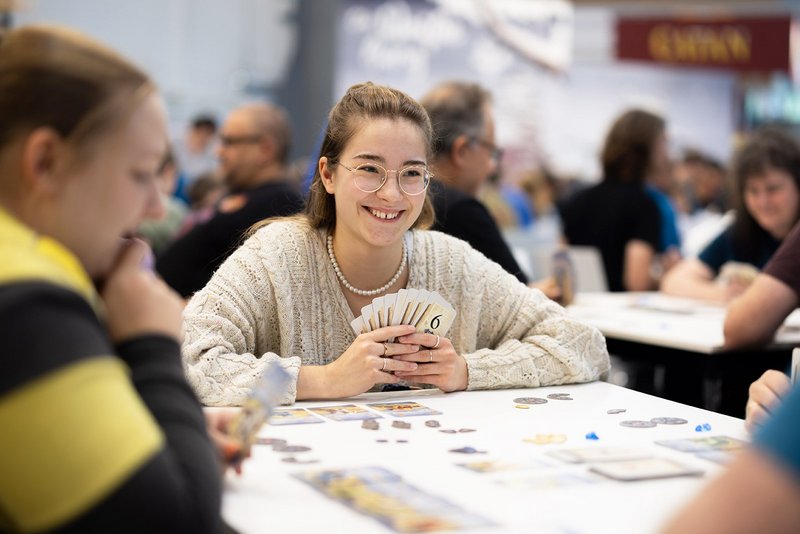
Thomas Voit: Exactly. Nuremberg is the ideal place for this. The city has been a toy hub for centuries; the International Toy Fair takes place here, and the German Toy Archive is located in the heart of the historic old town. The keys to the success of board game culture are clear rules, innovative mechanics, plenty of interaction, and strong emotions. All of this can be directly applied to digital games. For us, analog and digital aren’t opposites, but two forms of expression of the same craft. If, in a few years, the first studios emerge from our cohorts that gain international recognition, then we’ll have achieved our goal.
Employees: According to the industry association game, over 11,900 people are employed directly by game developers and publishers. When the broader value chain is taken into account, the number of jobs exceeds 30,000.
Companies: There are between 900 and 1,200 game companies in Germany.
Major Locations: The largest hubs are located in North Rhine-Westphalia (NRW), Bavaria, the Rhine-Main region, Hamburg, and Berlin. Well-known larger studios include Ubisoft (with locations in Düsseldorf, Mainz, and Berlin, among others), InnoGames in Hamburg, and Wooga in Berlin.
Skills shortage: Specialized professionals such as game designers, level designers, and programmers are in high demand as the industry continues to grow.

How is the master’s program structured?
Thomas Voit: It’s a four-semester Master of Arts program worth 120 ECTS credits. It’s taught entirely in English and will begin in the summer semester of 2027 with about 20 spots available each year. We’ve intentionally kept the class size small because we work more like a studio than a lecture hall. The first semester brings everyone up to the same level. Working in teams, students first develop paper prototypes, going through the complete cycle of designing, testing, and refining for the first time. Everyone learns to use a game engine, and the core module “Game as a System” focuses on the fundamentals: understanding a game as an integrated system comprising story, aesthetics, mechanics, and technology. Depending on their prior education, students therefore take targeted foundational modules in these four core areas during the first semester. In the second and third semesters, the focus is on the major team project. Teams of three to five people develop a fundable prototype. They are supported by mentoring as needed, as well as by modules that teach them the skills of pitching, community building, and game analysis. In addition, there are elective “Deep Dives” covering topics ranging from level design and balancing to multiplayer, AI, and virtual reality. The fourth semester is dedicated to the master’s thesis, publication, marketing, and fine-tuning the student’s own game design portfolio.
Who is this program suited for?
Thomas Voit: The program is aimed at enthusiasts from a wide variety of backgrounds: design, art, computer science, engineering, architecture, or the humanities. No one has to be good at everything. However, we do expect applicants to be truly strong in one area and to be able to demonstrate that through a portfolio. We deliberately admit a comparable number of artists, developers, and designers to ensure that the teams are diverse. We’re convinced that to do justice to the interdisciplinary nature of games, both the faculty and the students must come from different disciplines.
Can you describe what makes for a good gaming experience?
Thomas Voit: You can tell a good gaming experience by what the player feels, not by what she sees. Suspense when she doesn’t know if her plan will work out. Curiosity that drives her into the next room or the next round. And pride when she’s mastered something that previously felt impossible. The key here is that the player makes decisions that matter, and the game responds in a way she understands. She’s challenged, but not overwhelmed. And she feels that her success is her own. A big open-world game can achieve this, but so can a card game played at the kitchen table.
You describe the game designer as a kind of director of the gaming experience …
Thomas Voit: Yes. The game designer is like a director because he can’t create these experiences directly. He can only design rules, sequences, and feedback, and must trust that this will evoke the desired feeling in players. Whether that succeeds can’t be determined from behind a desk—it can only be tested with real people. That’s why playtesting isn’t just a mandatory exercise for us, it’s at the heart of what we do. The most important factor in the entire program is how often a team can test and make changes. Changing a rule and retesting it has to take just minutes not until the next meeting.
One of the requirements of the master’s program is “thinking in game systems.” Can you explain that in more detail?
Thomas Voit: A game is a system that generates emotional experiences. So when you design games, you’re not creating images or stories in the traditional sense, but rather rules, states, and feedback. It’s the interplay of these elements that creates something greater than the sum of its parts. A simple thought experiment illustrates this: Tetris has no story to speak of, a classic ASCII-based roguelike has no graphics, and a board game doesn’t need a computer. Yet all three are unmistakably games. But if you take away the rules, decisions, uncertainty, or feedback, nothing remains. That is precisely where the core of game design lies.
… thinking in terms of game systems …
Thomas Voit: Exactly. Thinking systemically means understanding how a small change in one place shifts the entire experience. If a resource becomes slightly scarcer, the pace, the strategy, and perhaps even the mood of the entire game change. Those who understand this can design more purposefully and have to guess less. In the long term, we also want to contribute to a more scientific approach. So far, a great deal in the industry still happens purely based on experience and gut instinct. That’s why we deliberately chose to offer a master’s program, to better understand games using scientific methods. It is this deep understanding of systems that empowers our students to break new, original ground in game design.
What is the specific added value of the interdisciplinary approach?
Thomas Voit: Games are always created at the intersection of disciplines: design, technology, storytelling, and sound. That is why we have structured this degree program jointly across three faculties: Design, Computer Science, and Electrical Engineering, Precision Engineering, and Information Technology. This structure is unique in Germany.
The concrete added value lies in three areas. First, we draw on specialized knowledge exactly where it belongs—whether it’s aesthetics and 3D design, rendering and AI, or audio and interaction. Second, collaboration across disciplinary boundaries becomes a subject of learning in itself. Anyone who has ever experienced how differently a programmer and an illustrator view the same problem—and yet still manage to forge a shared vision—has learned the most important lesson about the role of direction. Third, the boundary between design and technology does not run between the faculties here, but cuts across all three. All students are trained to become game designers, regardless of whether they come from the fields of art, computer science, or engineering. A game designer must speak the language of the other disciplines in order to facilitate collaboration among them. And they must be able to assess the cost of implementing an idea.
They place a strong emphasis on the indie market and on starting new studios. This is countered by bureaucratic and structural hurdles in this country, which cause many young founders to fail …
Thomas Voit: The hurdles are real, and we don’t downplay them. But that’s exactly why they’re part of the program. Many startups fail not because of their game concept, but due to financing, grant applications, legal structure, or a lack of visibility. That’s why we teach startup knowledge—from business plans to grant programs—train students in pitching, from elevator pitches to sales documents, and build the community during the project itself, not just after it’s completed. In doing so, we work closely with our university’s startup advisory service.
Focus on specific genres: In Germany, the main genres developed are strategy games, management simulations, point-and-click adventures, as well as mobile and browser games.
Few blockbusters: Unlike in the U.S., Japan, or Canada, massive AAA productions costing millions are less common in Germany. Well-known international brands with German origins include, for example, Anno (Ubisoft Blue Byte) and Crysis (Crytek).

Since 2009, the gaming industry has been the 11th submarket of the German cultural and creative industries. Does that help?
Thomas Voit: That helps a lot. As a result, the environment is more favorable than it has been in a long time. The federal government and the Free State of Bavaria have recognized games as an economic and cultural factor; Bavaria wants to double its funding for games and XR and become the number one hub for games. The German market is already heavily influenced by indie studios. There, success isn’t determined by budget, but by conceptual excellence—and that’s exactly what we teach.
And perhaps the most important point: You don’t start a studio on your own. Our motto is “Build your crew.” During their studies, students should figure out who they can create with, argue with, fail with, and produce with. Project teams can turn into studios, and that’s the best preparation for starting a business.
Prototypes are developed as part of the master's program. What characteristics must a prototype have to be eligible for funding?
Thomas Voit: An eligible prototype is not a finished game, but rather compelling evidence. For us, the production goal is, at most, a vertical slice that is, a small but representative excerpt that is close to final quality. Above all, it must demonstrate one thing: that the core of the game works, and that it’s worth pursuing further.
And what would those criteria be?
Thomas Voit: I see four criteria. First, the idea must be original, with a clear creative premise: a feeling, a conflict, or an experience that hasn’t been encountered before. Second, it must be demonstrated through play—not merely claimed, but tested on real people and refined based on those tests. Third, it must be realistically feasible: The team must be able to demonstrate the costs of further development and prove that it can cover them. And fourth, it must be communicable, with a pitch that convinces in one minute and, ideally, with the first players already waiting to try it out. At the end of the second semester, our teams must justify exactly this if they want to continue their project. What’s important to us is this: bold, innovative ideas and taking risks are rewarded. A project is also allowed to fail. Failing early and openly—and learning from it—is an explicit part of the program.
Gamification projects are becoming increasingly important in many areas of business and society. Do game designers also find opportunities in this field?
Thomas Voit: Absolutely. Anyone who understands how to foster motivation, curiosity, and a sense of progress through rules and feedback can apply these principles far beyond the gaming industry—for example, in education, medicine, and training through serious games and simulations; in museums and at trade shows; in the automotive sector; or in any form of interactive product development. The program offers specialized modules on gamification and serious games, supplemented by topics such as multimodal interaction. One insight is particularly important to us: Good gamification doesn’t have to look like a game. Simply slapping points and badges onto an app doesn’t constitute game design. It’s about designing the underlying system in such a way that people enjoy doing something because it feels good.
Do you already have experience in this field?
Thomas Voit: We can draw on ten years of in-house research: Using the Empamos framework, developed at Ohm University since 2016 in collaboration with the German Game Archive, we have been working for many years with more than 350 partners from the business, cultural, educational, and social sectors.
Using gamification methods we’ve developed ourselves and an AI-powered assistance system that has learned from games, they make their processes, products, and offerings more motivating—from logistics to museum exhibitions to university teaching. This is based on a clear understanding of motivation: People want to experience autonomy, competence, social connection, and a sense of purpose. Games are particularly effective at achieving this—and Empamos reveals which game elements make this possible. This knowledge is directly incorporated into the master’s program.
So graduation isn't a one-way street, it opens many doors …
Thomas Voit: Exactly. This degree doesn’t “just” lead to careers in the gaming industry. Our graduates can start their own studios, work as game designers on large teams, or apply their expertise in UX, interaction, and narrative design wherever experiences are being created.
Thank you, Thomas Voit, for this fascinating insight into this multifaceted degree program!
Go to the article “New in Nuremberg: International Master's in Game Design”
The questions were asked by Sibylle Dorndorf
Sibylle Dorndorf has been writing about the toy industry for over 30 years; most recently, she served as editor-in-chief of the TOYS magazine family at Göller Verlag in Baden-Baden. Her passions include companies that are reinventing themselves, brands that position themselves authentically, people who have something to say, and products with a promising future.