

Kobayakawa and Hanamikoji
Playing in Japanese
From Peter Neugebauer
Japan is the land of the rising sun and rich in tradition. Its distinctiveness is evident in nearly everything: culture, music, cuisine, and religion. Japanese pop culture has spread worldwide through anime and manga. It adds a unique flavor to analog play and enjoys great popularity. The following selection showcases the diverse game concepts of Japanese designers.
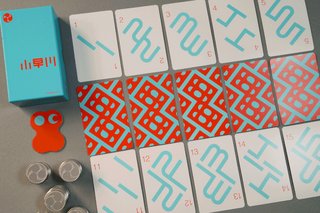
Oink Games published Kobayakawa by Jun Sasaki. The title refers to a feudal daimyo from Japanese history who was known for shifting wartime alliances. The game reflects that volatility with just 15 numbered cards. Each player tries to hold the highest value, but the weakest player has an open card added to their total. This value can be manipulated, which perfectly reflects the fickle fate evoked by the theme. The game is short, tense, and refreshingly different.
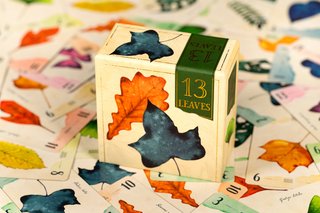
The same applies to 13 Leaves by Masato Uesugi, which is fairly recent and included in the Cranio Creations catalog. Elznir distributes it. The deck contains only 13 different leaf motifs, each is available in varying quantities. A clever tableau-building mechanism allows each player to contribute to the shared layout. If you can't play, you pass and draw a new card from the open display for the next round. The game requires more tactical decisions than you might initially expect.
Major Successes

Over the past decade, games designed by Japanese creators have consistently ranked high in the annual awards. In 2025, Hisashi Hayashi's Bomb Busters, published by Pegasus, received the Spiel des Jahres award. This cooperative deduction game was a first in its combination of cooperation and deduction. It also solves a common problem in cooperative games, which is that a dominant player often dictates how the group should play. Verbal communication is not allowed, therefore players must infer the best way to play based on others’ actions.
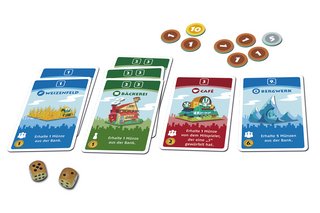
Machi Koro, designed by Masao Suganuma and published by Kosmos, was nominated for the 2015 Spiel des Jahres award. Through card play, each player builds a city. With a lucky dice roll, players can lure others into their café to collect income. The game is often called a modern Monopoly, a description that fairly captures its essence.
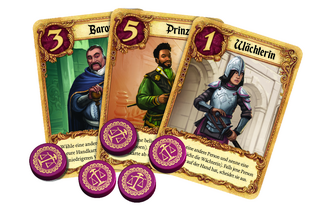
The Spiel des Jahres jury recommended Love Letter by Seiji Kanai, published by Asmodee, in 2014. The game consists of only sixteen large-format cards that depict members of a noble court. Each character has a value and a special ability. Players choose one card from their two hand cards to play, aiming to eliminate others or remain with the highest score. The game is full of guile and interaction. Love Letter sparked a wave of microgames, which are games with highly reduced components and rules.
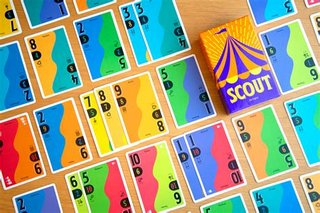
Scout, from Oink Games and designed by Kei Kajino, also rests on a unique core idea. In this game, players compete to put on the best show in a contest among rival circus directors. Cards must be played side-by-side rather than freely, and the tableau on the table may be raided, which means that an act card can be stolen from an opponent. The card is returned and rotated 180°, which changes its value. This plays very differently from familiar mechanics and demands new tactics. Unsurprisingly, Scout was nominated for the 2022 Deutscher Spielepreis.
A Special Gem

Hanamikoji by Kota Nakayama, published by Kosmos, is a special gem. In this game, two players compete for the favor of geishas, who are traditional entertainers trained in music, dance, etiquette, communication, and games. Gifts are used to court the ladies. The play of presents is governed by a clever tussle with action markers. Players can bluff or deliberately pass a gift to their opponent that they know their opponent doesn't want. Winning a geisha’s favor is not easy, but succeeding is highly gratifying.
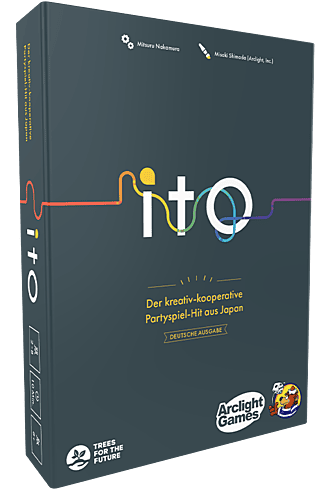
Ito, designed by Mitsuru Nakamuro and published by HeidelBär, boasts an engaging game concept. Each player receives one or two cards from a deck of 100 numbered cards. Then, a topic is read aloud. For example, the topic might be "What is 'kawaii,' or super cute?" A player with a high-numbered card might respond, "Newborn puppies." The others deduce that the hidden number must be high and try to identify other cute things. According to each player’s drawn card value, these answers are placed into the sequence in the center of the table. This super-simple guessing game stands out for its directness and creativity.
Selection of japanese authors and their games on the german games market:
Akihito Nakanish: Swopp!/ frechverlag
Fumiko Shimizu: Dying Message/ Oink Games
Goro Sasaki: Tropichaos/ Oink Games
Hisashi Hayashi: Bomb Busters/ Pegasus; Kimono/ Zoch; Yokohama/ dlp
Jun Sasaki: Kobayakawa/ Oink Games; Tiefseeabenteuer/ Oink Games
Kei Kajino: dnup/ Asmodee; Scout/ Oink Games
Kenta Murayama: Flossen weg!/ FunBot
Kosuke Takahashi, Natsumi Wada, Hayato Tabata & Momoka Nakayama: Yubibo/ Edition
Kota Nakayama: Hanamikoji/ Kosmos
Masao Suganuma: Machi Koro/ Kosmos
Masato Uesugi: 13 Leaves/ Cranio; Durian/ Oink Games; YRO/ HeidelBär
Mitsuru Nakamura: ito/ HeidelBär
Saashi: Shall we dance? / Saashi & Saashi and Bus & Stop/ Saashi & Saashi
Takashi Saito: Hey Yo/ Oink Games
Tsutomu Dejima: Matter Matters/ Amigo
Yasuyuki Nakamure: Lone Wolves/ Pegasus
Yoshiaki Tomioka: Bonfire Party/ itten
Publishers from the Land of the Rising Sun
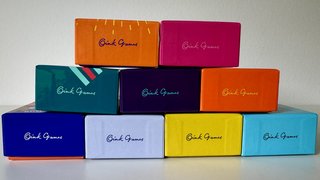
The Japanese publisher Oink Games has a branch in Germany, where it is also well-known. Founder, CEO, and lead designer Jun Susaki chose the curious company name. He liked the english pig grunt so much that he named his company Oink. He stylized a pig’s snout as the company logo. This reflects a typically Japanese tendency to adopt European elements and make them their own, which is quite charming. Besides the excellent games themselves, Oink's packaging is noteworthy. The boxes are no larger than a pack of cigarettes and filled to the brim with the necessary components. This design addresses the space constraints common in Japanese households. These small boxes also make it easy to store multiple games, even in a compact Tokyo apartment.
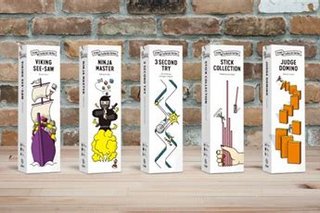
For several years, Oink has shared a booth at Spiel Essen, a toy fair in Essen, with itten, another Japanese publisher. Visitors will also find unique games there. The Funbrick series offers a variety of dexterity games presented in slim boxes that emphasize compactness.

Bonfire Party, designed by Yoshiaki Tomioka, is particularly enjoyable. Players must slide logs into a campfire to light a delicate flame. Saashi & Saashi, a Kyoto-based publisher, offers games with unusual themes, which are typical of many Far Eastern games.

One example is „Shall We Dance?“, where players actively seek a dance partner or are requested to dance the next foxtrot. Another Saashi title, „Bus & Stop“, places players in the role of bus drivers who must deliver passengers to their destinations while ensuring that riders aren't crammed in too tightly, a typical problem in Japan's megacities.
Games from the land of the rising sun are different. They feature plain elegance, profound lightness, surprising themes, and short playtimes, as well as a compact design. Fortunately, they are also available from local retailers.
World of Toys Tokyo
From August 27 to 30, 2026, Tokyo Big Sight will become the gathering place for all toy enthusiasts. At the Tokyo Toy Show, you can expect a fascinating glimpse into one of the world’s largest and most innovative toy markets, which is constantly growing and setting trends for the entire Asia-Pacific region. While the first two days are reserved for trade visitors, the fair opens its doors to everyone on the weekend. Immerse yourself in a world full of new products, discover international brands, and experience Japan’s unique toy culture up close. Whether futuristic gadgets or classic collectibles, the fair, with its tens of thousands of visitors, offers an extensive program that guarantees an unforgettable experience, especially for families and children.
Further information: Spielwarenmesse Group: Tokyo Toy Show
About the author
Peter Neugebauer is still a big kid through and through. In early childhood, his parents introduced him to board games. Games were obligatory and always welcome at Christmas and on his birthday. He didn’t stop playing, not even during his years of study or working life. Early on, he reviewed new products, initially in trade journals, then also in daily newspapers and, for almost 40 years, in industry magazines. He can’t live without playing.