

ToyTrend 2026: AI loves to Play
How Artificial Intelligence is revolutionising toys
By Clara Blasco
Artificial intelligence (AI) has already transformed industries such as healthcare, the audiovisual sector, and finance. Now, it has arrived in the playroom. The ToyTrend 2026 AI Loves to Play describes how AI has infiltrated the children's toy universe.
Toys that understand, think, and respond to children's interests create unique and personalised experiences. The aim is not to replace traditional play, but to enhance it by stimulating curiosity and creativity, and offering possibilities that once seemed like science fiction. For the global toy industry, this phenomenon is more than a technological advancement. It is a strategic opportunity to address global challenges, connect with new generations of consumers, and respond more precisely to the expectations of today's families.
From concept to product: Keys to applying AI Loves to Play
The ToyTrend AI Loves to Play is best understood through two complementary perspectives: on the one hand, the strategic aspects of the trend that signal the shift; on the other, the specific characteristics of the products that define the toys in this movement. These characteristics are not fixed or exclusive to one approach but can be flexibly combined and adapted to different development phases, offering extensive opportunities for innovation at the intersection of these elements.
AI Play in the seedbed. Unleashing the next frontier

Artificial intelligence applied to play is still in its early stages. We are currently in the germination phase of this trend. Early attempts show toys that not only execute commands but also learn and evolve with the child. Here we find two key product traits: toys with integrated AI and capable of adapting individually to the child. They learn from the user, adjust to their emotions or interests, and evolve over time. The appeal is clear: to offer products that do not provide the same responses, but instead support the child's growth and development. We see proposals such as
- companion toys that help establish sleep habits and emotional wellbeing,
- petbots with facial recognition that ensures personalised experiences for everyone in the family, or
- robots that combat loneliness, anxiety, and depression by adjusting their interactions based on individual needs.
For manufacturers and retailers, the opportunity lies in designing toys that, through AI, can adapt to the changing needs and preferences of each consumer, ensuring a more precise and appealing offering. The question is: How can we design a meaningful play proposal that adapts to the child's growth and development, fosters a stronger emotional bond, and generates long-term value for both families and businesses?
Hybrid Mix – Phygital Play
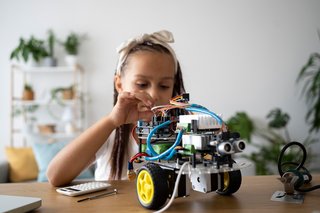
One of the driving forces behind this trend is the fusion of the physical and digital, known as phygital play. AI acts as an invisible connector, allowing robots, dolls, or board games to interact with apps and digital environments. This bridge between the tangible and the digital manifests in products like interactive robots, smart educational toys, and apps that enhance the experience, showing how AI can add value to the physical through personalised digital layers. Examples include dolls that engage in contextual conversations, board games offering challenging opponents, or robots whose physical behaviour is linked to mobile apps. These toys cease to be passive objects and become dynamic companions that combine touch, body expression, and digital stimuli. For manufacturers and retailers, the physical-digital hybridisation with AI extends the life cycle of products. Toys do not just stay on the shelf; they can be updated with new content, opening doors to complementary services and strengthening family loyalty. These products become toys with high added value, offering more interaction, personalisation, and extended longevity through digital updates. Although currently aimed primarily at families seeking innovation, the real challenge for the sector is to understand how the physical-digital fusion with AI can inspire new business models, generate additional revenue, and maintain relevance in a globally competitive market. The key question is: how can a toy be transformed into an evolving ecosystem that accompanies families beyond the moment of purchase?
AI-Driven Smart Toys: From entertainment to learning

The third aspect focuses on the educational value. KI-Driven Smart Toys: From Entertainment to Learning shows how AI transforms toys, turning them into tools that go beyond fun and become allies in child development. AI-driven toys are not just for entertainment; they also educate, teaching children how AI works in a natural and engaging way and fostering digital literacy from an early age. Additionally, smart toys facilitate intuitive learning. Thanks to their ability to personalise, these toys recognise behavioural patterns and suggest challenges tailored to each child’s level. In this context, screen-free toys gain relevance, as they offer more natural and enriching interactions without relying on digital devices. This addresses parents’ and educators’ concerns about screen time, while introducing children to a healthier technological environment. For manufacturers and retailers, the challenge is to position these products as allies in invisible learning, while expanding their portfolios to meet the high demand for educational innovation. The key lies in turning these advancements into business propositions that gain the trust of parents and educators across various educational contexts (formal, non-formal, and informal). The question is: how can we design screen-free educational toys that provide an enjoyable and effective learning experience, building trust and offering long-lasting value to families?
Conclusion: Enhancing play with AI
Play always reflects society, and today AI is already a part of it. The ToyTrend 2026 AI Loves to Play does not mean abandoning the joy of traditional play, but enhancing it with new layers of interaction, personalisation, and learning. While the market is still maturing, the growth potential is significant. The opportunity lies in designing unique experiences that sustain consumer interest and open new business avenues. The development of AI-driven toys will require new design approaches, alliances with tech startups, user experience experts, and specialists in safety or pedagogy. This shift in approach not only addresses the challenge of AI but also paves the way for a new era of innovation in the toy industry. For retailers, manufacturers, and suppliers worldwide, this is the moment to decide whether to lead the trend or merely observe it. Children and adults are ready and waiting to play with AI. The challenge for the toy industry now is to catch up.
What will drive the toy industry in the coming year? Discover the Toy Trends of the upcoming Toy Fair now.
You can find the right products from January 27-31, 2026, at the entrance to the middle of the exhibition center in Nuremberg.
About the author
Clara Blasco has a master's degree in product design and is a design and trend researcher at AIJU, the technology center for children's and leisure products in Spain. She has worked as a toy designer, UX researcher and lecturer. Clara Blasco advises toy companies and childcare facilities on the development of products, services and communication strategies, always focusing on people. She coordinates R&D projects with companies and moderates innovation workshops from a design thinking perspective.