

Enthusiasm for bridge building
Large structures on a small scale
By Peter Thomas
Bridges are fascinating structures and key elements of all ways of getting from A to B. They are spectacular masterpieces designed to keep traffic flowing or simply to allow people to cross roads. Their diversity in terms of materials, construction method and aesthetics is immense. With models and construction toys, bridge building can be experienced on a small scale, too.
International experts have spoken of 2024 as the Year of the Bridge in view of the global boom in the construction and repair of these transport structures. It’s a trend that’s likely to continue in the years to come. In its 2022 Bridge Report, the American Road and Transportation Builders Association listed the huge need for 78,800 bridges to be replaced and 224,000 to be repaired. And that’s just in the USA! In the run-up to the Eurobridge 2023 conference, the European Construction Industry Federation, FIEC, also reported large numbers of bridges in Europe’s highly dense transport network requiring urgent renovation or reconstruction.
The message is clear: there’s an urgent need for bridge planners and bridge builders! All the more important, then, to boost enthusiasm for these fascinating structures and knowledge about them. One way to do this is with bridges in the form of toys and models. The variety of materials and construction methods is at least as vast as it is in the real world, where bridges are made of stone, wood, steel, concrete, steel cables and other materials.
Leonardo da Vinci’s bridge
Construction kits or functional models can even be used to understand the principles of statics. There‘s no need for complex systems: for example, the many different kits made from small wooden strips that can be used to build the famous Leonardo da Vinci bridge are impressive. This is a “woven arch bridge”: it’s interlocking beams are held together solely by means of friction and their own weight.
Polymath Leonardo da Vinci probably didn’t invent the construction principle himself, but rather derived it from his studies of historical texts. Nonetheless, the construction is still ingenious. And as an educational toy that calls for a certain amount of patience and coordination, the bridge bearing his name is a classic toy.
The entire spectrum of bridge building
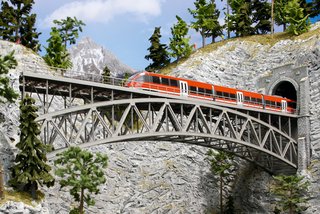
What kind of bridge do you want? An arch bridge, suspension bridge, cable-stayed bridge or box girder bridge? A folding, bascule or swing bridge? The entire spectrum of bridge construction is reflected in the model making world. Complex bridge constructions are particularly effective as core elements on model railway layouts.
However, not every gauge H0 enthusiast is likely to have enough space for complete replicas of icons such as the Müngsten Bridge in Germany. Felix Hack’s range includes this original bridge crossing of the River Wupper valley, dating back to 1897. The model is 1.60 metres long and 26 centimetres high. However, the individual components such as the impressive centre section, known as the high arch bridge, can also be purchased separately. “Right from the start, we focused on marketing individual components of the Müngsten Bridge,” Hack says.
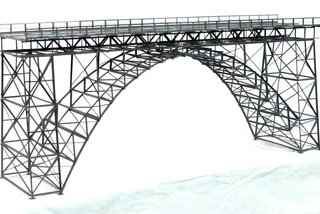
His filigree constructions made of fine tinplate profiles are hand-soldered and the first 10 bridge models were launched in 2004. Alongside the Müngsten Bridge, the range also includes other models based on actual constructions, including the Glienicke Bridge in Berlin and the George Washington Bridge in New York. “More highlights will follow,” the bridge builder from Swabia, Germany, promises.
Sheet metal as a building material

Using metal as a material for building models of real metal bridges has long been a tradition. The Richter company launched a bridge building kit as far back as 1895. The company supplemented its range of classic anchor stones with iron parts for arch bridges. The building blocks, consisting of chalk, linseed oil and pigment, are still being produced in Rudolstadt today, following the original formula.
For a long time, sheet metal bridges also played a significant role in model railways. Such as at Märklin, where the striking 467/2 arch bridge with integrated three-rail track was the highlight of the “Model Bridge Building” range in its 1949 catalogue. It changed very little over the next 20 years: Märklin’s H0 7163 arch bridge with point contacts as seen in the 1965 catalogue is immediately recognisable as a direct relative.
These days, the classic Märklin bridge can be bought as an antique. Nothing stands in the way of its use in a toy railway with M-track and analogue rolling stock, although the pillars of the 1950s and 1960s, made of thermoplastic, have generally survived the passage of time less well than the sheet metal bridge bodies. However, customised modern replicas using 3D printing are now available online; they just need to be repainted to match.
Plastic and cardboard
Bridges for model railways have long since freed themselves from their role models in terms of materials. For many years now, the segment has been typified by plastic kits and ready-made models in particular. There have even been cardboard models in the various scales. Since the advent of laser-cut technology, this material has played a more important role.
One prime example of this is the Noch range, where laser-cut bridges made of special cardboard have been available since 2009. The most successful model in its range is the 67029 H0 truss girder bridge. Like all laser-cut kits, it’s assembled from numerous fine parts using wood glue. The production method means that even very fine details, such as the typical riveted joints of the iron framework, can be reproduced, even on a scale of 1:87.
Bridges as machines
At first glance, bridges appear to be static structures. And yet they are constantly in motion, triggered by the dynamic forces of traffic and wind load, as well as changes in temperature, which is why bridges have flexible supports at one end: to allow for changes in their length. This is also why the US historian of technology Henry Petroski (1942 to 2023, Professor of the History of Technology and Civil Engineering at Duke University in North Carolina) compared bridge structures to machines in his book To Forgive Design: Understanding Failure.

Construction toys, such as metal construction kits, enable many of the mechanical and static principles of bridge building to be reproduced. This applies to stationary bridges, but above all to structures with moving parts. Examples of this can be found in the building instructions and ranges of the major 20th century manufacturers, from Meccano (Transporter Bridge, a suspension bridge with a moving carriage) to Märklin (Lift Bridge, a vertical lift bridge with a rope mechanism). The American sculptor Chris Burden (1946 to 2015) even shifted building model bridges using metal construction kits from the sphere of play and learning to that of contemporary art. His large-scale models created around the turn of the millennium using parts from Erector and Meccano have been exhibited in leading galleries and museums around the world.

Bascule, swing and lift bridges are among the classic forms of movable bridges, and can be built as impressive models using modular systems. This also applies to new kinetics such as the Rolling Bridge in London, which opened in 2004 and was designed by British architect and designer Thomas Heatherwick, born in 1970. The hydraulic drive of the original is provided by pneumatic elements, such as those offered by Fischertechnik and Lego Technic as part of their respective systems.
Enthusiasm for a connecting technology
Building models of bridges, playing with them and admiring their beauty – anyone who does so understands why these literally connecting structures on a large scale are so fascinating. They offer an opportunity that can be used to foster STEM skills. After all, building bridges in the form of models and educational toys isn’t just fun – it can teach important skills, too!
There’s a kidult inside every technophile, because enthusiasm for models and technical constructions arouses the joy of tinkering about. Experimenting along with trial and error teach people how to carry out research and make progress.
The Spielwarenmesse provides visitors with an overview of the various theme words that adults go crazy for.
About the author
Telling stories about technology and people: This has fascinated Peter Thomas, the journalist, author, cultural scientist and lecturer for more than 30 years. Technical toys are always in focus, from construction kits to interactive digital educational toys. After studying and working as a research assistant at university, Peter Thomas writes for daily newspapers, magazines and corporate publications in German and English-speaking countries. In addition to the world of games, his focus is on mobility, security, energy and medical technology.