FTO Symposium: Making toys fair
Balancing act between law, controls and critical consumers
By Peter Budig
Making toys fair. Behind these three words lies an initiative with big ambitions. The Fair Toys Organisation e.V. (FTO) has taken on a mammoth task. It is committed to ensuring that the following aspects receive greater attention in toy production:
- social responsibility towards the people involved
- ecological sustainability of the materials used and products manufactured
- transparent and fair designed supply chains
Self-commitment, responsibility, internationally valid.
At the end of September 2026, a symposium took place in the Schöner Saal of Nuremberg Town Hall, which outlined the current situation.
FTO Symposium at Nuremberg Town Hall
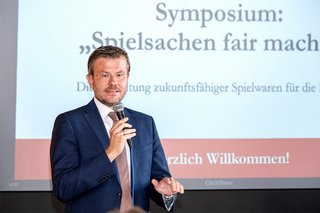
The city of Nuremberg is more than just a friendly host here. As a place of toy production in history and the present, as the location of the industry's leading trade fair, it is right in the middle of the subject and shares responsibility. Mayor Marcus König made this clear in his welcome address. He found a good example of how, as an FTO member, one can pay attention to the bigger picture in small ways: the city had the Dürer Hare produced as a gift: the Albrecht Cuddle Hare was fairly produced by the Upper Franconian plush toy company Heunec from Neustadt near Coburg according to FTO guidelines. It serves as an official gift and can be purchased in numerous shops and the Tourist Information for €19.90.
Keynote: Current legal developments
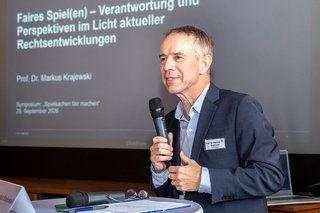
Professor Dr. Markus Krajewski, a lawyer from Erlangen, is an expert on international law issues in business and human rights. He holds the chair for Public Law and International Law at FAU Erlangen. According to Krajewski, there is indeed a globally defined legal framework for the FTO's concerns, such as the UN Guiding Principles on Business and Human Rights. "The Supply Chain Due Diligence Act" is "applicable law," with the focus primarily on human rights. However, global upheavals, China for example "actively prohibits these EU rules," and the US government's aversion to international regulations make binding behaviour difficult. That is the status quo, and while the legal framework may be reassuring, the impression cannot be avoided that self-responsibility rather than enforceable rules characterizes the present. It is no coincidence that the FTO describes itself as a Multi-Stakeholder Initiative (MSI), a voluntary association of social and economic groups working together to solve complex problems.
The Fair Toys Organisation was founded in 2020 in Nuremberg. The FTO is an association of members of the toy industry and civil society who are committed to "fair toys." To this end, companies enter into a self-commitment to anchor ecological standards and uphold social rights in toy manufacturing. This applies especially to working conditions such as working hours, job protection, statutory minimum wages, and occupational safety regulations in toy factories around the world.
To the FTO website
Panel discussions: Are the instruments sufficient?
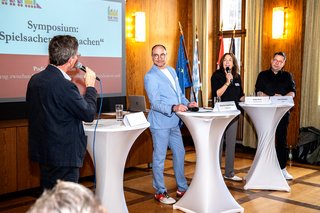
"It is a control problem." That is how succinctly one can sum it up, in the words of Professor Frank Ebinger, who researches sustainability at TH Nuremberg. He emphasises the importance of the digital product passport for toys, which will be introduced by 2030. Axel Gottstein, head of sigikid, is also clear: "We need globally valid, uniform minimum standards." And in the end, these can only be enforced "if the consumer demands quality," as FTO board member Helga Riedl makes clear. The city of Nuremberg, where Riedl works in the human rights office, stands by its Fair-Trade principle: "The city is committed to procuring toys from fair production." However, this is not always successful. Helga Riedl, who works in the human rights office of the city of Nuremberg, is committed within the framework of her engagement for fair trade to ensuring that "social and ecological standards are given greater consideration in toy procurement." If a customer only looks at the cheapest product when shopping, they accept that the child's new treasure is neither fair nor eco-friendly. On the sidelines, sigikid boss Gottstein posed a question to the audience: "Do you know who sells the most plush toys in Germany?"
Do you know? It's IKEA.
Expert discussion 1: How do sustainable toys get onto the shelves?
How can you win customers for fair toys? "People who buy this are not mainstream," says Josephine Dransfeld. The junior boss of the family business Heunec is nevertheless a woman of conviction; every plush toy from her company is monitored according to FTO guideline requirements. This does not change the fact that her plush highland cattle, mice, ants or the Dürer Hare are almost exclusively manufactured in China. For Frank Braun, CaWeLa Cadolzburg, self-commitment is simpler. He supplies 800 world shops in Germany, "a small but very critical audience." Jan Bussiek makes an unusual contribution to the topic: the ESG Score, which he developed, is a standardised, cross-category designation that makes it possible to sort products in online retail by sustainability. Here too, the informed consumer is called upon, but it is now made easier for them: when making their selection of computer keyboards, office chairs or toys, they can sort their personal offer: the fair ones first.
Expert discussion 2: "Value of play is an educational opportunity"
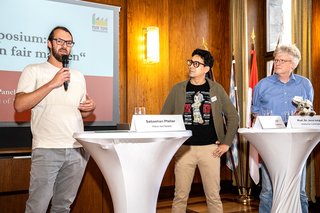
It has long been discussed that board games in the classroom could improve students' performance and willingness to learn. Professor Jens Junge is one of the most active protagonists of play and playing in Germany. He heads the Institute for Ludology in Berlin and has a nice motto ready: "Play is dialogue with the world." He adds: "Children need tactile toys." This brings one closer to FTO guidelines – who wants to take cheap-smelling, unpleasant-to-touch things into their hands? Markus Utomo, a Nuremberg game designer, also champions "games that convey learning," coupled with the inner mandate that "in the end you always have to create motivation." The House of Play in the Pellerhaus with the German Game Archive is a place of play culture where games are played, researched and preserved. "The oldest game in our collection is from 1650." Sebastian Pfaller, who works there, adds: "We have tailor-made board game offerings, for example for school classes." However, where the most benefit could be created, in schools, "there is no money for this further education," complains not only Markus Utomo.
The Bavarian State Government is called to action: Spielzeugland.Bayern initiative
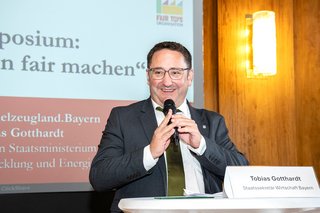
At this point, progress cannot be made without state advocates with budgets. It is therefore good that State Secretary Tobias Gotthardt has the final word in Nuremberg: he works in Aiwanger's Economics Ministry and was previously deputy chairman of the Committee for Education and Culture in the Bavarian state parliament. A man who could build bridges between culture, education and business. Gotthardt comes with words of praise for the FTO's concerns, but he has come to present the initiative he founded, Spielzeugland.Bayern – the network of the Bavarian toy industry. There are 1,500 businesses in Bavaria, with 4,000 jobs, generating 850 million euros in sales per year, he has calculated. He too knows that production no longer takes place in Bavaria, and he too appeals to "create awareness for people who pay attention to these fair criteria." But of 1,000 products that were test-ordered from temu.com, the Chinese discount platform, none met safety requirements. Far removed from fair trade.
A call for fairness
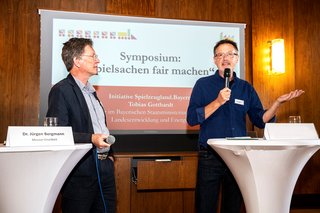
Outlook and call to action is the last item on the agenda. The best action would probably be if many more manufacturers, retailers, cities and organizations joined the FTO. Nuremberg, Fürth, the toy museum, Spielwarenmesse and several manufacturers are already involved. But out in the world, calls for fairness and self-responsibility are not currently in vogue. A word from Jens Junge fits here, who advocates for "paying attention not only to financial but also to social returns." For this, it is undisputed, the FTO stands.
The Fair Toys Seal is a company seal and recognises manufacturers who meet the requirements and criteria of the Fair Performance Check to a high degree. This examines the extent to which the company credibly assumes social and ecological responsibility for its supply chain. Only companies that meet the six minimum requirements of the Fair Performance Check and achieve at least 75% of the points available may use the Fair Toys Seal.
Further information on the review process and the seal can be found in the FPC Manual (PDF) and the FTO Strategy Paper (PDF).
From 2–6 February 2027, the Fair Toys Organisation will exhibit at Spielwarenmesse.
Nuremberg Exhibition Centre, NCC West | 06
About the author
Peter Budig studied Evangelical Theology, History and Political Science. He worked as a freelance journalist but also led the editorial team of a major advertising newspaper in Nuremberg for over ten years and was editor of the Nuremberg Evening News. Since 2014, he has been self-employed again as a journalist, book author, copywriter and funeral speaker. Storytelling is his preferred form in all respects.