

Let's play Medieval
Interactive Game Exhibition at the European Hanseatic Museum Lübeck
By Peter Budig
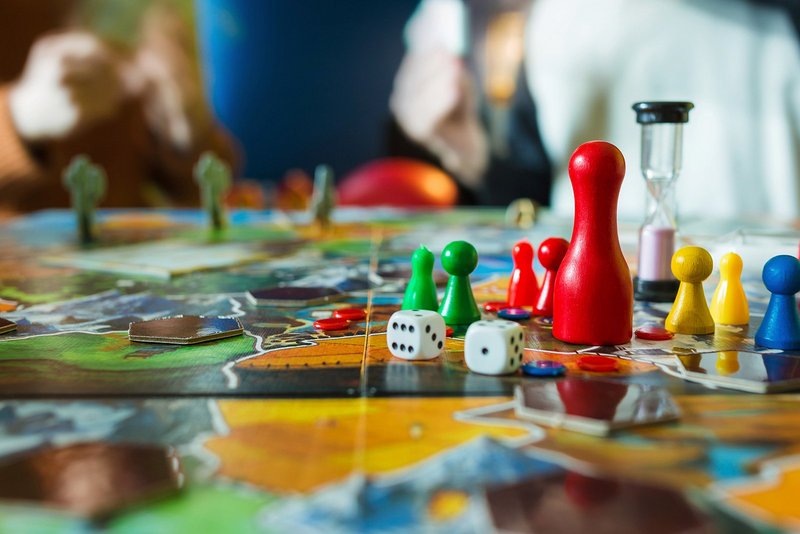
In the world of gaming, analog board games and digital games have long discovered the advantages of each other. There is an interweaving, a mutual inspiration of game ideas and worlds. In museums, curators have moved away from placing collectibles in glass display cases to let them speak for themselves with a brief explanatory text. The Lübeck Hanseatic Museum is such a place where history becomes experiential by telling stories. This makes it very entertaining and visitor-friendly.

The Lübeck historian and exhibition curator Franziska Evers can be considered a creative pioneer. This may also be due to the fact that her home institution, the European Hanseatic Museum Lübeck, opened in 2015, has hardly any noteworthy collections. At the same time, it must tell a complex medieval historical narrative: the rise and fall of the European Hanseatic League. The museum tells the story of trading success, endless sea voyages, skillful tactics, and if necessary, the use of military force. The European Hanseatic League was much more than a city alliance. These are primarily stories of men, successful merchants who dominated their city societies and allied themselves with others. In 2020, Evers specifically told such a story of men: "Störtebeker and Associates" about "the pirates of the Hanseatic era." Now the historian and her team are taking on a new venture: Why not stage a special exhibition as a game? Consequently, the special exhibition that opens on October 9, 2026 is called: Let's play Medieval. How Games Tell History.
The Middle Ages in Games
The European Middle Ages is defined as an epoch roughly from 500 to 1500 AD. Our images of it, church stories, knights, plague epidemics, castles, crusades, witch burnings, are all incomplete, fragmented, often shaped more by legend-making than by historical authenticity. Historian Dr. Lukas Boch is part of the Evers team. He is one of the founding members of the Boardgame Historian project and is co-responsible for the "Medieval Digital" project. In his dissertation, he examined how the Middle Ages are told in games. Boch has compiled a list of games for us that are relevant to the Lübeck Medieval exhibition: Kingdom Come: Deliverance, Anno 1404, The Witcher and Manor Lords, Inkulinati, all digital games; as well as analog board games such as Settlers of Catan, Carcassonne, Zombicide, Black Plague, Castle Combo and Glory: a Game of Knights. Furthermore, the exhibition has breaking news to offer. Game designer Klaus-Jürgen Wrede and the Hans im Glück publishing house have exclusively announced a new expansion for Carcassonne. Surprise, surprise: It's about the Hanseatic League!
The Authentic Location
The entire Hanseatic Museum is a magnificent place! It is located at an exposed historical site, directly on the banks of the Trave. The river encircles the Lübeck old town, it wraps around the historical core like the edge of a cave, and at the point where the ring closes and the river opens again toward the Baltic Sea, there stands a steep castle hill. At the top sits the Castle Monastery, founded in 1229, with its monastery courtyard and the historically significant confessional house. For many years it was a Dominican monastery, and the confession service was their most lucrative offering to Lübeck's sinners. During the Nazi era, it was used as a courtroom and prison. Some of the cells can still be visited.
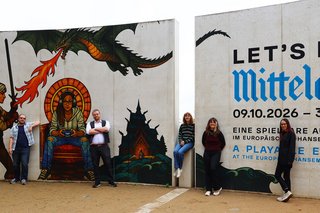
Today it is part of the museum area and the place where "Let's play Medieval" will take place. The entire museum grounds extend from the top of the castle hill down to the street "An der Untertrave". It covers approximately 7,400 square meters. The museum with its permanent exhibition, which is dedicated to the history of the Hanseatic League, is not recognizable from the outside. A staircase leads from the ring road up to the monastery courtyard, and halfway up, unexpectedly, you can turn off into the museum's ticket office and souvenir shop. From the foyer, it goes downhill, practically into the mountain, where the stories live. "The architecture of the building is derived from the historical conditions of the property and its surroundings. An essential design motif is the medieval city wall that ran at the foot of the castle hill. The building's cubic form quotes this wall," says Andreas Heller Architects & Designers. This alone is definitely worth a trip, 100,000 people visited the European Hanseatic Museum in 2025.
Museum as a Game
At the beginning, the exhibition makers posed themselves this task: How is the Middle Ages told in board games and e-games, how is it conveyed? What images are shown and created? "Historical images are often pop culture, not the result of scientific research," says Evers, who was born in Lübeck and studied in Kiel under Hanseatic expert Rolf Hammel-Kiesow. Now, as she and her team are aware, they are venturing an "experiment". In the exhibition text, it is described as follows: "Visitors create their own avatar, solve tasks and decide for themselves which path they take in the medieval world. It is not texts that guide visitors through the exhibition, but the game itself: a tournament ground, a festive banquet in the green, a mysterious dragon's cave and further immersive settings. Each station represents a chapter in the game and demands its own decision before moving on. Information is not conveyed, but played out." Explanatory texts are almost completely dispensed with, and mediation takes place via headphones.
Let’s play Medieval
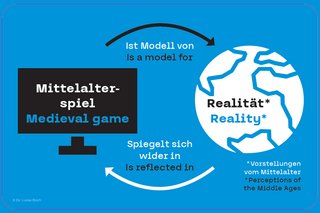
Like a red thread, this decision of each visitor runs through the game: Am I a follower of the light or the dark Middle Ages? Do I think of "The Name of the Rose" or "Game of Thrones"? This influences how I design my avatar, which lives as a chip in my wristband that is evaluated at the end of the game. The target audience for the exhibition, which is being set up in the rooms of the Castle Monastery, "are people who have been socialized with games," according to Boch. However, all those interested in history are also invited to explore the Middle Ages and their image of it in a playful way. At the end, visitors receive their developed character as a digital element on a card. You can then reflect on the experiences once more in the tavern, an extra room. The medieval-early modern equipped pub offers screens with interactive interviews from well-known game makers and content creators such as Hand of Blood aka Max Knabe.
Messages as Experience
On the homepage of the Augsburg advertising agency Liquid, whose motto is to convey messages packaged in stories, Leonardo da Vinci is quoted: "Learning without desire corrupts memory, and it retains nothing that it takes in." The agency Liquid has been responsible for implementing storytelling in numerous museums, including Let's play Medieval. "Let's play Medieval should not only be an exhibition about the representation of the Middle Ages in games, but should also employ the mechanisms of gaming," explains Nikola Schlichtherle from the agency Liquid. Thus it became a playable exhibition with the special challenge of embedding the content to be conveyed in a story and turning it into an experience. To interweave narrative thread, game idea and content, extensive exchange and gradual exploration were enormously important in the development, according to Schlichtherle.
Questioning Perspectives Playfully
The result is an exhibition that encourages visitors to question established images and perhaps opens the world of gaming to some. Those who dare step through rooms and spaces as a visitor, or rather as their own avatar, which symbolize thematic islands of the Middle Ages such as knights, religion, trade (Hanseatic League). They are called "World Tree of the Vikings," "Cathedral of Piety" or "Dragon's Cave." Thus the player acquires their special character by solving tasks. Whether one's own conception of the Middle Ages is shaped more by romance or by horror can be read at the end on a digital game card, which can also be taken home.
Here the Middle Ages is not packed into display cases, but becomes experiential through play. From October 9, 2026, part of the Lübeck Castle Monastery transforms into an exhibition that is a walkable medieval gaming world.
About the author
Peter Budig studied Protestant theology, history and political science. He worked as a freelance journalist, but also led the editorial department of a major advertising newspaper in Nuremberg for over ten years and was editor of the Nuremberg Evening News. Since 2014, he has been self-employed again as a journalist, book author, copywriter and funeral speaker. Storytelling is his preferred form in all matters.