

Spheres of Glass and Stone
Why Marbles Still Captivate
By Peter Thomas
Marbles are both children's toys and works of art, prized collectibles and pieces of sporting equipment. At Spielwarenmesse 2026 in Nuremberg, the world's leading manufacturer from Mexico offered a behind‑the‑scenes look at the industry, while in the Palatinate players were busy gearing up for the tournament season.

The glass shimmers a deep blue, white swirls drift across its surface, with colorful patches glowing beneath. The photograph, titled "Blue Marble", is arguably the most iconic image that captures the peculiar beauty of the glass marble. Of course, there isn't an actual marble in the picture: on December 7, 1972, Apollo 17 astronaut Harrison Schmitt photographed the globe against the blackness of space with his Hasselblad medium‑format camera. The fascination of that motif has remained unchanged ever since. In April 2026, fresh images of Earth taken by the Artemis II mission once again caught the planet's magic from the perspective of space.
Innovation and Transformation
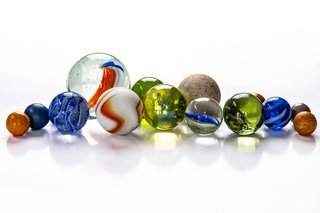
Why have we been comparing our planet to a marble in images like these for more than fifty years? Because the view really does echo the beauty of a classic glass marble, both tactile and visually beguiling. Credit for that charming toy goes to Thuringian glassmakers from Lauscha. In the mid-19th century they combined an inventive spirit with a willingness to experiment to create something new. Key pioneers were Elias Greiner Vetters Sohn and Johann Christoph Simon Karl Greiner. They drew inspiration for their glass marbles from precious agate spheres from the gemstone town of Idar‑Oberstein.
A decisive development was the adaptation of a pair of tongs used to make eyes for stuffed animals into the so-called Märbelschere (the marble shears). With that tool, factory production of glass marbles in Lauscha took off, and the Thuringian town remained the world capital of marble making until the early 20th century. Since 1975 glass marbles (locally known as "Glosmärbel") have again been made by hand in Lauscha, chiefly at the Elias Farbglashütte. Historic Lauscha marbles are prized collectors’ items, and the Lauscha Museum of Glass Art mounted a major special exhibition on the subject in 2019–2020.
Global success of the glass marble
Today much of glass marble production is concentrated in Mexico. "We produce for the whole world," Edgar Armenta, Glasfirma’s international sales manager, told Spielwarenmesse 2026 in Nuremberg. The company is based in Guadalajara. The metropolis of 1.9 million residents in the state of Jalisco is the country’s second-largest city. Glasfirma’s mechanized production covers the full range of glass marble manufacturing, and even makers of the popular marble runs are among its customers.
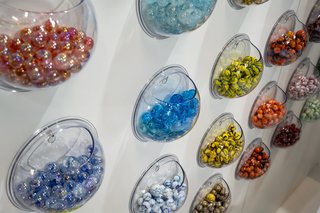
In addition, glass marbles remain highly sought after as classic children’s toys, collectors’ items, sports equipment and promotional merchandise. "It’s not always possible to draw a clear line," says expert Armenta. Children who play with marbles often collect them as well, for example special editions featuring popular designs. In any case, this analogue toy, so firmly rooted in the 19th century, is very popular in an age of digital media. Glasfirma processes around 60 tonnes of raw material into marbles each month, which equates to a production of several million of these attractive toys. Sustainability is important to the Mexican manufacturer, the sales manager emphasizes: recycled glass plays a key role as the starting material.
Responsible use of resources
The theme of sustainability is not new in the history of marbles. Their story goes back at least 3,000 years. That is the age of finds and depictions of play spheres made from clay, stone, glass and other materials. For many centuries marbles made of marble and other fine stones were especially influential. That origin is also reflected in the word "marble". In English "marble" denotes both the rock and the toy.
They were produced in Kugelmühlen. These were water‑powered mills in streams or small rivers where roughly shaped reject fragments from the stone industry were ground into perfect spheres. Originally the small balls were used as shot for ship cannons and as ballast in long‑distance trade with large sailing ships. Eventually they became established as children's toys. The craft of the Kugelmüller was once widespread in the Alps and low mountain ranges. Today working historic marble mills can still be found, for example in Neidlingen (Swabian Alps) and Seeham (Austria).
From Schoolyard to Championship
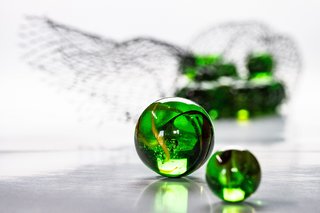
Whether it’s a spontaneous children’s game on the schoolyard or an official championship, marbles invite playful competition. Legendary is the annual Good Friday event The British and World Marbles Championship in England, a slightly eccentric contest traditionally held outdoors at the Greyhound pub in Tinsley Green. Locals trace the tradition back to the late 16th century, and play follows the rules of the "English Ring Game". The aim is to use a large marble, the "tolley", to knock the smaller marbles out of the playing area. If you buy a modern marble set from Glasfirma in a mesh bag, you will often find exactly that combination of one large and several smaller marbles.

Competitions often demand an astonishing level of dexterity and precision. A visit to the First Marbles Club Ludwigshafen‑Friesenheim 1997: the sports club meets in winter for indoor training on small table lanes with various obstacles. "This is our Friesenheim pentathlon," laughs club chairman Theo‑Heinz Adrian. Play is with marbles made of glass or ceramic materials, each with a diameter of exactly 16 millimetres. "The tolerance is plus/minus 0.25 millimetres," Adrian explains.
In summer the club moves its activities outdoors, where there are dedicated sand‑surfaced lanes. Training and tournaments there follow the rules of the "German hole game". In everyday speech the game is simply called "Kuhlemurmeln". There are around 20 active marble clubs in Germany, with the German Marbles Council as the umbrella organisation. The German Championship will take place this year on 25 July 2026 in Sandhatten. The tournament is being organised by the local sports club Murmel 011, which is celebrating its 15th anniversary.
About the author
Telling stories about technology and people: This has fascinated Peter Thomas, the journalist, author, cultural scientist and lecturer for more than 30 years. Technical toys are always in focus, from construction kits to interactive digital educational toys. After studying and working as a research assistant at university, Peter Thomas writes for daily newspapers, magazines and corporate publications in German and English-speaking countries. In addition to the world of games, his focus is on mobility, security, energy and medical technology.