

India: The Next Global Toy Hub
From a Growing Market to a Global Export Ambition
By Anand Khetan and Atish Laddha
As toy supply chains diversify, India is shifting from a domestically focused market to a serious export partner. Policy support, a design-driven manufacturing base and the pending EU India FTA position the country as a complementary hub to China and Vietnam, opening sourcing options for brands, manufacturers and buyers.
From import dependence to exports

India’s toy industry has experienced a remarkable turnaround. Once heavily dependent on imports, the industry no longer competes only for its domestic consumers but also commands a foothold in the global market, accounting for roughly 0.3 % of worldwide toy exports. In 2025, the United States emerged as the single largest destination, absorbing 53.1 % of India’s total toy‑export volume, followed by the United Kingdom, Germany, the Netherlands and Poland. On the import side, China provides 39.6 % of all toy imports, making it the dominant source, while the United Arab Emirates, the United States, Germany and the Netherlands round out the top five suppliers.
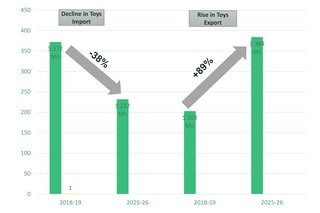
The import of toys into India has declined by 37.5%, while toy exports have increased by 89.1%. These shifting dynamics highlight India’s evolution from a net importer to an emerging exporter in the global toy arena, underscoring new growth opportunities and the need for strategic market diversification.
The Indian Government now targets 5% of the global toy market by 2032, up from roughly 1.9% today. That expansion is not accidental, it reflects a coordinated Government push spanning manufacturing incentives, cluster development, and export financing aimed squarely at international buyers.
Reaching the target demands more than assembly work. It requires a design-driven manufacturing base that can produce components, certify safety, and build recognizable brands. For brands, manufacturers, and buyers seeking to diversify supply chains beyond China and Vietnam, India is emerging as a serious proactive alternative and not a fallback.
Government Initiatives Strengthening India’s Toy Industry
National Action Plan for Toys: 21-point framework coordinated by 14 ministries promoting quality, innovation, indigenous toy design and manufacturing.
Quality and Safety: Stronger standards and monitoring to curb substandard imports and improve global competitiveness.
Manufacturing & Exports: Cluster-based manufacturing, promotional programs such as “Toycathon” and RoDTEP (export incentive) support are strengthening domestic production and exports.
FTA-led Market Access: India’s growing network of FTAs including with the EU, UK, EFTA, UAE, Australia, Oman and New Zealand is opening preferential/duty-free access for qualifying toys, subject to Rules of Origin.
EU–India FTA: A potential new chapter for Indian toy market
Negotiations concluded on 27 January 2026 and yet to be signed, the EU–India FTA is expected to provide broad duty-free market access for Indian exports, with significant tariff liberalization for labor-intensive sectors such as toys. The removal of tariffs is expected to enhance the competitiveness of Indian toy manufacturers, support employment and strengthen India’s integration into the European toy market.
Beyond tariffs, the FTA opens a strategic pathway for Indian manufacturers to become part of Europe’s supply chain rather than a peripheral assembler. The FTA can further strengthen the competitive advantage of Indian toy manufacturers, as their growing alignment with international safety standards positions them to meet stringent EU requirements and build greater buyer confidence in the European market. The agreement also encourages alternate sourcing, allowing European companies to diversify risk by adding India as a reliable, second‑tier base for components, moulds, and finished toys.
Timing is crucial. The FTA arrives as global toy makers reassess supply‑chain resilience, favoring multi‑country strategies over single‑source dependence. Coupled with India’s domestic strengths such as large consumer base, skilled labor, government incentives for indigenous manufacturing, and existing along with upcoming FTAs with the Gulf Cooperation Council nations, Mexico, Brazil and Canada, the country is poised for a ten‑fold growth trajectory. Success will hinge on firms delivering European‑grade design, safety, sustainability and cost‑competitiveness, while navigating rules‑of‑origin requirements that demand genuine Indian value‑addition.
In short, the EU‑India FTA offers more than a tariff break; it provides a platform for Indian toy makers to evolve from domestic suppliers to global manufacturers, driving investment across the entire ecosystem from moulds and plastics to R&D and branding. If Indian firms can meet the higher standards and seize the expanded market access, the agreement could shift India’s toy industry from a domestic supplier to a globally recognized hub, fueling economic development and ushering in a new era of play worldwide.
Global Players: What’s Next?
For companies looking to source, manufacture, partner or expand in India, the evolving EU–India trade landscape creates several strategic opportunities:
Rethink the supply chain. A “hub-and-spoke” model can enable companies to source raw materials and components from cost-competitive FTA partners and undertake manufacturing/ assembly in India. Businesses should conduct a material-level Rules of Origin assessment and optimize their bill of materials to meet applicable origin requirements for preferential EU tariff treatment.
Choose the right manufacturing model. Companies can establish a full-scale manufacturing base, enter into joint ventures with established Indian manufacturers to leverage local capabilities and market knowledge, or use contract manufacturing as a capital-efficient way to test and scale their presence in India.
Build compliance into the supply chain. FTA benefits require robust processes for certificates of origin, procurement, production and customs records. Digital documentation and traceability will be critical to substantiate origin claims and withstand customs verification.
Protect intellectual property early. Companies should register trademarks, designs and patents in India and incorporate clear IP protection, confidentiality and ownership provisions in partnership agreements.
From Opportunity to Action
India’s toy sector is no longer a peripheral market; it is positioning itself as a global manufacturing and design hub. The convergence of government support, state-level manufacturing clusters and the EU–India FTA is creating new opportunities for both Indian and international players.
Companies that build compliant and cost-efficient supply chains, select the right manufacturing model and establish strong local partnerships will be best placed to convert these evolving trade conditions into a sustainable competitive advantage. For international businesses, India offers more than access to a growing domestic market it could become a strategic gateway to Europe and wider global markets.
For companies looking to turn this potential into business opportunities, engaging directly with India’s toy ecosystem and building the right local connections will be increasingly important. As India strengthens its position as a global toy hub, Kids India, the premium trade fair in the country for toys and children’s products, provides an ideal platform for international companies to experience this dynamic market, meet potential partners and explore the opportunities ahead.
Looking to understand India’s rapidly evolving toy industry and identify new business opportunities?
Join our exclusive delegation and gain first-hand insight into India’s dynamic toy market through expert briefings, B2B matchmaking, a visit to Kids India, factory visits and retail tours.
Discover the market. Meet the industry. Explore new opportunities.
About the authors
Anand Khetan
With two decades of experience, Anand Khetan advises multinational companies on GST, customs, foreign trade, M&A, subsidies and industrial policy matters. He is Partner, CFO and Head of Tax Advisory at RÖDL India, and has contributed as a speaker at industry and educational forums, including as a guest lecturer at universities in Germany.
Atish Laddha
Atish Laddha is Partner and Head of Indirect Tax Advisory at RÖDL India, with nearly 15 years of experience in indirect tax consulting and litigation. His practice covers GST, customs, cross-border transactions, tax structuring, M&A due diligence and investigations. He also regularly shares his expertise through industry seminars and professional training sessions.