The rise of the robots
ToyHistory: How the vision of automation found its way into the playroom
By Artemis Yagou
Long before modern Artificial Intelligence dominated headlines, humans were already obsessed with automata, moving forms with clockwork mechanisms. For centuries, audiences were fascinated by such figures that imitated life. These objects were microcosms that elicited human wonder about new technologies as well as anxiety about their potential implications.
The fascination with robots entered the playroom
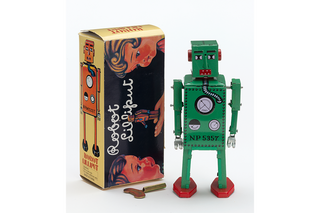
But it wasn’t until the 1920s that Czech writer Karel Čapek introduced the word "robot" to our collective vocabulary and captivated human imagination. By the late 1930s, this fascination entered the domain of play; it was in 1937 when a Japanese toy maker released Lilliput, a tiny tinplate figure powered by a simple clockwork mechanism. Today, it is widely considered as the world’s first toy robot. Lilliput established a silhouette that became widely imitated and defined toy robots for several decades. After World War II, in the 1950s and 1960s, there was an explosion of toy robot production, shifting from tinplate to colourful plastics and from wound-up toys to battery-operated ones. Toy robots invited open-ended role-playing and pure fantasy. Their simple mechanics and futuristic designs became catalysts for endless adventures, limited only by the boundaries of a child’s imagination.
Toys backed the robots' reputation

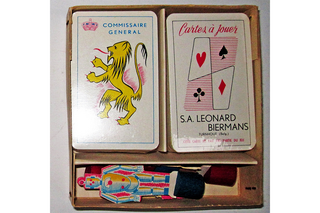
The idea of robots influenced other types of play too. Take Exporama, a 1958 Belgian board game launched in conjunction with the Brussels World’s Fair. This international Expo 58 celebrated the post-war optimism about the peaceful and constructive use of powerful science and technology. Exporama included game pieces featuring national exhibition pavilions and uniformed hostesses; additionally, players could move a dedicated robot figure. Serving as a substitute guide for players without a hostess, the robot was a literal representation of automation stepping in to assist rather than threaten humans.
Indeed, play-related robots responded to the complex emotions elicited by the development of robotic technology. Throughout the twentieth century, rapid scientific advances sparked intense and mixed reactions: excitement for the future, shadowed by fear of what that future might bring. Toy robots helped tame those fears. By turning intimidating, sci-fi concepts into cute, approachable figures, they made the unknown feel safe.
Collectors’ delight
Since the 1970s, reproductions of tinplate robots aimed specifically at the adult collector market began emerging; these products take advantage of people’s nostalgia for childhood and for the toys they enjoyed as children. One faithful replica of the Lilliput was made in China in 2013 for the U.S. toy company Schylling. Its packaging captures the deep cultural split that robots have always inspired. On the one hand, a charming illustration of a young girl showing the toy to a boy highlights childhood wonder. On the other hand, the long edge of the box features a stark, yellow robot printed with a stencil font, evoking utility, efficiency and precision. This modern version of the Lilliput is no longer a toy; the box explicitly warns that it is "for adult collectors only”. The reason is that sharp edges and small clockwork keys violate modern safety regulations and thus vintage tinplate toys cannot be legally sold as children's toys today. They are however highly sought after by collectors. While early originals of the toy are exceptionally rare—one fetched £2,280 at a UK auction in 2016—modern reproductions can easily be picked up online for under €30.
The epitome of history, design and technology
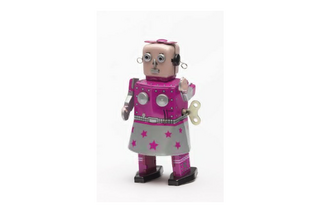
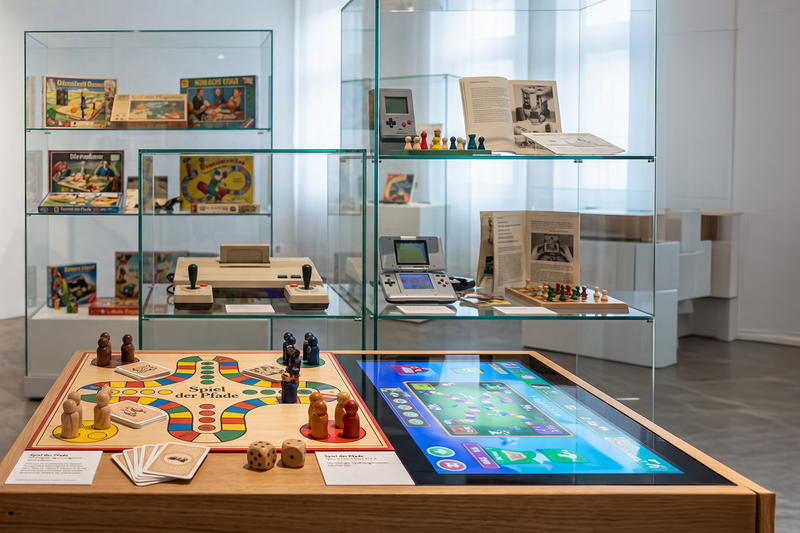
Toy robots fascinate people because they combine history, design and technology. It comes as no surprise that they are nowadays preserved and exhibited in remarkably different types of museums. Toy museums, like the Nuremberg Toy Museum, display them as nostalgic objects of childhood history. Design Museums, like the Vitra Design Museum at Weil am Rhein, showcase them as iconic examples of 20th-century aesthetics and popular culture. Science and Technology Museums, like the Deutsches Museum in Munich, present them as early reflections of how society visualised automation and robotics.
Over the decades, robot technology has evolved massively. Robots are nowadays standard elements in many aspects of everyday life: as vacuum cleaners in our homes, as industrial robots in modern manufacturing, even as robotic pets for companionship, care and education. Proper robots are admired and feared at the same time, as they represent our grandest technological dreams and our deepest anxieties.
Conclusion: Toys help to set up for the future
In this context, what toy robots achieve is to transfer our fascination and fear onto the small scale of everyday life and make it more manageable. Dealing with such toys, we can transform the unsettling into something not only controllable, but also fun. The success of toy robots for almost a century illustrates how excited we are by forms of artificial life—a story we've been playfully exploring for generations.
Technical Toys, Educational Toys, Action Toys
Exhibitors will be showcasing the latest robots and technical toys at the Nuremberg Toy Fair, taking place in Nuremberg from 2 to 6 February 2027. Find out more about the market segment and the manufacturers in Halls 4, 5 and 6.
Go to the product group: Technical Toys, Educational Toys, Action Toys
About the author
Dr. Artemis Yagou works at the Research Institute for the History of Technology and Science at the Deutsches Museum in Munich. Her research focuses on the history of design, the cultural history of technology, the history of technical construction kits, the history of chronometry, the material culture of Greece (18th to 21st centuries), and museums. Since 2016, she has been collaborating on the DFG project ‘How they played: Children and construction toys (c. 1840–1940)’. In 2026, her outstanding research findings were honoured with the ITRA Senior Prize by the International Toy Research Association.