

History of Toy Industry Associations
ToyHistory: History of the Toy Industry Association (1900–1950)
Editor’s Foreword
To mark the 75th anniversary of the Spielwarenmesse, we are expanding the Spirit of Play online magazine to include the “ToyHistory” section. To kick things off, we look back at the historical circumstances that made Nuremberg the home of the world’s leading toy trade fair. The research was conducted by Dr. Helmut Schwarz, an economic historian and former director of the Nuremberg Toy Museum.
By Dr. Helmut Schwarz
With the emergence of a diversified industrial and consumer society at the beginning of the 20th century, the first trade associations also began to form in the toy industry. In this extraordinarily heterogeneous sector, the realization gradually took hold that the prevailing “everyone against everyone” struggle was ultimately harmful to all. Consequently, members joined forces on the basis of shared economic goals in order to effectively represent their interests to external stakeholders (politicians, government agencies, workers, the press, etc.). Internally, these associations served to facilitate the exchange of information and provide expert support to members on all matters related to their profession.
Toy manufacturers generally formed associations based on the type of products they produced and/or their regional origin. As a result, numerous independent associations emerged by the mid-1920s in the major toy-producing regions of Nuremberg–Fürth, Thuringia, Saxony, and Württemberg. Pioneers in this field included the Association of German Pewter Figurine Manufacturers (founded in 1904 in Nuremberg) and the economically significant Association of Toy and Metal Goods Manufacturers and Related Industries of Nuremberg–Fürth and the Surrounding Area (founded in 1912). From the outset, the associations representing wholesalers and retailers tended to be organized on a nationwide basis. For example, the Association of German Department Stores and Retailers, which was significant for the toy industry, was founded as early as 1903 and was headquartered in Berlin. The following year saw the founding of the Association of German Toy Merchants (VEDES), which was initially based in Witten and later in Berlin.
Under pressure from the war economy, leading individual associations merged in Leipzig in 1917 to form the German Toy Association, at the initiative of toy manufacturers from Sonneberg. However, due to conflicting interests between industry and commerce, this first umbrella organization for the sector was short-lived. More successful was the Reich Association of German Toy Manufacturers, founded in Nuremberg in 1924, to which all major individual associations belonged. After 1933, in the wake of the National Socialist restructuring of the economic order, all independent interest groups were dissolved. The existing associations were replaced by economic and professional groups organized according to the Führer principle, with mandatory membership.
After the war ended, the occupying powers dissolved all Nazi economic organizations. In the Western zones, the establishment of new voluntary trade associations at the state level was permitted. Against the backdrop of the looming division of Germany, the associations in Bavaria and Baden-Württemberg played a particularly important role in the reconstruction of the toy industry. Through their cooperation in the bizonal Working Group on the Toy Industry, they—together with VEDES—made a decisive contribution to the realization of the first German Toy Trade Fair.

The association landscape of the toy industry retained a federal structure in the young Federal Republic. It was not until 1974 that a national umbrella organization was reestablished for the first time with the Nuremberg-based Association of the German Toy Industry, from which the German Toy Industry Association ultimately emerged in 1991 under the influence of reunification, the EU single market, and globalization.
[Manuscript completed by the author in July 2017]
Suggested Citation
Schwarz, Helmut: History of Toy Trade Associations, manuscript completed by the author in July 2017; published posthumously online on August 31, 2026, in: Spirit of Play Online Magazine. Spielwarenmesse Group, Nuremberg. Online:https://www.spielwarenmesse.de/de/magazin/toyhistory/helmutschwarz-trade-fair-history (Accessed: DD, Month YYYY).
About the Author
Dr. Helmut Schwarz (September 5, 1952 – February 20, 2022) was an economic historian and served as director of the Nuremberg Toy Museum from 1994 to 2014. Together with his team, he modernized the museum, expanded the children’s play area, and created the museum playground with a café and the virtual storage facility. He also personally championed the effort to bring the German Toy Archive from Marburg to a new home in Nuremberg. He authored numerous works on the history of the toy industry.
Toy History – The Beginnings of the Spielwarenmesse
Starting in 2016, Dr. Helmut Schwarz conducted research on the company’s history on behalf of Spielwarenmesse eG. In particular, he identified the conditions and factors that led to the founding of the trade fair in Nuremberg. The trade fair team will publish the manuscripts he completed in 2026 in the online magazine *Spirit of Play* to mark the 75th anniversary of the Spielwarenmesse, thereby honoring a significant custodian of knowledge regarding German toy and economic history.
Die Reihe im Überblick
The series will consist of nine web summaries and seven research papers examining the origins of the Toy Fair.
ToyHistory 01: The Nuremberg Toy Region | 24. Juni 2026
- Short web version: The Nuremberg Toy Region (November 2017)
- Short web version: Fürth and Zirndorf as toy-making centres (December 2017)
- PDF research paper: Nuremberg, the Toy City (January 2017) - Available in German only.
Toy History 02: Toy-making regions in Germany | 13 July 2026
Thuringia – Saxon Ore Mountains
- Web summary: Toy Region Thuringia (November 2017)
- Web summary: Toys from the Saxon Ore Mountains (see below) (November 2017)
Toy History 03: Toy-making cities in Germany | 27 July 2026
Württemberg – Berlin and Brandenburg at the Havel
- Web summary: Toy Region Württemberg (November 2017)
- Web summary: Toys from Berlin and Brandenburg an der Havel (December 2017)
Toy History 04: Ways to the Buyer | 03 August 2026
Toy trade in Germany until 1945
- Web summary: Toy trade in Germany until 1945 (November 2017)
- PDF research paper: Ways to the Buyer (January 2017) — Available in German only.
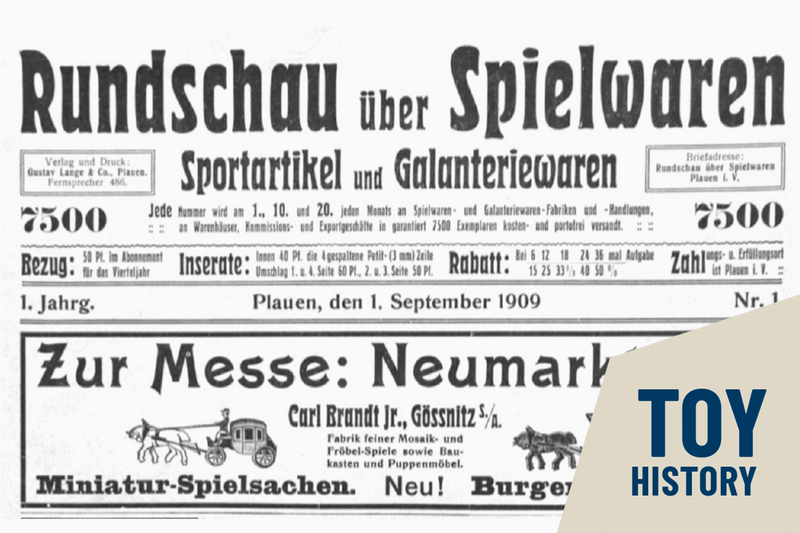
Toy History 05: The Trade Press | 24 August 2026
Trade Journals and Newspapers of the Toy Industry (1886–1960)
- Web summary: Toy trade in Germany until 1945 (November 2017)
- PDF research paper: The Trade Press (January 2017) — Available in German only.
Toy History 06: History of the Toy Industry Associations | 31 August 2026
- Web summary: History of the toy industry associations (July 2017)
- PDF research paper: History of the toy industry associations (1900–1950) (January 2017) — Available in German only
Preview 14 September 2026: Toy History 07: Trade Fair History of the Toy Industry before 1950
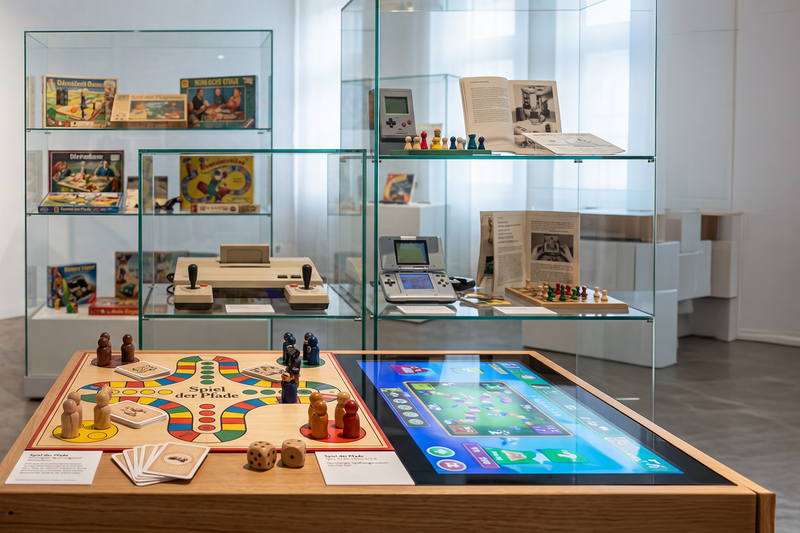
Delve even deeper into the history of the toy industry: Spanning 1,400 square meters, the world-famous Toy Museum showcases the world in miniature with a wealth of extraordinary exhibits ranging from antiquity to the present day. In addition to an imaginatively designed children’s area in the attic, visitors can also enjoy a large outdoor playground and the museum café in the courtyard.
Location: Nuremberg Toy Museum, Karlstrasse 13-15, 90403 Nuremberg
Exhibition: Games—History(ies) February 20 through September 13, 2026
Visit the website Spielzeugmuseum Nürnberg