

“Happiness on Earth” made of wood, fabric, and lots of joy
Equestrian Sports in Games and Toys
By Peter Thomas
Show jumping, dressage, Western riding: All disciplines of this playful sport were on the program at the first European Hobby Horsing Championships in Prague in June 2026. The European Championships were the latest highlight in this success story of equestrian sports in games and toys. An entire segment has developed within the industry, one that is attractive to both manufacturers and retailers.
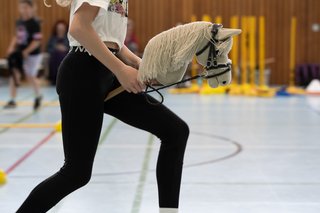
Full concentration, the reins are held slightly taut, and the course with its steep jumps lies directly ahead. Then the starting signal—rider and horse set off. The judges’ eyes follow every movement: How are the jumps executed? What is the horse’s posture like? Is the lead change successful? No, this scene isn’t taking place at a traditional horse show, but at a Hobby Horsing competition. The sport draws on the concept of the hobby horse and combines the toy with the fascination of competitive equestrian sports.
Hobby horsing has long since evolved from a niche sport into an international phenomenon. In Germany alone, Andreas Karasek, president of the German Hobby Horsing Association (DtHHV), estimates the number of active athletes at well over 10,000. The focus is on the 12- to 15-year-old age group. This includes a vibrant ecosystem of clubs, training camps, competitions—and related products. A major highlight of the 2026 events for the scene was the German Championships in Frankfurt am Main, which drew more than 1,000 participants and featured competitions in numerous disciplines. This was followed in June by the inaugural European Championships in Prague, which garnered significant international attention.
Impressions from the European Hobby Horsing Championship in Prague
European Hobby Horsing Championship: https://www.instagram.com/europeanhobbyhorsechampionship/?igsh=MWMxdDg1dXhybjU0MQ%3D%3D#
International Hobby Horse Federation: https://www.instagram.com/hobbyhorsefederation
A Long Tradition
Hobby horses are by no means a new type of toy: Their history can be traced back to the Middle Ages, and there are even accounts of them from antiquity. This is hardly surprising; after all, since its domestication some 5,000 years ago and well into the 19th century, the horse played a key role in human mobility—as a mount, a carriage horse, and a driving force in agriculture. In children’s play, these functions were imitated using various play items and toys: rocking horses are just as much a part of the classics as toy horses made of wood and other materials—and, of course, hobby horses. The term has become established in various languages as a way to describe leisure activities pursued with great enthusiasm. In German, “Steckenpferd” sounds a bit dated in this context. But the English word “hobby,” a shortened form of “hobby horse,” is understood worldwide as an umbrella term for sports and games.
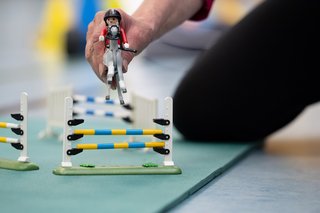
Today, miniature horses remain among the most popular animal figures: from Schleich’s wide range of lifelike plastic horses to Ostheimer’s beautifully abstracted wooden horses, and from role-playing systems like Playmobil to products from numerous other manufacturers. At the 2026 International Toy Fair, visitors could discover the full spectrum of horse-themed offerings in the toy industry. The offerings even include mechanical riding simulators, such as those presented by Ponycycle in Nuremberg, which are also designed for adults. The appeal of this playful imitation of horseback riding has a long tradition in the form of elaborately designed carousels. These rides drew inspiration from courtly equestrian games and made them accessible to a middle-class audience. The oldest operational carousel in Europe is located in Hanau (Hesse) and features a series of particularly high-quality horses. For conservation reasons, these “Dresden parade horses” can no longer be ridden today, but visitors can admire them while comfortably seated in a carriage as the carousel turns.
From Equestrian Sports to Hobby Horsing
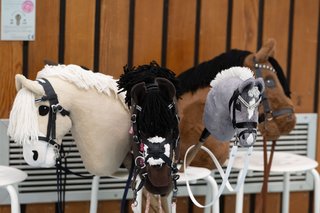
A hobby horse typically consists of a rod-shaped body and a horse’s head—often with wooden handles. In hobby horsing, a simplified version of the toy without such handles is used; instead, the horse is guided by reins and a handle on its body. The sport emerged as a leisure phenomenon in Scandinavia in the early 2000s. There, a fascination with the classic children’s game converged with the new possibilities of digital interaction. As digital and social media gained momentum, the hobby horsing scene also grew. Championships have been held in Finland, for example, since 2012. The transition from a playful internet phenomenon to a sport with rules, training, and championships went hand in hand with the demand for “horses” and the full range of accessories, from bridles to stalls. HKM Sports Equipment, a supplier based in Neuenhaus, Lower Saxony, and focused on recreational equestrian sports, already possessed the necessary expertise in “full-scale” equestrian sports. The company recognized the Hobby Horsing trend early on and successfully adapted its product line. Managing Director Orlando Roque says that “virtually every product available for full-size horses” can also be adapted into a miniature version for hobby horsing. The industry benefits from the fact that this playful sport closely follows the rules of real equestrian sports. HKM’s current hobby horsing product line now includes more than 100 items, among them are 23 different horses alone. One of the company’s bestsellers is the first Hobby Horse, which was launched in 2021. Outdoor jumping obstacles are also in high demand. The complete product line—including bridles, decorations, storage solutions, and grooming supplies—rounds out the play experience. Here, sports, role-playing, and collecting all come together.
A Successful Media Topic
Diversity defines hobby horsing: The sport is just as prevalent in the private sphere as it is in its organized form, with clubs, rules, and championships. But the industry itself is also highly diverse. This is evident at events ranging from regional training camps to top-tier championships. After all, the supporting program always includes numerous booths from manufacturers and retailers. These include major brands as well as small businesses that specialize in handmade items. In any case, the customization of one’s own hobby horse and accessories plays an important role. This trend has also made the leap from digital media to traditional formats. Kosmos Publishing, for example, publishes the series “Die Hobby-Horsing Kids” for readers ages seven and up. There is already a wide selection of guidebooks on the sport.
A Segment for the Future
Clubs, associations, and the manufacturing industry are pleased with the current development of hobby horsing. HKM, for example, confirms that tournament formats and championships are becoming increasingly important to customers. As a result, alongside the play trend, a structured leisure activity with established platforms and a competitive nature is taking hold. This offers interesting growth potential for the category in the toy retail sector. But another sector is also benefiting, says HKM Managing Director Orlando Roque: Traditional equestrian specialty retailers have likewise established themselves as an important sales channel for the sport. The fascination with “the joy of riding on horseback” finds expert advice here for both hobby horsing and “traditional” equestrian sports.
Sport, Leisure, Outdoor Product Group at the Spielwarenmesse
This product group at the Spielwarenmesse in Nuremberg brings together everything for an active lifestyle and leisure activities. From durable outdoor apparel and camping gear to fitness and team sports equipment, as well as games and leisure accessories. Visitors will find new products, technical innovations, and sustainable concepts, as well as hands-on product demonstrations. It’s ideal for buyers, distributors, and specialty retailers looking to expand their product ranges, discover new brands, and build business partnerships.
More information about the product group Sport, Leisure, Outdoor
About the Author
Telling stories about technology and people: This has fascinated Peter Thomas—a journalist, author, cultural studies scholar, and lecturer—for more than 30 years. Technological toys are a recurring focus of his work, ranging from construction sets to interactive digital educational toys. After completing his studies and working as a research assistant at the university, Peter Thomas has been writing for daily newspapers, magazines, and corporate publications in both German- and English-speaking regions. In addition to the world of play, his areas of focus include mobility, security, energy, and medical technology.