

The reconstruction of the toy industry in Nuremberg
‘In the face of the rubble-strewn landscape …’ From ‘Toy City’ to trade fair venue (1945–1950)
Editor’s Foreword
To mark the 75th anniversary of the Spielwarenmesse, we are expanding the Spirit of Play online magazine to include the “ToyHistory” section. To kick things off, we look back at the historical circumstances that made Nuremberg the home of the world’s leading toy trade fair. The research was conducted by Dr. Helmut Schwarz, an economic historian and former director of the Nuremberg Toy Museum.
By Dr Helmut Schwarz
With the end of the war, all state authority in Germany passed to the four occupying powers: France, Great Britain, Russia and the USA. Politically speaking, the country’s reconstruction was to follow the unanimously agreed guiding principles of denazification, demilitarisation, democratisation and decentralisation.
The reconstruction of Germany after the Second World War
However, joint administration of Germany by the Allied Control Council soon proved impossible. As the rift between the victorious powers widened, the course was increasingly set for the emergence of two German states with different political and economic systems. In the early post-war years, within the framework of the guidelines and regulations laid down by the respective military governments, the federal states and local authorities were primarily concerned with restoring orderly administration, providing for the population and rebuilding a functioning infrastructure.
Toy production had come to a standstill
At the end of the war, Nuremberg lay in ruins. Around half of the local toy manufacturers had been completely destroyed or severely damaged. Many skilled workers had been killed or were being held as prisoners of war. Shortages of materials, a lack of capital, and the collapse of trade relations and sales channels made the production of toys seem virtually impossible. In view of the widespread shortages, therefore, the focus was initially on producing mainly everyday necessities.
Tin toys are becoming a hit export
However, it soon became apparent that producing export goods made far more economic sense and held greater promise for the future. The foreign exchange earnings generated in this way could be used to pay for urgently needed imports of food and raw materials. Due to its high value-added ratio (significant value creation with minimal raw material requirements), mechanical tin toys in particular proved to be a prime export commodity. At the behest of the US military government, and in consultation with the Bavarian Minister for Economic Affairs, Ludwig Erhard, special export programmes were therefore launched as early as 1946. Many major companies in Nuremberg and Fürth were occupied almost exclusively with export deliveries – mostly to the USA – for two to three years. Although the domestic market was neglected, the export orders were essential for a relatively rapid recovery of the tin toy industry.
Franken is driving the recovery of the toy industry
Following the de facto disappearance of the toy-producing regions in the Eastern Zone, the Nuremberg-Fürth industrial district assumed the leading economic role in West Germany. Experts from the Franconian toy industry – notably Ernst Theodor Horn, Ernst Riemer and Hans Mangold – also played a confident pioneering role in the organisational reconstruction of the German toy industry. As early as May 1946, the Association of the Bavarian Toy Industry was founded (with Ernst Th. Horn as its first chairman, followed by Hans Mangold). Shortly afterwards, the official pricing and registration office for toys was established in Nuremberg. Its director, Ernst Riemer, also served as the Bavarian State Government’s export representative. He assessed the export suitability of the respective items, allocated raw materials and handled the highly bureaucratic export formalities.
The merger of the US and British occupation zones led to the creation of the United Economic Area in Germany in January 1947. This bi-zone, together with the currency reform and the accompanying economic reforms the following year, paved the way for the transition from a command economy to a market economy. At the same time, it opened up the possibility of representing industry interests across the previous state borders. In November 1948, the trade associations of southern and western Germany joined forces to form the Working Group of the Toy Industry of the United Economic Area, based in Nuremberg. Together, they worked with the military administration and the German government authorities of the bi-zone to bring about market-based liberalisation of production and sales conditions in the toy industry. A key objective was, above all, the removal of existing export barriers.
Calls for a dedicated trade fair are growing louder
The de facto demise of the Leipzig Universal Fair as the central marketplace for the whole of Germany also left a painful void in the toy industry. Hanover, Cologne and Frankfurt vied to take its place, but their multi-sector trade fairs were unable to meet the specific needs of the toy industry. Consequently, in the spring of 1949, business circles in Nuremberg-Fürth came up with the idea of launching a dedicated trade fair in Nuremberg, the ‘toy city’. Arno Drottboom, a member of the Vedes Executive Board, pledged the support of the specialist retail trade, and the AG Spielwarenindustrie set about organising the event. It formed trade fair committees comprising representatives from all regional trade associations as well as the wholesale and retail sectors. Carl Ehmann, chairman of the Württemberg-Baden Association, proved to be particularly important in this regard. Under the leadership of Hans Mangold, who personally vouched for the fair, the organising team led by fair director Fritz Drescher and Ernst Theodor Horn managed to set up the first German Toy Trade Fair practically from scratch within a few months. The city of Nuremberg was involved from the outset and supported the project at an administrative level.
German Toy Fair: A turning point between the post-war period and reconstruction
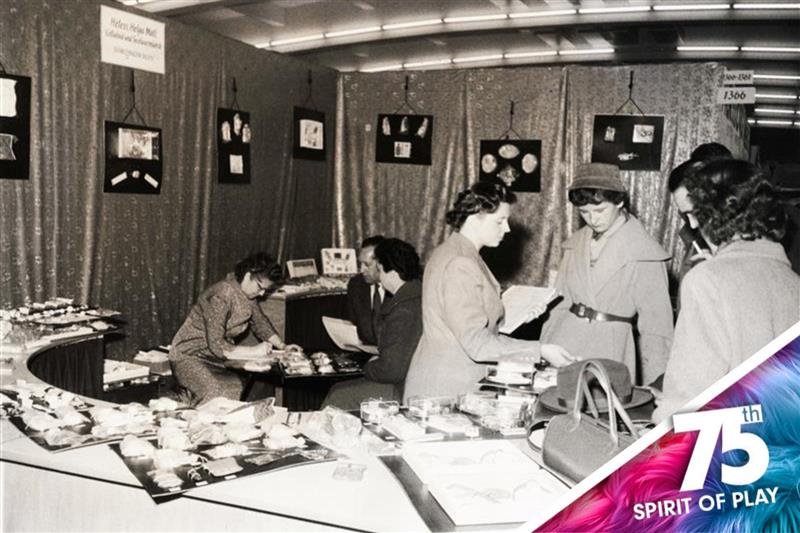
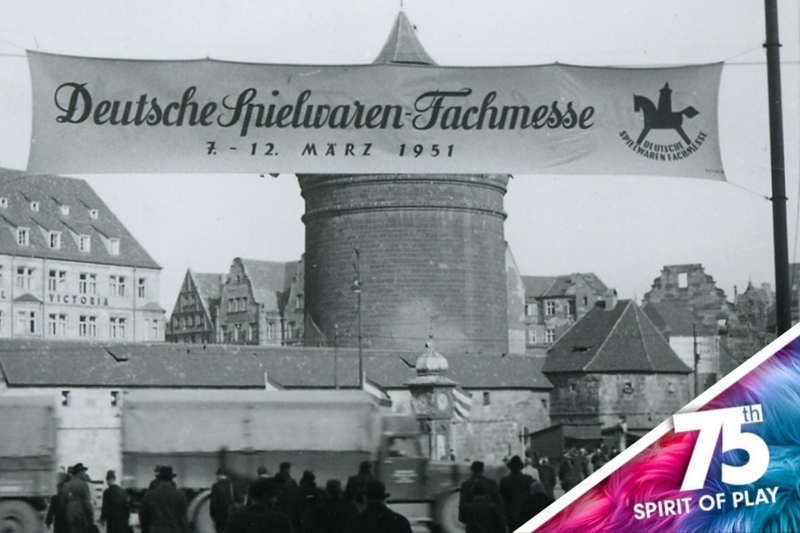
What began as an experiment with an uncertain outcome turned out to be – despite the expected teething problems – a resounding success. The fair, which ran from 12 to 18 March 1950, was attended by 351 exhibitors. 4,341 buyers, including around 600 from abroad, were able to gain a comprehensive overview of the German toy industry, which had already regained its astonishing capacity.
Acting as a bridge between the post-war ruins and the economic miracle, the first Toy Fair made a significant contribution to the industry’s continued recovery and return to normality in peace and freedom. All those involved agreed that the fair, as an indispensable marketplace for the toy industry, should be held regularly in Nuremberg in future. To this end, on 11 July 1950, 46 members of the toy industry founded the cooperative ‘Deutsche Spielwaren-Fachmesse eGmbH’, later renamed ‘Spielwarenmesse eG’.
References
Georg Wenzel: Die Geschichte der Nürnberger Spielzeugindustrie. Diss. Nürnberg 1967.
Eckehard Wiest: Die Entwicklung des Nürnberger Gewerbes zwischen 1648 und 1806. Stuttgart 1968.
Heidi A. Müller: Ein Idealhaushalt im Miniaturformat. Die Nürnberger Puppenhäuser des 17. Jahrhunderts. Nürnberg 2006.
Thomas Stauss: Frühe Spielwelten. Zur Belehrung und Unterhaltung. Die Spielwarenkataloge von Peter Friedrich Catel (1747‐1791) und Georg Hieronimus Bestelmeier (1764‐1829). Hochwald 2015.
Spielzeugmuseum Nürnberg (Hrsg.): Paradestücke. Zinnfiguren aus Nürnberg und Fürth. Nürnberg 2000 ( = Schriften des Spielzeugmuseums Nürnberg, Band IV).
Marion Faber: Nürnberg – ein Platz für Spiele. In: Helmut Schwarz/ Marion Faber: Die Spielmacher.
J.W. Spear & Söhne: Geschichte einer Spielefabrik. Nürnberg 1997, S. 24‐43.
Marion Faber: Spielzeug für die Welt. Nürnberg und die deutsche Spielwarenindustrie 1900‐1914. In: Mitteilungen des Vereins für Geschichte der Stadt Nürnberg. Bd. 100. Nürnberg 2013, S. 509‐543.
Helmut Schwarz/ Marion Faber: C. Baudenbacher. Erste Nürnberger Holzspielwarenfabrik. Firmengeschichte und kommentiertes Musterbuch, Nürnberg 2008 ( = Schriften des Spielzeugmuseums Nürnberg, Band VII).
Swantje Köhler: Christian Hacker. Holzspielwaren‐Fabrik in Nürnberg. München 2009.
Jürgen und Marianne Cieslik: Lexikon der deutschen Blechspielzeugindustrie. Jülich 2014.
Helmut Schwarz / Marion Faber: Bewegte Zeiten/ Moving Times. Ernst Paul Lehmann Patentwerk – Geschichte einer Spielwarenfabrik. Nürnberg 2003 ( = Schriften des Spielzeugmuseums Nürnberg, Band V).
Andreas A. Berse: Die Schuco‐Saga. 100 Jahre voller Wunderwerke. Bielefeld 2012.
Vedes (Hrsg.): 75 Jahre Vedes – 75 Jahre spielen. Nürnberg 1979.
Fritz Drescher: Die ersten 25 Jahre der Nürnberger Spielwarenmesse. Bamberg 1976.
Spielwarenmesse Nürnberg.
Citation suggestion
Schwarz, Helmut: The reconstruction of the toy industry in Nuremberg, manuscript completed by the author in March 2020; posthumously published online September 28, 2026 in: Spirit of Play (online magazine). Spielwarenmesse eG, Nuremberg. Online: https://https://www.spielwarenmesse.de/en/mag/toyhistory-helmutschwarz-trade-fair-history/ (accessed: DD Month YYYY)
About the author
Dr Helmut Schwarz (5 September 1952 – 20 February 2022) was an economic historian and director of the Nuremberg Toy Museum from 1994 to 2014. Together with his team, he modernised the museum, expanded the children’s play area, and created the museum playground with a café and the virtual storage facility. He also personally championed the cause of finding a new home in Nuremberg for the German Toy Archive from Marburg. He authored numerous works on the history of the toy industry.
Toy History – The Beginnings of the Spielwarenmesse
Starting in 2016, Dr. Helmut Schwarz conducted research on the company’s history on behalf of Spielwarenmesse eG. In particular, he identified the conditions and factors that led to the founding of the trade fair in Nuremberg. The trade fair team will publish the manuscripts he completed in 2026 in the online magazine *Spirit of Play* to mark the 75th anniversary of the Spielwarenmesse, thereby honoring a significant custodian of knowledge regarding German toy and economic history.
An overview of the series
The series will consist of nine web summaries and seven research papers examining the origins of the Toy Fair.
ToyHistory 01: The Nuremberg Toy Region | 24. Juni 2026
- Short web version: The Nuremberg Toy Region (November 2017)
- Short web version: Fürth and Zirndorf as toy-making centres (December 2017)
- PDF research paper: Nuremberg, the Toy City (January 2017) - Available in German only.
Toy History 02: Toy-making regions in Germany | 13 July 2026
Thuringia – Saxon Ore Mountains
- Web summary: Toy Region Thuringia (November 2017)
- Web summary: Toys from the Saxon Ore Mountains (see below) (November 2017)
Toy History 03: Toy-making cities in Germany | 27 July 2026
Württemberg – Berlin and Brandenburg at the Havel
- Web summary: Toy Region Württemberg (November 2017)
- Web summary: Toys from Berlin and Brandenburg an der Havel (December 2017)
Toy History 04: Ways to the Buyer | 03 August 2026
Toy trade in Germany until 1945
- Web summary: Toy trade in Germany until 1945 (November 2017)
- PDF research paper: Ways to the Buyer (January 2017) — Available in German only.
Toy History 05: The Trade Press | 24 August 2026
Trade Journals and Newspapers of the Toy Industry (1886–1960)
- Web summary: Toy trade in Germany until 1945 (November 2017)
- PDF research paper: The Trade Press (January 2017) — Available in German only.
Toy History 06: History of the Toy Industry Associations | 31 August 2026
- Web summary: History of the toy industry associations (July 2017)
- PDF research paper: History of the toy industry associations (1900–1950) (January 2017) — Available in German only
Toy History 07: Trade Fair History of the Toy Industry before 1950 | 14 September 2026
- Web summary: History of the toy industry associations (July 2017)
- PDF research paper: History of the toy industry associations (1900–1950) (January 2017) — Available in German only
Toy History 08: Nuremberg and the reconstruction of the toy industry (1945–1950) | 28 September 2026
- Web summary: Nuremberg and the rebuilding of the toy industry (1945–1950) (March 2020)
- PDF research paper: "In view of the fields of rubble ..." From the toy city to the trade fair venue – Nuremberg and the reconstruction of the toy industry (1945–1950) (March 2020) — Available in German only.
Preview 12 October 2026: Toy History 08: Cooperatives. Prehistory of Spielwaren-Fachmesse eGmbH