

Toy Making Cities in Germany
ToyHistory: Württemberg and Toys from Berlin and Brandenburg an der Havel
Editor’s Foreword
To mark the 75th anniversary of the Spielwarenmesse, we are expanding the Spirit of Play online magazine to include the “ToyHistory” section. To kick things off, we look back at the historical circumstances that made Nuremberg the home of the world’s leading toy trade fair. The research was conducted by Dr. Helmut Schwarz, an economic historian and former director of the Nuremberg Toy Museum.
By Dr. Helmut Schwarz (1952–2022)
The Württemberg toy industry differed from other German toy-producing regions in several respects. It was not concentrated in a relatively small area, and home-based work and cottage industries played virtually no role here. Nor was there ever, in this part of Germany, the clustering of companies that—as in Nuremberg or Sonneberg—produced similar items in a single location. Instead, the industry was dominated by a few relatively large companies that were spread throughout Württemberg, mostly located in small and medium-sized towns with a strong industrial base. They produced a wide range of toys made of wood, tin, fabric, cardboard, and paper, and many of them are still in business today.
Over the course of the 19th century, the production of hand-painted tin toys gained great significance in Biberach (Rock & Graner, 1813–1904), Ellwangen (Ludwig Lutz, 1857–1891), Böblingen (Kindler & Briel, since 1895), and, above all, Göppingen (Gebr. Märklin & Cie., since 1859).
Starting as a small tin workshop, Märklin grew—especially after the acquisition of the Lutz company in 1891—into one of the largest companies in the toy industry. Production focused on steam engines, motorized models, dollhouse and kitchen accessories, ships, airplanes, and cars—but especially on metal construction sets and model railroads in various gauges and with different drive systems. Thanks to the outstanding craftsmanship and technical perfection of its products, Märklin maintained its market leadership in model railroads for decades.
The Margarete Steiff company, founded in 1880 in Giengen am Brenz, achieved comparable prominence in the field of plush toys. With the teddy bear, Richard Steiff succeeded in creating a toy for the ages in 1902. To this day, the name Steiff stands for high-quality plush toys, though the company has also produced felt dolls, wooden toys, kites, and kick scooters at various times.
The J. F. Schreiber publishing house, founded in Esslingen in 1831, earned a strong reputation with paper theaters, pop-up picture books, and cardboard model kits.
Ravensburger Spiele have long held a prominent position in the international game market. In 1883, Otto Maier founded a publishing house in Ravensburg that, from the very beginning, included educational and family games in its product line alongside pattern books for craftsmen, guidebooks, and children’s books. Classic games such as “Memory,” “Malefiz,” numerous award-winning “Game of the Year” titles, and countless puzzles propelled Ravensburger to become Germany’s largest game manufacturer after World War II.
Another successful game company is the Stuttgart-based Kosmos Publishing (“Settlers of Catan”), which traces its roots back to the Franckh Publishing House, founded in 1822. As the company increasingly focused on nonfiction books, this was accompanied by the development of games as well as a new type of toy: the science experiment kit. Since the 1920s, children have been using Kosmos kits to explore the wonders of science and technology in a playful way. Toys were also at the heart of the company’s early days; it was based in Ludwigsburg from 1904 to 1936. Hausser also manufactured wooden and tin toys, but became best known for its Elastolin brand of molded figures.
With bendable and stand-up plastic figures, the Schleich company—founded in Schwäbisch Gmünd in 1935—has secured a leading position among German toy manufacturers in recent decades.
[Author Dr. Helmut Schwarz completed the manuscript in November 2017.]
Literaturhinweise
References
Julius Kurz: Württemberg und seine Spielwarenindustrie. In: Deutsche Spielwaren‐Zeitung. II. Januarheft 1931, S. 21‐27
Christian Väterlein: Blechspielzeug aus Württemberg. In: Die Welt aus Blech. Mechanisches Spielzeug aus zwei Jahrhunderten. Mainz 1981, S. 70‐96
Alte Spielsachen. Schloßmuseum Aulendorf. Zweigmuseum des Württembergischen Landesmuseums Stuttgart. Begleitbuch von Dieter Büchner, Andrea Tietze und Christian Väterlein. Stuttgart 1997
Friedrich Salzmann: Die geschichtliche Entwicklung der Firma Kindler & Briel. In: Broder‐Heinrich Christiansen/ Ulf Leinweber (Hrsg.): Auto, Lok und Dampfmaschine. Technische Spielware des 19. und 20. Jahrhunderts. Kassel 1984, S. 46‐59
Jürgen und Marianne Cieslik: Knopf im Ohr. Die Geschichte des Teddybären und seiner Freunde. Jülich 1989
Günther Pfeiffer: 125 Jahre Steiff‐Firmengeschichte – die Margarete‐Steiff‐GmbH. Königswinter 2005
Klaus Eckert (Hrsg.): Die Legende lebt: Geschichte, Menschen, Modelle. 150 Jahre Märklin. Augsburg/ Essen 2011
Götz Adriani/ Roland Gaugele (Hrsg.): Dem Spiel auf der Spur – Mythos Modelleisenbahn. Ostfildern‐Ruit 2003 ( = Katalog zur gleichnamigen Ausstellung in der Kunsthalle Tübingen, 15.11.2003‐15.2.2004)
Otto Borst: Ein Stück deutscher Kulturgeschichte. Dem Verlag J. F. Schreiber zum einhundertfünfzigsten Geburtstag. Esslingen o. J.
Otto Rundel: Otto‐Maier‐Verlag Ravensburg 1883 – 1983. 100 Jahre Verlagsarbeit. Ravensburg 1983
Reggie Polaine: Die Geschichte von Hausser‐Elastolin. Neustadt b. Coburg 1978
Suggested Citation
Schwarz, Helmut: Toy Making Cities, Manuscript completed by the author in November 2017; Published posthumously online on July 20, 2026, in: Spirit of Play Online magazine. Spielwarenmesse Group, Nürnberg. Online: www.spielwarenmesse.de/en/magazin/toyhistory/helmutschwarz-toy-making-cities/ (Access: DD. Monat YYYY).
Toys from Berlin and Brandenburg an der Havel
By Dr. Helmut Schwarz (1952–2022)
In the two cities of Berlin and Brandenburg an der Havel, large-scale toy production did not begin until after 1871. This was because the founding of the German Empire marked the start of a general period of economic expansion. Against the backdrop of overwhelming competition from the traditional toy-producing regions, only a relatively small number of companies, particularly in Berlin, managed to hold their own in the market over the long term.
Toys from Berlin
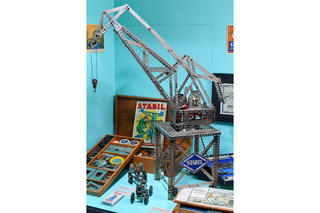
In addition to the tin toy manufacturer Gerhard Söhlke (founded in 1819), this group included, above all, the game manufacturer Anton Sala, who had emerged from a book publishing house. Under the Rotsiegel-Spiele brand, his superbly crafted board games, card games, and activity games achieved a prominent position in the gaming industry by the time of World War I. The same is true of the highly successful metal construction set from Walther & Co. under the Stabil brand. A well-designed system, high-quality craftsmanship, and clever marketing strategies made the Stabil construction set—first introduced in 1904—virtually synonymous with the most popular technical construction toy of the 20th century throughout much of Germany.
While production of the Stabil modular construction set was discontinued in the 1970s, Wiking models have retained their excellent reputation to this day. In 1932, company founder Friedrich Peltzer began producing metal ship and airplane models in Berlin, and soon expanded to include plastic models as well. The military was the main customer, using Wiking models for training purposes. With the wave of motorization during the “Economic Miracle” years, the small plastic traffic models in particular became extraordinarily popular toys. After the founder’s death in 1981, the company was acquired by the Sieper Group, which continues to produce Wiking models to this day—though no longer in Berlin.
Tin toys from the city of Brandenburg
Starting in the 1880s, the city of Brandenburg developed into a center of German tin toy manufacturing. The Ernst Paul Lehmann Patentwerk, founded in 1881, in particular, achieved international fame with its original mechanical tin toys. Its cars, trucks, airships, and a wealth of whimsically moving animal and human figures delighted children all over the world for decades. At its peak, Lehmann employed more than 1,000 people.
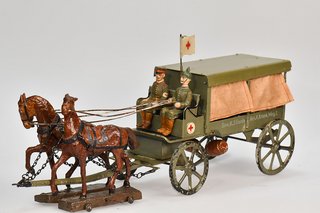
The carefully modeled and painted mass-produced figurines from Lineol AG—founded in 1906 by Oskar Wiederholz—also enjoyed great popularity. Animals, knights, and, above all, soldiers were at the heart of the Lineol product line, which took on a very warlike character during the Nazi era—in part due to the production of all kinds of military vehicles. After 1945, Brandenburg’s toy companies were nationalized and transformed into “state-owned enterprises.” The expropriated owners of E. P. Lehmann Patentwerk managed to make a difficult but ultimately successful fresh start in Nuremberg. On the original Lehmann site, the successor company, VEB Mechanische Spielwaren Brandenburg, continued production and became the largest manufacturer of tin toys in the GDR. With German reunification in 1990, the company ceased operations. Since the subsequent attempt at reprivatization was unsuccessful, over a century of Brandenburg’s toy-making history came to an end in 1992.
[Author Dr. Helmut Schwarz completed the manuscript in December 2017.]
References
Ignacio Czeguhn/ Erhard Schraudolph: Gerhard Söhlke: Musterbuch für Spielzeug und Zinnfiguren. Berlin, um 1856. Bremen 2006
Rudolf Rühle: Vom Luxus zum Dumping – Sala‐Spiele. In: Spielbox. Heft 5 (2003), S. 40 f.
Werner Sticht: Spiel mit „Stabil“. In: Joseph Hoppe/ Bernd Lüke/ Stefan Poser (Hrsg.): Spiel mit Technik. Katalog zur Ausstellung im Deutschen Technikmuseum Berlin 3.11.2006 – 29.4.2007). Leipzig 2006, S. 68‐78
Helmut Schwarz/ Ansgar Henze/ Marion Faber: Eisenzeit. Geschichte des Metallbaukastens. Nürnberg 1995 ( = Schriften des Spielzeugmuseums Nürnberg, Band I), bes. S. 44‐47, 164‐171
Ulrich Biene: Wiking Autoträume. 85 Jahre Miniaturen zu Wasser, zu Lande und in der Luft. Bielefeld 2017
Helmut Schwarz / Marion Faber: Bewegte Zeiten/ Moving Times. Ernst Paul Lehmann Patentwerk – Geschichte einer Spielwarenfabrik. Nürnberg 2003 ( = Schriften des Spielzeugmuseums Nürnberg, Band V)
Hans Schulte‐Kellinghaus / Katharina Kreschel: Die Anderen Brandenburger. Geschichte und Spielzeuge der Firmen Reil & Metz, Metz & Duncker, Tellus‐Werke, Gundka‐Werk (Greppert und Kelch), Reil & Co., Oro Werke. Hilden 2007
Katharina Kreschel: Brandenburger Blechspielwaren – die Firmen und ihre Produkte. In: Gerd Heinrich (Hrsg.): Stahl und Brennabor. Die Stadt Brandenburg im 19. und 20. Jahrhundert. Potsdam 1998, S. 481‐509
Gerd Heinrich: Ritter und Soldaten. Aufstieg und Fall der Lineol‐Werke Oskar Wiederholz. In: ders. (Hrsg.): Stahl und Brennabor. Die Stadt Brandenburg im 19. und 20. Jahrhundert. Potsdam 1998, S. 457‐479
Ernst Schnug: Kleine Geschichte der Massefigur. In: Staatliche Kunstsammlungen Kassel (Hrsg.): Die kleine Figur. Geschichte in Masse und Zinn. Kassel 1985
Dennis Fontana: The War Toys / Kriegsspielzeug. The Story of Lineol / Die Geschichten von Lineol. London 1991
Suggested Citation
Schwarz, Helmut: Toys from Berlin and Brandenburg an der Havel, Manuscript completed by the author in January 2017; Published posthumously online on July 20, 2026, in: Spirit of Play Online magazine. Spielwarenmesse Group, Nürnberg. Online: https://www.spielwarenmesse.de/en/magazin/toyhistory/helmutschwarz-toy-making-cities/ (Access: DD. Monat YYYY).
About the Author
Dr. Helmut Schwarz (September 5, 1952 – February 20, 2022) was an economic historian and served as director of the Nuremberg Toy Museum from 1994 to 2014. Together with his team, he modernized the museum, expanded the children’s play area, and created the museum playground with a café and the virtual storage facility. He also personally championed the effort to bring the German Toy Archive from Marburg to a new home in Nuremberg. He authored numerous works on the history of the toy industry.
Toy History – The Beginnings of the Spielwarenmesse
Starting in 2016, Dr. Helmut Schwarz conducted research on the company’s history on behalf of Spielwarenmesse eG. In particular, he identified the conditions and factors that led to the founding of the trade fair in Nuremberg. The trade fair team will publish the manuscripts he completed in 2026 in the online magazine *Spirit of Play* to mark the 75th anniversary of the Spielwarenmesse, thereby honoring a significant custodian of knowledge regarding German toy and economic history.
Series Overview
The series will consist of nine short online articles and seven research papers exploring the origins of the Toy Fair.
ToyHistory 01: The Nuremberg Toy Region | 24. Juni 2026
- Short web version: The Nuremberg Toy Region (November 2017)
- Short web version: Fürth and Zirndorf as toy-making centres (December 2017)
- PDF research paper: Nuremberg, the Toy City (January 2017) - Available in German only.
Toy History 02: Toy-making regions in Germany | 13 July 2026
Thuringia – Saxon Ore Mountains
- Web summary: Toy Region Thuringia (November 2017)
- Web summary: Toys from the Saxon Ore Mountains (see below) (November 2017)
Toy History 03: Toy-making cities in Germany | 20 July 2026
Württemberg – Berlin and Brandenburg at the Havel
- Web summary: Toy Region Württemberg (November 2017)
- Web summary: Toys from Berlin and Brandenburg an der Havel (December 2017)
Announcement for August 03, 2026: Toy History 04: Ways to the Buyer
The Toy Trade in Germany Until 1945
Delve even deeper into the history of the toy industry: Spanning 1,400 square meters, the world-famous Toy Museum showcases the world in miniature with a wealth of extraordinary exhibits ranging from antiquity to the present day. In addition to an imaginatively designed children’s area in the attic, visitors can also enjoy a large outdoor playground and the museum café in the courtyard.
Location: Nuremberg Toy Museum, Karlstrasse 13-15, 90403 Nuremberg
Exhibition: Games History(ies) February 20 - September 13, 2026
Visit the website Spielzeugmuseum Nürnberg